GothamSchools — daily independent reporting on NYC public schools

Posts tagged "teachers’ union"

observation observations

School leaders share Danielson concerns at union-led trainings

Teachers brainstorm where features of the ideal classroom fit into the Danielson Framework's four domains.

Training sessions about a classroom observation model opened up dialogue between teachers and principals this month, even after becoming a flashpoint in the city and teachers union’s ongoing conflict over a new evaluation system.

The city and union planned to host trainings on the teaching model the city hopes to adopt for its new evaluation system together. But after Mayor Bloomberg ratcheted up rhetoric against the union in the State of the City address, the union cut city officials out of the planning. The sessions began two weeks ago, drawing hundreds of attendees even after the Department of Education emailed principals informing them that the sessions were off.

I spent an afternoon last week at a training session at the United Federation of Teachers’ Bronx headquarters, where well over 100 union chapter leaders and their principals were receiving a crash-course on the Danielson Framework, a classroom observation model that serves as one component of the city’s proposed evaluation system. The city has encouraged principals to practice using the Danielson Framework when conducting informal classroom observations this school year, and 140 schools have been piloting the observation model more formally.

As an impasse over new teacher evaluations has deepened between the city and the UFT, a tension has emerged about whether the model is meant first to help teachers improve — the union’s position — or whether it is a tool to help principals usher weak teachers out of the system, as the city’s rhetoric has sometimes suggested.

Catalina Fortino, the UFT’s vice president of education, said the purpose of the training sessions is to foster “a shared understanding” of the model for teachers and principals — an understanding that the city’s pilot of the Danielson framework had failed to develop, she said. (more…)

roll call

At union meeting, jobless teachers decry ATR deal “shell game”

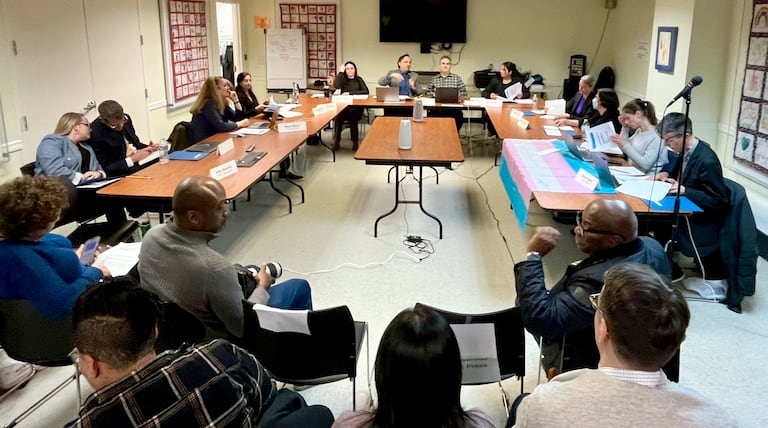
Tensions ran high at the United Federation of Teachers Brooklyn office on Tuesday, as union officials volleyed questions, demands, and some cries of exasperation from nearly 100 teachers without permanent positions.

The union office was hosting the second in a series of meetings for members of the Absent Teacher Reserve — the large pool of teachers whose jobs were eliminated when their schools closed or cut costs.

The union is holding the meetings to explain changes to the way teachers in the ATR pool are deployed, based on an agreement struck this summer between the UFT and the Department of Education that stipulates that ATRs must travel to a different school each week. The first weekly assignments are set to start going out today.

But union officials spent much of the meeting deflecting criticism from teachers who charged that the constant upheaval would not make use of their expertise and make them less likely to land permanent positions.

Amy Arundell, a UFT special representative, told the roughly 100 teachers at the meeting that the point of moving teachers weekly is to position them for jobs that could open up at the schools where they are temporarily assigned. The previous arrangement, in which members of the ATR pool often stayed at one school for an entire year, allowed principals to use them as free labor, she said, without necessarily incentivizing them to offer the ATR teachers permanent jobs. (more…)

turn around

A union skeptic, converted by Steve Barr, befriends the UFT

Steve Barr argues that education activists need to move from campaigning to governing.

When Gideon Stein first picked up the 2009 New Yorker profile of California charter school leader Steve Barr, he put the article down without finishing it. The story was all about Barr’s decision to work with the teachers union rather than fight it.

“I was like, eh, how great can his schools be?” Stein, an entrepreneur and real estate developer based in Manhattan, recalled in an interview this week.

A board member of at one of Eva Moskowitz’s Success Charter Network schools, where teachers are determinedly not unionized, Stein didn’t believe that anyone working with a teachers union had a shot at turning a school around.

But at the urging of his family, he finished the piece and was so impressed that he asked Moskowitz to broker an introduction. Soon he flew to Los Angeles to visit Locke High School, the school that Barr’s group, Green Dot, took over in 2008. The trip was “transformative,” Stein said.

In Barr, he saw the solution to the problem that troubles many education philanthropists: Successful transformations urban and rural schools are too rare. They have not achieved “scale.”

“While I love my work with Eva, and I think Eva is just an unbelievable educator and advocate for children,” Stein said, “if you really want scale, I think you’re going to have to make some compromises.”

He asked Barr how he could help Green Dot’s mission of re-making schools in partnership with labor.

Now Stein is the president of Barr’s national organization, which changed its name today from Green Dot America to Future Is Now Schools. And he’s rejiggered his social calendar. “I’ve now had dinner and drinks with Randi 10 times in the last eight months,” he said, referring to Randi Weingarten, president of the American Federation of Teachers.

Winning the Future (more…)

layoff likelihood unclear

Cuomo suggests cutting city school funds to near-2007 levels

Governor Andrew Cuomo is suggesting that the state cut its contribution to New York City public schools by nearly $600 million from the level that schools received this year.

The budget, released today, proposes reducing statewide school spending by $1.5 billion from this year’s level. Activists said that would be the largest dollar figure cut to public schools in New York’s history.

The proposal would bring the state’s contribution to city schools close to the level received in 2007. That year ushered in substantial funding increases after a court ordered New York State to reduce historic funding inequities by pouring billions of extra dollars into the New York City schools.

picture-16

Governor Andrew Cuomo's proposed budget for fiscal year 2011, denoted with the asterisk, would reduce the state's spending on New York City public schools to $7.5 billion.

(more…)

don't stop till you get enough

On his way out, Klein pushes for end to ATR pool, last-in first-out

picture-8

The final installment of Joel Klein's weekly memo to principals

In a nostalgic final missive to city principals this week, outgoing Chancellor Joel Klein suggested three things to do once he’s gone.

He urged lawmakers to end the last-in first-out process of teacher layoffs, pushed for an end to the Absent Teacher Reserve pool, and underlined his belief in the importance of closing struggling schools.

Klein’s statement that “we have to eliminate the ATR pool” ratchets up the city’s position on the pool of teachers — city teachers who lose their positions, don’t find new ones, but stay on the city payroll anyway. Previously, the city has asked the union, in contract negotiations, to add a limit to the amount of time a teacher can spend in the reserve pool. That would make the pool smaller, but it would not cause it to disappear altogether.

Describing the costs of keeping those teachers on the city payroll as exceeding $100 million a year, Klein argues:

We cannot afford it, and it’s wrong to keep paying this money. It amounts to supporting more than a thousand teachers who either don’t care to, or can’t, find a job, even though our school system hires literally thousands of teachers each year. That’s money that could be spent on teachers that we desperately want and need.

Klein also describes teacher layoffs as a sure thing. “I wish it were otherwise, but the economics of our state and city make this virtually impossible to avoid,” he writes.

The Bloomberg administration has a history of being bullish on layoffs in order to push for the end of the state law regulating how teachers lose their jobs. Klein reiterates that case in his letter:

If we have layoffs, it’s unconscionable to use the last-hired, first-fired rule that currently governs. By definition, such a rule means that quality counts for zero. Our children cannot afford that kind of approach. They need the best teachers, not those who are longest serving. (If you had to have surgery, would you want the longest-serving surgeon or the best one?) This doesn’t mean that many of our longest-serving teachers aren’t among the best, but this is not an area for “group think.” We need individual determinations of teacher effectiveness to decide who stays and who doesn’t.

Klein also quoted his favorite T.S. Eliot poem, “Little Gidding,” excerpting four cryptic lines that seem to summarize his “odyssey” as something more complex than a straight line of a progress:

We shall not cease from exploration / And the end of all our exploring / Will be to arrive where we started / And know the place for the first time.

Other curious lines from the poem:

… Either you had no purpose
Or the purpose is beyond the end you figured
And is altered in fulfilment. …

Klein has sent a memo to principals every week for years. Read the full letter here and below. (more…)

Primary Sources

Al Shanker, father of teachers unions, also the father of ARIS?

Did Albert Shanker scoop Joel Klein on ARIS?

The late formidable teachers union leader may not have named that particular New York City platform, meant to make it easier for parents and teachers to share information about student achievement and teachers’ lesson plans. But, in 1995, giving testimony to a Congressional committee on educational technology, Shanker did imagine a future tool that sounds quite modern:

picture-6picture-7

Of course, this vision sounds more like what the web site Better Lesson is building than what embattled ARIS has been able to achieve.

The full text of Shanker’s testimony is inside the PDF linked on this page, on page 266.

bonus points

City, union agree to performance pay deal for struggling schools

The city and the teachers union have struck a performance pay deal that will tie some teachers’ salaries to a range of measures of their effectiveness, including their students’ test scores.

The deal is part of a federal grant program to “turn around” the city’s most struggling schools. It also builds on a teacher evaluation agreement reached between the union and state education officials last month. According to the deal, 34 schools that have been designated as persistently lowest achieving will be able to pay model teachers significantly more money to take on greater responsibilities. Deemed the best-of-the-best, these teachers will mentor their colleagues, write curriculum, and open their classrooms to teachers who want to watch a lesson.

City officials have decided that 11 of these 34 schools will undergo the transformation model beginning next September. This means they can get support services, have an extended school day or an entirely new schedule, and can keep the teachers they have. In some cases, the city may decide to replace these schools’ principals. (more…)

Two men and the union in a room, talking charter cap

Maybe we’ll have a charter cap deal after all.

We’re hearing that the mayor’s top political aide, Howard Wolfson, is in Albany right now meeting with Assembly Speaker Sheldon Silver and representatives of the city and state teachers unions. They’re all trying to hammer out a deal that would allow 260 more charter schools to open in New York State. And they’re racing against a super-tight deadline: June 1, next Tuesday, when the state’s second application to the federal Race to the Top competition must be delivered to the U.S. Education Department headquarters in D.C.

Sticking points in today’s negotiations, we hear, include a continued effort to push against allowing SUNY to act as an authorizer of charter schools. Charter school supporters, led by the Bloomberg administration, say that snatching SUNY’s power is a poison pill that would force them to drop out of negotiations. They say the same thing about a proposal on the table that would mean charters could only open through an RFP-like process.

But our source says that the mayor’s side has given in on at least two key issues: a ban on for-profit companies managing charter schools and permission for the state comptroller to audit charter schools.

We’ll keep you posted as we hear more.

, at 5:53 pm
explainer

What to expect when you’re expecting layoffs: a rough guide

We’re told there are layoffs coming. But how many people will be laid off? Who will they be? And will you or your child’s teacher be among them?

“I wish I had more money and I wish I had more clarity,” was Chancellor Joel Klein’s answer to these questions a few weeks ago, speaking to principals by conference call.

The process of laying off teachers in New York City is so complex that few people have clear answers right now. But after studying the state law that sets teacher hiring and firing rules, talking to union and city officials, and looking back to the 1970s — the last time a economic crisis forced thousands of teacher layoffs — I have some clues. Here are answers to questions I’ve heard from parents and teachers (send more!).

Will there be layoffs?
Several scenarios exist that could reduce — but probably not eliminate — the number of layoffs.

In its leaderless, unpredictable state, Albany could rewrite the budget forecast as I type these words. (more…)

thought experiment

Ending the rubber room backlog by December looks impossible

Mayor Bloomberg and UFT President Michael Mulgrew got a lot of applause when they vowed to shut down the city’s infamous “rubber rooms” by December. But that might be an impossible goal.

The trouble hinges on the fact that the city has not ended the practice of granting a trial to all teachers accused of incompetence or misconduct. It has simply decided to speed up those trials, which take place in a lower Manhattan office building across from Tweed Courthouse, presided over by paid attorneys called arbitrators who act as judge and jury.

To speed up the trials, the city has promised to nearly double the number of arbitrators starting in September, and also to increase the number of days they work on teacher cases each month to seven from five. By doing this, the city and the union claim, all of the nearly 650 teachers still waiting for a verdict will get one by December.

But a GothamSchools analysis shows that, to meet this goal, the city will have to force arbitrators to cram multiple hearings into each working day — a rate that is now unprecedented. (more…)

Tips, questions, feedback?

Contact us at .

Follow GothamSchools

RSS

Feb. 10: You’re invited!

Recent Comments

23 comments so far today

Our Twitter Updates

  • As closure votes for 23 schools near, we mapped all the city schools that have closed or could soon close: http://t.co/Uv26t1tA 2 hrs ago
  • 13 statistical tables from the city's Independent Budget Office about the schools up for closure tonight: http://t.co/kPYikzgj 5 hrs ago
  • @Charter411 We are always happy to write updated stories when we get substantively new information from the city or anyone else. 5 hrs ago
  • RT @sarcasymptote: Just realized I will be starting the trig unit on valentines day. My valentine to my kids is 6 weeks of hell. 19 hrs ago
  • ” you don't want to come to class? Have a packet. You don't like your teacher? Have a packet” - @leoniehaimson 21 hrs ago
  • More updates...

Archives

February 2012
M T W T F S S
« Jan  
 12345
6789101112
13141516171819
20212223242526
272829  
?>