GothamSchools — daily independent reporting on NYC public schools

Posts from Rose D'souza

constant learning

Summer takes city teachers into the stacks and onto the stage

Teachers look at old books at the New-York Historical Society during a summer class.

GothamSchools spoke to several city public school teachers who sought out summer seminars, workshops, and classes to help them learn more about their fields.

On Thursday, we looked at what a handful of math and science teachers were doing. Today, we’re checking in with a few teachers who used the summer to bolster their history and humanities knowledge.

Did you learn something new this summer? Leave a comment to share your experience.

Ann McCormack, Brooklyn International High School

An educator and art performer for more than three decades, Ann McCormack still looks for creative ways to help her students, who are mostly recent immigrants without strong English-language skills. The theater teacher paid out of her pocket to attend a $1,200 workshop in Williamstown, Mass., where she learned how to build and use puppets.

“I’ve done puppetry with students in the past but it was all self-taught. I’ve never taken a workshop,” said McCormack, who works with a team of teachers to help Brooklyn International’s English language learners. “By using puppetry, acting, and filmmaking, students can explore the language in an interesting and creative way.”

“Some of my students are very shy about speaking English, so the idea of speaking to a puppet — so the focus is on the puppet and not on them — seems to free them,” she added. “They suddenly speak English. The puppetry provides them with an opportunity to loosen up.” (more…)

constant learning

Educators use the summer to bolster math and science skills

Jose Luis Vilson attended a science and math workshop at the Kennedy Space Center. (Courtesy of the GE Foundation)

Some teachers use the summer break to unwind from a busy school year, refine their lesson plans for the fall, or take a short-term second job. Others seek out new knowledge in the subjects they teach.

“If you’re teaching science, you should be learning about science,” said Nate Finney, a Manhattan teacher who is spending the summer working in a physics laboratory.

GothamSchools spoke to a handful of city public school teachers who sought out seminars, workshops, and classes to help them learn more about their fields. Today, we’re looking at teachers who decided they wanted to know more about math and science.

Jose Luis Vilson, I.S. 52, Manhattan

In sunny Orlando, Jose Luis Vilson got the chance to live out a childhood dream of becoming an astronaut.

Vilson arrived at Florida’s Kennedy Space Center in mid-July to take part in a weeklong course created and funded by the GE Foundation. The course focused on integrating math and science instruction and anchoring both in new learning standards that call for more critical thinking.

“They’re working with NASA to try to approach and integrate Common Core standards with current pedagogy,” said Vilson, who teaches eighth-grade math in Washington Heights and maintains a popular blog about teaching. (more…)

Techie Teachers

Tech-savvy teachers build educational apps in pilot program

EDesign Lab members brainstorm ideas in group meeting. (Courtesy of Hsing Wei)

Dara Ross didn’t know how to write code or develop online software until she joined a pilot program that offered to help teachers use technology in the classroom last year. By the program’s end, the high school English teacher had helped build several of her own educational mobile apps, including one that assesses her students’ emotions after they read. Another one featured an animated robot that acted as a reading buddy.

She and five fellow teachers did that with the help of tech savvy mentors as participants in Digital Teachers Corp, a program launched last year by New Visions for Public Schools, a national non-profit organization, and as lab members in EDesign Lab, an initiative to bridge the educational technology gap between software developers and educators.

“It was valuable to work on education with teachers and technologists; I think that combination is not usually talked about,” said Ross, who teaches English as a second language at Brooklyn International High School. She became interested in incorporating technology in her curriculum when she started creating online videos for her students.

The EDesign Lab is entering its second year and looking for a new crop of teachers to join.

Getting technology into the classroom has been a slow process, in part because the people who develop software and build digital tools aren’t in touch with the learning needs of students. Participants in the pilot said the program helped them quickly bridge that divide by getting in the same room and working out problems together.  (more…)

instructional change

City physics educators retool their teaching in summer school

On most days, Room 404 in Zankel Hall is a laboratory used by graduate students at Columbia University’s Teachers College.

But for the next two weeks, the lab is the temporary headquarters for a group of educators who are rethinking what it means to teach physics to high school students.

The educators are participating in a workshop about a three-decade old teaching strategy called Modeling Instruction in Physics. The strategy shuns the rote memorization of physics formulas and instead applies abstract ideas to real-life situations so that students can observe and understand concepts from “model” experiments.

“This modeling instruction method incorporates the best things that have happened in physics education in the last 50 years, and puts it in a way that is teachable and reproducible to a large extent if the teacher is motivated, interested, and well-educated,” said Fernand Brunschwig.

Brunschwig chairs Physics Teachers NYC, a 100-member group of educators who meet once a month to share ideas and trade instructional methods. The group organized the summer workshop. (more…)

removing elephants

Educators look for help making the most of cultural differences

New York University's Metropolitan Center for Urban Education held a training about boosting diversity and cultural responsiveness in the classroom last week.

If Wes Edwards had his way, the middle-school teacher would regularly invite parents into the classroom to help bridge the language divide between his Spanish-speaking students and educators.

More than 90 percent of students at his Washington Heights charter school, New Heights Academy, speak Spanish at home. But only about a third of the staff speaks Spanish, Edwards estimates — leading to communication problems among students, parents, and teachers.

“In order to really have support in the classroom and from families, you need to have translation for everything. Parents need to feel comfortable speaking Spanish,” Edwards said, adding that he understands just enough Spanish from growing up in Texas to speak to his students’ parents.

Edwards said he thought the language barriers contributed to low test scores for students like his because they cannot always get help from their parents, who often barely speak English. He said he also thought his students often feel disconnected from what they study in school.

Edwards said he would like to use his students’ language challenges and cultural heritages as assets, rather than see them as challenges, but he wasn’t sure how to.

He hoped he would find answers last week at a daylong conference on how to incorporate lessons on diversity and cultural sensitivity into the classroom. The conference, organized by New York University Metropolitan Center for Urban Education, drew nearly 300 educators from across the city and state for speeches, panel discussions, and workshops. (more…)

senior portrait

Schooled in activism, Grover Cleveland grad aims for law school

Grover Cleveland High School student Diana Rodriguez spearheaded student protest against her school's closure.

Less than two weeks after graduating from high school, Diana Rodriguez is staying busy. The Queens teenager is up at 6 a.m. to go for a morning run, work her two summer jobs, and take driving lessons a few months before she is set to start college.

It’s a heavy workload — but it’s not the biggest responsibility the 17-year-old has taken on. This spring, she led classmates at Grover Cleveland High School in a fight for the school’s life.

The school was one of 33 the city planned to close and reopen using an overhaul process, known as “turnaround,” that included changing the school’s name and replacing half of the school staff.

Rodriguez was enraged. Already the senior class president, she sprang into action galvanizing her classmates to protest the turnaround plans.

“I wouldn’t stand for it,” said Rodriguez. “You can’t mess with my education – education is a right.”

That was Rodriguez’s rallying cry as she joined other students in schools facing closure across the city in a group called Student Activists United. The group turned out students for public hearings, called Panel for Educational Policy members who would vote on the closures, and even held an early-morning rally outside Mayor Bloomberg’s Upper East Side home. (more…)

with our powers combined

Union’s ‘community schools’ initiative gets a boost from the city

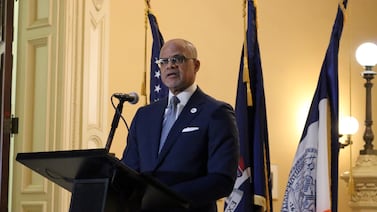
Teachers' union president, Michael Mulgrew, greets chancellor Dennis Walcott, at announcement for community school initiative.

When teachers’ union president Michael Mulgrew announced a grant program last month to bolster social services in schools, he said the union was moving ahead because the Department of Education was not.

But today, when Mulgrew announced the schools that will receive grants, Chancellor Dennis Walcott was standing next to him. The two came together in a last-day-of-school show of camaraderie after a year in which relations between the union and the city grew more strained than ever.

The joint appearance meant that amount of grant money awarded doubled, to $600,000, since Mulgrew’s May announcement. That will make it possible for six schools to bring health and dental clinics, tutoring, counseling programs, and social services to students and their families, as part of a pilot program to create “community schools.”

The UFT and Department of Education are each contributing $150,000, and the Partnership for New York City, a coalition of business groups, is adding another $300,000.

The initiative is based on a program in Cincinnati that coordinates and targets social services there. The goal is to harness existing services so they are used more effectively.

“We put enormous resources into our education system, into our healthcare system, and some of our other service systems, but we don’t do a very good job of maximizing the output,” said Kathryn Wylde, president of Partnership for New York City.

“We’ve had services for very long time in New York City. What we want to do now is start coordinating the services at the school site,” said Mulgrew, who was part of the team that began developing the initiative two years ago. (more…)

in the hole

At P.S. 9, parents are rushing to fundraise for lost federal funds

P.S. 9, a Prospect Heights elementary school, faces a sudden budget shortfall.

The city’s annual calculation of schools’ enrollment of poor students has at least one Brooklyn elementary school on the wrong side of an unyielding line.

The city gives extra federal funds to schools where 60 percent of students are eligible for free lunch. P.S. 9, which hosts a gifted program in gentrifying Prospect Heights, has received the funds in the past, but now its enrollment of poor students has dropped — to 59.1 percent.

That means the school won’t get the Title I funds, even though it has virtually the same proportion of eligible students as many other schools that will receive them.

“It’s sounds great that we’re coming out of a Title I position but we still don’t have enough resources,” said Christine Scalon, secretary of the school’s parent-teacher organization.

Scanlon and other parents are leading a frantic push to raise $160,000 by the end of the school year, the amount they have calculated the school is losing. (more…)

Space case

Harlem parents protest against Success Academy co-locations

Protesters rally in Harlem against Success Academy, the controversial charter network.

Parents and community activists protested in Harlem yesterday, taking turns to give speeches and heed warnings to schools that will soon share space with a controversial charter network.

But unlike previous protests against the Success Charter network, the rally was significantly smaller. Noticeably missing were the politicians who came out to support a protest against the plan to bring a new Success Academy to the building where Wadleigh Secondary School of Performing Arts operates.

Organizers said they didn’t expect politicians or union to attend because they were busy dealing with last-minute city budget affairs and the close of the state legislative session. Instead, they said the rally was planned specifically with parents in mind – after state exams ended this week.

“This is not a union rally. This is not a special interest rally. This is a parent and a community rally,” said Noah Gotbaum, a vocal education activist and member of Community Education Council 3.

At yesterday’s event, approximately 50 protestors chanted “separate is unequal” and held signs despite in 95 degree weather at 110th Street and Fredrick Douglass Boulevard, just a few blocks from Wadleigh. A handful of children attended the event.  (more…)

up in the air

DREAM Act advocates hope Obama action nudges Cuomo

Nataly Lopez at her kindergarten graduation. (Courtesy of Lopez)

At 20 years old, Luis Saavedra has used his exhausting list of accomplishments — high school valedictorian, purple belt in taekwondo, track and field star, 3.8 GPA in college — to earn enough scholarships to pay nearly the entire amount of his school tuition.

Still, the Bronx resident’s plans to finish his bachelor’s degree at Lehman College and attend medical school will be impossible to achieve if his pool of scholarship aid dries up.

Like other undocumented students, Saavedra cannot rely on government financial assistance or on private bank loans.

But Saavedra, like many immigration reform advocates, hopes that President Barack Obama’s recent announcement to halt some deportations will push Gov. Andrew Cuomo to support New York’s version of the DREAM Act today, hours before the state’s legislative session ends. The act has languished in the State Senate without Republican support for more than a year.

Cuomo has said he supports a federal DREAM Act but has declined to endorse the state’s version and, unlike other elected officials, did not praise Obama’s policy announcement last week.

The state’s bill would give undocumented students access to financial aid through the state-funded Tuition Assistance Program, which provided $885 million to students in 2010-2011. Extending financial aid to undocumented students could cost about $17 million more, a 2 percent increase. (more…)

Tips, questions, feedback?

Contact us at .

Word from Our Sponsor

Follow GothamSchools

RSS
Subscribe to the daily email digest:

Recent Comments

1 comment so far today

Archives

May 2013
M T W T F S S
« Apr  
 12345
6789101112
13141516171819
20212223242526
2728293031