Posts from Emma Sokoloff-Rubin
climate change
May 17, 2013
Community members carve out a role in school guards’ training

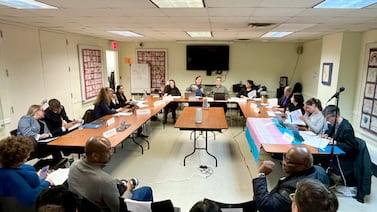
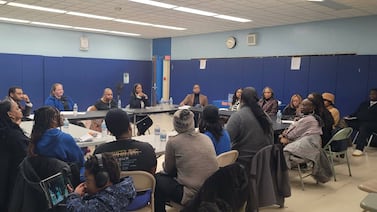
School safety agents participated in a community-run training session in the Bronx earlier this year.
When Lynn Sanchez, a Bronx parent activist, challenged police and education officials to address persistent school climate problems during a public forum on school safety last year, she did not think they would say yes.
And yet just months later, Sanchez was sitting with safety agents during one of their training sessions — which, for the first time, community members and advocates were helping to lead.
She saw a long-standing vision of collaboration coming together in that room. “We have to make sure everyone is on same page — we have to include school safety officers, teachers, principals, paras, students, and parents — in order for a school climate to change,” Sanchez said.
The community-run training sessions represent a striking shift in the city’s strategy for preparing safety agents to work in schools, where their role has historically been fraught. While the Bloomberg administration has famously considered principals to be the CEOs of their schools, principals’ authority does not extend to safety agents, who since 1998 have been under the authority of the New York Police Department in an arrangement that advocates say breeds tension.
The quiet shakeup so far has taken place only in a corner of the Bronx, where community groups were able to persuade the police department to let them play a role in the training of 450 agents, and its future is far from certain. But students, educators, and advocates say they are confident that the approach could go a long way toward easing some of the tensions that have plagued city schools, and a small-scale expansion of the first round of trainings appears to be in the works. (more…)
from the neighborhood
May 15, 2013
Addressing immigrant parents, Sotomayor channels her mother

Justice Sonia Sotomayor left the stage to answer parents’ questions after speaking at the Department of Education’s
To make sure that all attendees of the city’s annual conference for families of English language learners today could go home with an autographed copy of her book, Supreme Court Justice Sonia Sotomayor signed 3,000 copies of her book in two days.
She was able to write the book, she told parents at the conference, because her mother – who didn’t speak English — taught her to value words. “My mother loved reading. Seeing her read inspired my brother and me to read,” Sotomayor said in her speech.
The Department of Education’s annual conference is designed to help immigrant families navigate the city’s education system and support their children’s learning at home. Sotomayor’s address, as well as the workshops that followed, was translated into nine languages, just a fraction of the 180 languages spoken by students in the city’s public schools. (more…)
on the steps
April 16, 2013
Advocates ask candidates for school discipline climate change

At a rally Monday, junior Benia Darius said the next mayor needs to take a different approach to school discipline.
After years of pressing Mayor Bloomberg to make school discipline fairer, students and advocates are turning their attention to the candidates seeking to replace him.
At a rally outside City Hall just before a City Council hearing on school climate Monday, students and advocates the Dignity in Schools Campaign called on the next mayor to take a different approach to school discipline. They want a model that relies less on suspensions and other punitive measures, and also ensures that black and Latino students are not disproportionately affected by school discipline.
“We need a mayor that is going to implement and fund restorative justice in our schools,” said Benia Darius, a junior at Bushwick School for Social Justice. “I am soon going to start my training as a peer mediator, and I’m going to be part of the change in my school. But what I want to know today as a student is what you as mayoral candidates are going to do to change these issues in our schools?” (more…)
Mind shift
April 9, 2013
At KIPP Infinity, the Common Core means rewiring math ‘robots’
Joe Negron, the founding principal of KIPP Infinity Middle School, picked a tricky year to return full-time to the classroom. After heading the charter school since it opened in 2005, Negron became a full-time math teacher in August, just as new standards were reshaping what students are supposed to learn.
Negron taught math at I.S.164 before starting KIPP Infinity and kept one foot in the classroom while serving as principal. But even for a seasoned educator, he said, shifting to the Common Core standards is a challenge.
“This is so much messier than what I’m used to and comfortable with,” said Negron, who will appear this evening on the panel at GothamSchools’ event about the Common Core in math. “It used to be, I’m going to teach you this strategy and you’re going to use it until your eyes pop out.”
This year, responding to the Common Core’s emphasis on solving problems in multiple ways, he is asking students to master three approaches. (more…)
"maybe even panic"
April 8, 2013
Despite city’s reassurance, Common Core exams cause concern
In the three years since New York officially adopted the Common Core learning standards, students have tackled tougher assignments, teachers have remade assignments, and schools have rethought when topics should be taught — all in an effort to prepare students to show they have mastered the new standards.
Now, the first test of whether the teachers have been successful is here.
Next week, students in grades three through eight will take their first set of Common Core-aligned state exams, in English. The following week, they’ll sit for three days of Common Core aligned math tests. The scores will help decide everything from whether the students will be promoted to where they will attend middle or high school.
“They’ve been talking about the Common Core for a couple of years now,” said David Baiz, who teaches math at Global Technology Preparatory Middle School. “This year is really the year when we’re staring down the barrel of the gun.” (more…)
final round
April 2, 2013
With future murky, Bloomberg celebrates his last new schools
As some of the biggest news in New York City politics unfolded this morning, Mayor Bloomberg was focused on a story that hasn’t changed in more than a decade
He called a press conference to tout this year’s crop of new schools — 78 in all — at the same time as several elected officials were being arrested for trying to sell a slot on the mayoral ballot.
The 78 new schools, 26 of which are charters, represent the largest single-year total for an administration that has opened more than 650 schools since 2002. As the last new schools to open under Bloomberg, they also represent the uncertain future of the administration’s signature policies: closing low-performing schools and replacing them with new ones. (more…)
state of the union
April 2, 2013
Behind UFT’s robust operations, a small army of chapter leaders
The UFT is a politically powerful organization with millions of dollars at its disposal and sweeping campaigns that aim to make change at the highest levels of education policy. But at the heart of all of the spending and lobbying is the union’s contract with the city.
Clocking in at 165 pages just for classroom teachers, the contract spells out everything teachers must do, and everything they should not. Some of its clauses, such as those specifying what teachers cannot be compelled to do, have drawn fierce criticism for impeding administrator discretion so much that student performance suffers. But the contract is also the only guarantee that teachers are compensated for their time and receive due process rights when they are accused of misconduct.
For all of the conflict the contract elicits, it has meaning on the ground only if someone enforces its terms. That job falls to the small army of “chapter leaders” who represent the union at each school, and who are many teachers’ only contact with their union.
UFT Secretary Michael Mendel calls chapter leaders — who are elected by their colleagues every three years — “the backbone of the union.” But who are the chapter leaders? What do they actually do? What challenges do they face? The answers to those questions, which have long been obscured behind individual schoolhouse doors, are essential to understanding how the UFT serves its members and calls upon them to take action. (more…)
taking it to the streets
April 1, 2013
In class, Validus Prep students helm an anti-violence tradition

Students at Validus Preparatory Academy organized the school’s fifth annual March Against Violence as part of a senior-level class called “Art + Action.”
Few current students at Validus Preparatory Academy knew Martin Jackson and Nadairee Walters personally. But that didn’t stop them from honoring Jackson and Walters, members of Validus’s first class who were killed in 2008, with a march against violence last month.
“Even though you didn’t know Martin and Nadairee, everyone has lost someone to gun violence,” senior Destiny Daley said from the center of a wide circle of students, faculty, and staff who marched together to a park near the school.
Andrea Hines, who was the school’s social worker when Jackson and Waters died, said she helped organize the first march, along with the New York Police Department’s Office of Community Affairs, to honor the two students and help their classmates grapple with their murders. It became a tradition, Hines said, when students the following year told her, “Let’s keep this going.”
This year is the first since then that Hines is not working at the school. Daley said she e-mailed one of her teachers, Jamie Munkatchy, last summer to ask how she could make sure the tradition continued. (more…)
walkout
March 21, 2013
Students turn backs on PEP members before co-location vote

Tilden Campus high school students walk out of a PEP meeting, protesting plans to co-locate an elementary school.
Compared to last week’s marathon meeting where the Panel on Education Policy voted to close 22 schools, Wednesday night’s hearing was significantly shorter (four instead of nearly eight hours). But it still featured a slew of controversial proposals to change schools.
It also featured a brief dust-up over the two newest members of the panel who have ties to charter schools. After raising questions about the discipline model at Success Academy Charter Schools, panel member Patrick Sullivan said, “I know we have an attorney for the network joining us.” Sullivan, who was appointed by the Manhattan borough president, frequently votes against the mayor’s proposals.
“I’m not on this panel to represented Success or because I’ve done pro-bono legal work for Success,” said the attorney, David Brown. Brown recused himself from a vote about a proposal to co-locate a Success Academy middle school with four district schools in Harlem. The proposal passed.
Two other co-location proposals drew most of the crowd in the ornate auditorium at Brooklyn Technical High School. (more…)
for the sake of argument
March 18, 2013
At Dewitt Clinton, tackling progress report as informational text

Ann Neary, right, looks over her school’s progress report with teachers at a conference on education and social activism.
When it came time to teach her ninth graders to write a research paper, Ann Neary, a teacher at Dewitt Clinton High School, decided that rather than write about a topic distant from their lives, students would try to decipher the school’s city-issued progress report.
The idea formed in November, when the city announced that Dewitt Clinton was so low-performing it might be closed. The school had just received an F on its November progress report, Neary told teachers at a conference about education and social activism hosted by the Museum of the City of New York over the weekend.
The city ultimately opted not to close Dewitt Clinton, though the Panel on Education Policy voted last week to shrink the school and move two new schools into the building. But back in November, when it still looked like the school might close, students got to work.
“We were really rallying around this issue in the school,” Neary said. “So I adopted it as a way to teach research.” An assistant principal had just asked all Dewitt Clinton ninth-grade writing teachers to assign a Common Core-aligned research paper, Neary said, and urged them to focus on non-fiction texts that included graphs for students to analyze.
“It wasn’t an assignment I thought would be interesting to my students,” she said. “I thought the F would be more meaningful to them.” (more…)