GothamSchools — daily independent reporting on NYC public schools

student voice

Let us handle co-locations, city students tell education officials

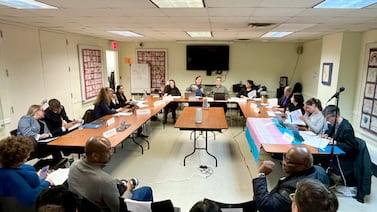
The Brooklyn Youth Advisory Council, with leaders from the Coro New York Leadership Center, recommended co-location policies to Department of Education officials on Monday.

Sharing space doesn’t have to hurt schools, high school students told Department of Education officials Monday night. Done right, students said, co-location can give schools strength in numbers.

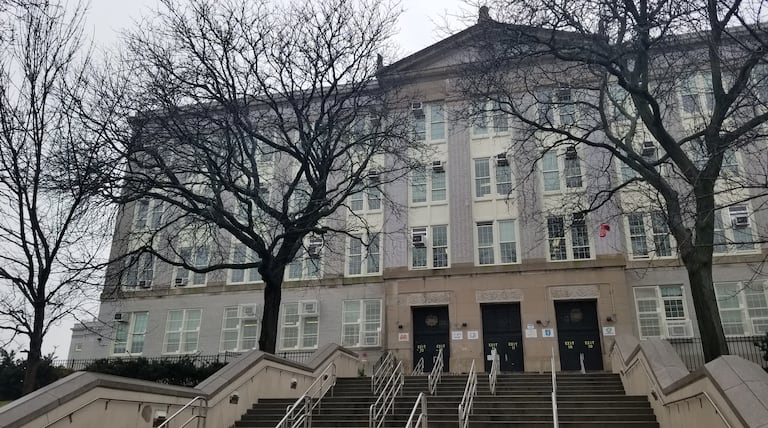
In a hallmark policy, the Bloomberg administration has closed many large high schools and opened multiple smaller schools in the same buildings. Now, hundreds of schools coexist in shared spaces, an arrangement that can be uneasy at times.

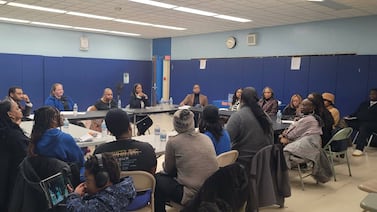
After carrying out surveys and focus groups with nearly 400 students on four co-located campuses in Brooklyn, members of the youth council this week made recommendations for how to reduce tension and make the most of the space-sharing to top department officials, including Deputy Chancellor Marc Sternberg.

At the top of their list: youth councils on all co-located campuses to plan joint academic and extracurricular activities, and youth courts to deal with infractions of co-location rules.

“This would ensure that campus issues are addressed by and within the campus community,” said Adje Wilson, a senior at the Gotham Professional Arts Academy. Principals would appoint students to serve on their campus’s council and board, according to the students’ proposal.

The nine members of the Brooklyn Youth Advisory Council all attend co-located schools and researched the space-sharing practice as a team for the past four months.

The group is run by the Coro New York Leadership Center in collaboration with the Department of Education and the Brooklyn Borough President’s Office, with funding from the National Grid Foundation.Teachers nominate students to join the advisory council after the students compete a yearlong introductory Coro program.

Members of the council said their research found that students in co-located schools have two main requests: To be able to move more freely throughout the building and to take classes at other schools in the same building.

In many co-located schools, students are limited to their school’s floor and to a single entrance and exit, where lines to go through security scanners can delay students’ arrival in class. Additional entry and exit points for each school would ease the wait times, the council said.

Advisory council members said they recognize that letting students take classes at schools other than their own could create scheduling issues. But, they said, intentionally sharing resources could lower tension among schools and ease the frustration that students feel when they see that advanced courses or electives are offered in their building but are not open to them. (Some schools do allow students to take courses at other schools in their building, but the practice is not widespread.)

Taking classes in other schools should be a privilege for students who meet certain academic and behavioral standards, advisory board members said. Other events, including sports games, should be open to the entire campus, they said.

The “overwhelming majority of students identified schools being able to open their activities to all students on campus as the most valuable advantage,” said Shondel Nurse, a junior at the High School for Public Service. “However, when asked how often there were activities that all students on campus could attend, the majority of responses ranged from rarely to never.”

“Support [for small schools] can come from within co-located campuses,” her classmate Delores McQueen added.

The proposals marked the second time that Coro worked with Brooklyn teens to tackle the thorny issue of co-locations. A different set of students made similar recommendations a year ago.

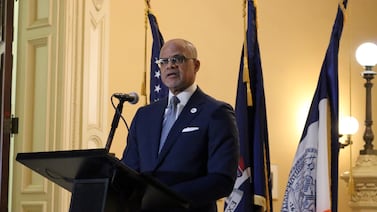
Clara Park, who coordinates the youth council for Coro, said Sternberg met with the advisory board for a full hour last week, and when the students concluded their policy presentations, he responded, “Done.” He didn’t go quite that far at the public presentation on Monday, but he did suggest that the Department of Education plans to take students’ proposals seriously.

“I want to encourage you to make this not just a presentation, but to go back into your schools, to work with us, to work with Coro and the borough president and his team to find opportunities to take these ideas and make them real,” he said. “Don’t take no for an answer.”

Terry Byam, who oversees campus governance for the Department of Education, said the youth courts struck him as the freshest and most surprising proposal. “The idea of [students] creating something that they are responsible for is important for them,” he said.

Cheyanne Smith, a junior at the Bushwick School for Social Justice, said her research team got feedback that students wouldn’t have shared with adults.

“Usually a student wouldn’t say most of the stuff, the data that we got, in front of an adult. Because it would be, oh, you’re saying bad stuff about your school … but then we’re all students so it’s basically just talking to a friend,” she said.

  • http://twitter.com/PFSANY PFSA

    Five, six, seven different schools in one building is NOT working, causes harm to our youth, begets Separate & Unequal in the 21st century and can’t possibly be cost effective (seven DIFFERENT school administrations housed under one roof). Over the last few years I’ve spent time on the ground, witnessed and fought for BASIC access to required (as in kids need a specific room’s equipment to graduate) shared space that has been denied to students because the adults in the building don’t have time to meet and if they do may not even get along.

    The amount of time taken up and out of the day that’s devoted to room/space scheduling and the inevitable errors is ludicrous and the farthest thing from: professional, streamlined, useful or educational.

    While I’m glad a few make this work…this policy is a failure.

  • john q public

    In many NYC high schools now, you have 5 or 6 or even 7 different schools housed in one building like sardines. You have teachers, counselors, social workers and in some cases even Assistant Principals all sharing one office. In my school currently we have 2 counselors, 1 parent coordinator and the AP all housed in the same office!!!

  • john q public

    When you share the common space you now have issues…all seven schools in my building share ONE CAFETERIA. So, there is one school that is forced to have their students eat lunch at 10 am. Another school is forced to have their students eat lunch at 2pm!! Get the picture. We had a lock down last week because the schools were fighting over which school the gymnasium belongs to.

  • john q public

    So, in essence what you have is students, teachers, counselors, social workers and APs are crunched into tiny spaces which will cause tension like you can’t imagine.

  • vanna

    I also work in a school building that houses over 7 different high schools. Can you imagine the chaos!! We actually have 2 different high schools located on the same floor!!! Our school counselors have no private meeting offices to meet and work with students because the counselors have others sharing their office space such as parent coordinators, teachers, paras, asst principals….there is no space for anything…..our school does not have any teacher parking nor does it have any teacher cafeteria so we as teachers are left to find parking and to find lunch spots in the neighborhood of thugs and thieves.. If you bring your own lunch you can eat in the media lab with all other teachers. The media lab is now used for lunch, house teachers coats and boots, garbage you name it. ….the room smells like sh**

  • vanna

    All these small schools housed like sardines have theme names like high school for music or high school for business — These themes have no meaning what so ever. Students are hoaxed into thinking they will be attending a school that has a curriculum designed for them such as the famous high school for sports professions. Students attend these type schools thinking they will be learning sports professions. However, the graduation requirements are the same for ANY school and its the same ole 44 credits. And these so called theme schools are fake and misleading to students and parents

  • Bronx Teacher

    In essence, arent they just asking for a return to comprehensive high schools?

  • Former Turnaround Teacher

    I have yet to meet a single veteran teacher who believes that the “campus” model is working well. This move has only worsened the space crises and created a form of educational apartheid, sometimes in the same building. Administrators have to constantly fight for space, and work out crazy scheduling for cafeterias gyms etc. Meanwhile, most of the these schools cannot offer the full array of AP courses, and electives, and the “themes” of the school often die after a few years.

    Under the current policy when a school is stuggling, often due to being over crowded and under resourced, rather than reduce enrollment to alleviate crowding while still keeping the same funding, the DOE chooses to reduce enrollment while also co-locating. This practice actually creates for an even more crowded building, since you have the same number of students but also space sharing issues. At the same time funding is taken away from the original school due to lower enrollment and the large schools lose the best things they can offer, advanced courses, wide arrays of electives, clubs, guidance interventions etc.

    The final stage is that after being starved of resources and likely co-located once or twice more, the original school is deemed unsavable and closed, and a few more schools are put in to replace it. This has been going on for years, and of course hits the poorest communities the hardest. The DOE likes to pretend the Bronx doesn’t exist, but those of us who have worked there know that the DOE has damaged the school system in The Bronx beyond repair. They did it to Evander, Columbus, Taft, Stevenson, and many others. They are currently doing it to Lehman, and they have taken the first steps with Clinton.

  • KitchenSink

    Wow. Sorry to hear about all the negative reaction from people who seem to want to return to the 1950s factory model of education.

    Instead, we should celebrate the initiative and willingness to compromise of these young people. They are truly training to tackle the problems of the fractious world they will inherit.

  • harry

    This country churned out more great leaders, educators and pioneers during that time pal so get your facts straight….In those days the students did not walk the halls with their pants falling down and their red head phones on their ears……If you have any experience working in education from the inside you would understand,,,if you are a street worker than you only know what the NY Post tells you,,,,sorry but mi just saying you know

  • harry

    Say Yes to comprehensive high schools…….Bill DIblasio for MAYOR!!!

  • harry

    What young people are you referring to my friend….There are no “young” people tackling anything….There is a midget tyrant mayor who is acting as an educator just ask kathy black….

  • harry

    this is a great piece,,,,accurate to the tee

  • http://www.facebook.com/people/Tommy-Calderon/100000263260717 Tommy Calderon

    Saying “factory model” is like saying “boogeyman”. They are conjured images of oppression. If you want to be accurate, you would refer to the “tyranical” or “dictatorial” model that is in effect in schools for the last 11 years. Schools have never had a more restrictive, demoralizing, uninspiring atmosphere than they do now.
    THe creativity and learning that took place in schools throughout the 50′s, 60′s and 70′s was the foundation for much of the advancement in this country over the last 20 years.

  • MrKotter

    Campus Magnet, the model for all of the campus schools (1 Academic Comprehensive HS = 4 small schools with different principals in the same building) Joint Public Hearing for phase out of Law and Govt. HS was this evening. If that doesn’t refute everything DOE has said and done (hear that Nadelstern?) about destroying large high schools and promoting small schools as the solution, what does? And the new solution? FIVE schools in the same space. Maybe it would have been better to support Law and Govt., give them the same Principal for say, five years instead of giving them four principals in less than that time period and cutting their budget?

Tips, questions, feedback?

Contact us at .

Word from Our Sponsor

From Our Jobs Board

Featured Employers
Recent Jobs

Chalk It Up

Recent Comments

0 comments so far today

Archives

June 2013
M T W T F S S
« May  
 12
3456789
10111213141516
17181920212223
24252627282930