GothamSchools — daily independent reporting on NYC public schools

compare and contrast

Interactive map offers illustration of college-readiness disparities

Two screenshots from the Annenberg Institute for School Reform's new interactive college-readiness map show how many students in the Class of 2011 graduated college-ready in two adjacent Manhattan neighborhoods.

If a picture is worth a thousand words, the Annenberg Institute for School Reform is betting that an interactive map is worth about 5,000.

The institute today released a 10-page report arguing that demography is still destiny for New York City schoolchildren, at least in terms of whether they are prepared for college. Accompanying the report is a new data tool that lets users handicap students’ chances of graduating from high school ready for college by neighborhood.

The interactive map was created by the Coalition for Educational Justice, the Annenberg Institute’s organizing partner in the city. CEJ has called attention to the city’s low college-readiness rate in the past.

Since last year, the city and state have released college-readiness rates for each high school. The state’s measure looks at students’ scores on reading and math Regents exams and how many students earn advanced diplomas, and the city’s measure adds performance in college-preparatory courses and tests and real college enrollment rates. Both methods found that fewer than a quarter of city students in the Class of 2011 graduated college-ready in four years, a statistic that both are using to justify changes to curriculum and assessment. The city is also launching new initiatives aimed at boosting the numbers.

But the city and state data reflect only where students attend school. The Annenberg Institute instead looked at students’ home addresses. Breaking the city into nearly 300 different neighborhoods, researchers found that the whiter, the wealthier, and the more educated the women in each area, the more likely students there were to graduate ready for college, regardless of where they attended high school.

On the Upper East Side, for example, 70 percent of students hit the college-readiness mark. But cross 96th Street into East Harlem, and a student’s chances of graduating college-ready drops to just 18 percent. Next door in Harlem, the rate falls to 13 percent. Continue on a little farther west to Morningside Heights, where Columbia University is located, and the rate rises again to 29 percent.

The report concludes that the Bloomberg administration’s sustained policy to replace long-struggling high schools with smaller options has not made a dent in even longer-standing inequities. It reads,

In a broadside that former Chancellor [Joel] Klein and Michelle Rhee published in 2010, they declared, “The single most important factor determining whether students succeed in school is not the color of their skin or their ZIP code or even their parents’ income – it is the quality of their teacher.” Yet our findings indicate that ZIP code, income, and, above all, the racial composition of students’ neighborhoods is very strongly correlated with student success.

Lisandra Tejada, left, and Jade Williams attended the High School of Medical Science in the Bronx and said it did not prepare them for college. (Neither lives in Jackson Heights.)

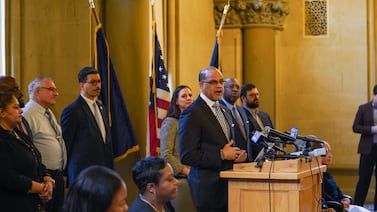
At a press conference about the report this morning, several recent high school graduates said they were surprised when they were told they would have to take remedial courses once they got to college. Lisandra Tejada graduated from the Bronx High School of Medical Science in 2009 after just three years, with Regents scores in the 80s, well above the level considered college-ready. But she still failed the math placement test at Lehman College.

A former classmate, Jade Williams, stayed on for a fourth year, but as a senior she took only art, math, and physical education. That was all the school offered that she hadn’t previously taken, she said.

Both students said their high school had focused almost exclusively on preparation for the Regents exams required for graduation, with lessons centering on how to guesstimate and eliminate answers to increase the likelihood of getting a questions right.

“High school was the most easy thing in my life,” said Williams, whose neighborhood, Highbridge, has a college-readiness rate of just 15 percent. “I think middle school was more challenging.”

The press conference was organized by CEJ, and some of the report’s recommendations, such as to boost counseling services, closely mirror others the group has put forward in the past. Another recommendation, to increase the number of schools designed to admit students with a wide range of skill levels, echoes a 2009 report from the Center for New York City Affairs.

The city’s high school progress reports this year will factor in a school’s college readiness rate into its final score for the first time. The reports are set to be released next week. Department officials said last year that they expected schools’ scores to fall substantially if they did not do more to prepare students for college.

The Annenberg Institute’s complete report, “Is Demography Still Destiny?”, is below.

  • Youdontneedtoknow

    But the DoE says it’s not about zip codes…..hmmm.

  • Mr. Flerporillo

    Depressing, not surprising, but mainly depressing.  I taught argumentative writing for a few years at a state university, and my mind was consistently blown by how ill-prepared the vast majority of students were (as writers, at least.  I’m sure they were all brilliant physicists).  Most of them weren’t poor and didn’t appear to have had much trouble getting As in high school.  And most of them were probably “college ready” by whatever standard that implies.  So to see a number like 13%, wow.

  • http://www.facebook.com/profile.php?id=100002397245457 Mary Conway-Spiegel

    Malpractice.  Education malpractice.  As parents, as advocates we’ve known this all along…we’ve told everyone…we’ve never been fooled.
    Poor doesn’t mean stupid.  It just means underfunded, under represented…

  • http://twitter.com/MyInspirationIs My Inspiration Is

    These are sad statistics. The at risk schools need to be given tools and incentives to keep these schools afloat rather than letting them fail.

  • http://www.facebook.com/profile.php?id=1652419195 Travis Dove

    I think there comes a point, some time, when it becomes the fault of the students and not the teachers.

  • Former Turnaround Teacher

    From the Daily News article regarding this study, “City schools officials defended the mayor’s record, noting that the citywide college readiness rate — currently 13% for black students and 15% for Latinos — is better than when Bloomberg took office. “Since our administration’s reforms, college readiness rates have nearly doubled for black and Latino students — but there is still more work to do,” spokeswoman Erin Hughes said.”

    Even if it has “doubled” which I am not sure about since I college readiness seems to have only be tracked recently, this is a disgrace.  How can we have a so called “Education Mayor” for almost 11 years now, and say that this is acceptable.  All he has done is destroy neighborhood schools, and bash teachers.   This is an extremely important story that I hope a lot of people read, but as noted below, it is truly depressing.

  • Milo

    I’m surprised the usual suspects have not blamed this on teacher pensions or 55/25. (You know who you are)

  • Mr. Shoop

    Think about this: The Upper East Side has a 70% college readiness rate and East Harlem has an 18% college readiness rate. However, there are tenured teachers in both the Upper East Side as well as East Harlem. Also, teachers from both of these locations are still evaluated under the “S” or “U” system. The fact is that neither tenure nor the current teacher evaluation system can or should be blamed for college readiness with such a high difference in these two locations. On a side note, I’d bet that there are probably a whole lot more tenured teachers on the Upper East Side than in East Harlem as these schools tend to not have as many TFA’ers or face huge staff turnover problems. But in the end, the ed-deformers don’t care about petty facts like poverty as it is all about “no excuses”. 

  • Mr. Flerporillo

    Let’s say someone:  (1) lives in Harlem; (2) is a high school dropout; (3) has no skilled trade and has  employment prospects that are basically limited to retail; (4) is a single-parent with several children; (5) watches television for entertainment; (6) doesn’t read unless she has to, and doesn’t enjoy it; (7) usually isn’t in a great mood for a whole bunch of reasons, finds her children’s whining and fighting exhausting, and tells them that often; and (8) doesn’t have health insurance.  By the time her children were 3, they had heard approximately 30 million fewer words than children in households with college-educated parents.  She doesn’t help her children with their homework much — they forget to bring it home, or they refuse to sit down and do it, and anyway she was never any good at long division herself.  

    Assuming that the problem of poverty will not be retroactively solved, what’s the plan to make sure her children are “college ready”?  And then what’s the backup plan?  Are children like this just write-offs at this point?

  • Vote NO!

    The  “plan” to  counter  all  of  the  points  you  stated, is  to  put  all  of  the  responsibility  on  the  teachers.  Turn  the  teaching  profession  into  one  of  the  least  desirable  professions.  Burn  out  all  of  the  teachers  within  a few  years  of  their  entrance  into  the  profession.  Watch  the  college  readiness  rate  drop  from  18%  to  8%  in  a decade.  Then  “scratch  our  heads”  and  wonder  what  to  do  next.

  • Mr. Flerporillo

    Can I just put you down for “write them off”?

  • http://www.facebook.com/profile.php?id=100002397245457 Mary Conway-Spiegel

    Thank you Mr. Flerporillo…because the plan is:  There is no plan.  Just like there was no plan when the TurnAround debacle failed.
    All of this is one big commercial “college ready” is a buzzword, just like: “raise standards,” “students first,” “it’s about the kids,” etc. 

  • Mr. Flerporillo

    I should have been clearer.  I was trying to ask if anyone here had a plan. I know most people here think the city doesn’t have one.  And to be clear, I do not have a plan, although it’s my sense that a truly effective plan would have to be much more ambitious and expensive than most people like to acknowledge.   

  • A.S.Neill

    As I’ve pointed out before, there is an alternative plan well supported by research: high quality and extensive pre-K, a plan in fact championed by Obama in 2008 but later disregarded under Arnie Duncan. It is expensive and long term; words that most politicians don’t want to hear who want credit for a quick fix. Someday the US may get such a plan, but probably not any time soon.   

  • Former Turnaround Teacher

    I agree with Neill.  Since the gap clearly starts at a young age, and has to do with the home and surrounding environment, I believe the best investment would be quality and extensive pre-k.   I also think that innovation needs to really be worked on at the Elementary Level.  Perhaps by adding more after school literacy programs for young children, some of the achievement gap lost at home could be closed.

  • Vote NO!

    No, ” Just  put  me  down”  as  one  who  believes  with  a great  deal  of  confidence,  that  the  current  strategy  will  NOT  work.

  • Mr. Flerporillo

    Fair enough. But nobody gets many points for predicting that a problem that’s grave, deeply entrenched, and generally considered unsolvable will remain grave, entrenched, and unsolved. Sounds a lot like a write-off to me. If the parents of the 87% in Harlem tune out, I certainly couldn’t blame them.

  • Guest101

     Mr. Flerporillo,I think there is certainly much that could be done in order to make a tremendous impact in regards to overcoming the the tremendous impact that poverty has on children and student achievement. I’ll lay it out after this short rant. 1. I bet that college & career readiness rates were the same if not higher before this administration. Back then, neighborhood schools and districts did a much better job of articulation then they do now. Although more students supposedly did not graduate, the ones that did, met higher standards. 2. Make no mistake that this conversation is being led by the 1% who; A. want to see as much privatization in public the public sector as it ultimately means more money and opportunity for them. Teachers, custodian, food services, it’s just a matter of time before they set their sights on the police force the way they have prisons. (Crime is big business) B. Pensions, there is a double bonus here, let private employees put money in privately managed 401ks, etc. Remember, there’s a lot money to be made in Education. The vultures will continue to prey and are very difficult to deter. 3. College Readiness is defined by 75 on English Regents & 80 Algebra, or meeting the 3 year sequence in math (Algebra, Geometry, Trig.) or a particular score on the SAT.  If a student scores 85 on the ELA & 79 on the Algebra, doesn’t complete the 3 year sequence and doesn’t take the SAT, he may very end up at a community college and eventually a graduate from a 4 year school. So the metrics which qualify this standard are gibberish. Now to the solution:From the day someone decides to take this on, this has to happen on multiple levels.Absolutely this starts with early childhood. Getting students into early enriching environments for an entire day. I would recommend 8-5. This would support healthy play habits, build a foundation for students, allow parents the time to work or get job training. But you also need to teach parents how to be parents and what they should be doing to support their children. I know how dare I say such a thing. But just because you know how to make a baby, doesn’t mean you know how to raise one. We shouldn’t assume that. Those on public assistance it would mandatory for this support. Teenage mothers, should have various options to support them. Oh, by the way you need wrap around services. NYC should be able to coordinate services but this administration has no clue on how to do that, one on their major failings. That was what mayoral control should have done. Next, let’s go back to districts. That way we could bring back articulation between, elementary, middle schools, & high schools. We need to identify students at risk, and track them through the system. Cradle to College or Career. We also need to reestablish strong vocational programs. We need to rebuild the arts & sports programs at early ages. This is going to cost a fortune you say. Nope, same money, maybe even less over the long run as you get more students on track, less young men going through incarceration. Less single parent households, although in itself is for another conversation. Sorry folks, I have to get back to work, but this can be done. But it will only be done when people who have committed their lives to this work are put in a position of power to affect change in this system. Those leading policy in this city have never done this work. They have agendas that are in the best interest of a wealthy minority. The rest are here to support that cause. Sorry I was unable to finish my manifesto for change. Take care and keep advocating for kids.

  • Michael Haberman

    Through PENCIL’s work bringing
    the skills and resources from the business community into public schools, we’ve
    found that creating programs targeting college access and readiness increases opportunities
    for students to attend and succeed in college—wherever they live!


    Our Partners are doing this throughout
    New York City. In some cases, they’re introducing students to college as early
    as first grade. Partners have role models discuss the benefits of college and
    what it takes to get there, as well as where they went to college and how they
    succeeded. They also bring students to college campuses, and demonstrate to
    parents that college is achievable for everyone through “college nights” and
    financial aid workshops.


    Businesses support older
    students with college application assistance, providing workshops and tutorials
    on college application essays, FAFSA, and helping students identify the right
    schools for them.


    Collectively, these small steps
    add up to a big difference:

    ·        
    More PENCIL Students
    apply to college than their peers.

    ·        
    80% of surveyed
    PENCIL High School students reported increased planning and decision making
    about their college choices, such as selecting a school or choosing a
    major.
      

    ·        
    Principals
    report that PENCIL Students have a better
    understanding of how to find and apply for the right college for them


    Business volunteers can apply
    their talent and skills to provide students with the guidance and resources that
    they need to make college a real, obtainable goal—and to help them succeed once
    they’re enrolled. In the words of one parent whose first grade student visited
    a college through PENCIL: ”They have something to look forward to, to keep them
    on the right track…It means a lot that my daughter [visited a] college. I want
    her to reach big, and I want to her to have a really good career and a good
    life.”

    Michael Haberman
    President, PENCIL

  • Bob Williamson

    Do East Harlem and the Upper East Side have any difference in their legitimacy birth rates?  It seems to me that the rather than poverty causing poor education, absentee fathers could be the cause of both low incomes and lack of academic achievement.

Tips, questions, feedback?

Contact us at .

Word from Our Sponsor

Follow GothamSchools

RSS
Subscribe to the daily email digest:

Chalk It Up

Recent Comments

0 comments so far today

Archives

May 2013
M T W T F S S
« Apr  
 12345
6789101112
13141516171819
20212223242526
2728293031