GothamSchools — daily independent reporting on NYC public schools

Outside the Cave

Why I’m Starting a School: The Political Answer

I get asked frequently why I’m helping to start a school. I have three different answers to the question, depending on the audience. All are true, and I’m not sure they’re contradictory. The first answer dealt with the particulars of Harvest College High School, and the second answer was more personal. My final answer is political.

Anyone who tells you they know how to improve schools at scale is lying or delusional. There is simply no precedent for taking a large number of struggling or mediocre schools and improving them. To say that the solution is to close them down and replace them with new ones, as the Bloomberg administration has done for 10 years now, is one of the great acts of hubris in our time. The part of me that cares deeply about the politics of educational policy, and its utter lack of regard for democracy under Bloomberg, doesn’t want to support this policy in any way.

But opening a school is doing that. I’m excited for Harvest Collegiate High School to be born, but for that to happen, Legacy High School has to die.

Legacy is not just any school. It’s a small school founded as a member of the Coalition of Essential Schools, as is ours. It’s also the school whose closure was most resisted by its students last year.

I don’t know much about Legacy. I know the Department of Education says it was “failing.” I know it was showing signs of improvement under new leadership. I know a critical mass of students fought its closure. I don’t have the information to address the particulars of the decision to close this school. I do know I trust its students more than I trust the department. Please read what one of them, Justin Watson, wrote me on my blog earlier this spring.

In February, a fellow active union member and organizer wrote me that while he understood my desire to open a great school, he hoped I would have waited until a moment when opening such a school would not make me complicit in the current “school reform” project.

I’m certain his analysis is right, but I’m of two minds on whether or not good people should try to open new schools in New York City right now. On the one hand, it makes one complicit in the failed current “school reform” project; on the other hand, if schools are going to be opened anyway, it’s better that good people be part of that. I honestly don’t know which is right in the end and accept the judgment and criticism I get for my decision to side with the latter view.

But there’s another political part of me, and it’s the part that, in the last year, I realized was more important.  This is the part of me that is interested in the politics and policy of what actually happens in classrooms among teachers, students, curriculum, and assessments. Let’s call this the politics of pedagogy, as opposed to the politics of schools and personnel discussed to this point.

Nearly all political discourse around so-called “school reform” misses the most important part of schooling. The charter vs. public debate, or the big vs. small debate, or the which teachers should be hired or fired debate, while important, only address the container in which learning happens. It doesn’t address the learning itself, which is the result of a relationship among students, teachers, curriculum, and assessment. While there is public dialogue around these pillars as isolated pillars, there is rarely any around what happens in the actual classrooms when they come together. You can’t just focus on one; you have to look at pedagogy, or the complex multifaceted relationship between them. Anything that doesn’t is oversimplifying an immensely complex challenge, thereby making it harder to address.

Ultimately, my decision to help open Harvest is about creating a school where a certain kind of teaching, learning, and assessment can flourish. This kind of pedagogy is captured in the Coalition of Essentials Schools Common Principles. My greatest hope for Harvest is that we’ll embody and realize them.

  • Michael Fiorillo

    You’re understating two important points, Stephen: good people are what good people do. In other words, the prospective good you hope (and probably will) accomplish in your new school is contingent on what you rightly call your complicity in a straight-out evil process that harms students, teachers and communities. A fraught situation, to say the least.

    Second, your separation of the policies governing schools from classroom pedagogy is too facile: there is indeed a tremendous amount of overlap between them, as we are all finding out to our dismay. Without wanting to unduly judge your decision, you are participating in a process driven by agendas far different from yours, and you’d do we’ll to consider how long you’ll be allowed to practice the teaching you seek for your students. Every public school is a target, and you’re fooling yourself if you think your turn won’t come.

    You might want to ask what Michael Bloomberg and Chancellor Walcott would prefer you and your colleagues do, and thus feel confident in doing the opposite.

  • Former Turnaround Teacher

    This is a very interesting piece and I am glad it was written. When I was looking to transfer at the end of the past school year I often faced a similar decision. I could not bring myself to apply to certain schools that I know where in current phase out buildings. However I did apply to some schools in buildings that had finished phasing out. When it comes down to it, in the current system unless you are lucky enough to get into the 20% or so of High Schools that are either specilized or the DOE for whatever reason has decided to leave alone, you are either in a school that is phasing out, or a school that is phasing in. 

  • Former Legacy Teacher

    The unspoken thing about starting a new school is the hierarchy of the new school over the closing school.  As a veteran teacher, I have been through two school closings, my second being Legacy, and the snobbery that the kids and teachers of the closing school experience by the kids, teachers, and administration of the new school is extremely damaging.  There is this idea by the new teachers and students that the closing school members are defective, that they failed.  Everyone may say that they are supportive and don’t judge but it happens.  I’ve overheard teachers and students at the new schools talk down about the closing school.  I’ve been told by new school members how they aren’t going to make the mistakes of the failing school.  It’s amazing to me the hubris, as you put it, that people have when opening a new school, how sure they are that they won’t fail.  
    I am glad that you had reservations in starting at a new school.  It gives me hope that you will make sure that the relations between the new and old school stay friendly, but I am not confident that this is going to happen.  I am no longer at Legacy but I do keep in touch with my students and they say that the worst part of the year so far has been the dismissiveness of Harvest towards the Legacy kids.  Some kids told me of being chased out of the cafeteria despite it being their scheduled lunch period because the Harvest teachers didn’t want the Legacy kids mingling with the Harvest kids.  

    As I stated earlier, Legacy was my second phased out school.  I can’t tell you how depressing kids find it that the school they spent years at no longer exists.  It’s as if we’ve erased part of their life away.  This idea that something that was, no longer is, and how the kids are suppose to deal with that loss is never discussed with any real importance when we discuss school closing.  We don’t discuss how those kids feel about themselves and their education, past and future, when they come from a closing school.

    I hope that all this public angst you’ve shared with us leads to a more sympathetic viewpoint to the kids that you are sharing the building with.  That somehow you make sure the kids at Harvest understand that this could be them in the future, that given the current political climate in education no one is guaranteed that when their 10 year reunion comes around their school may no longer exist.

  • Cave – Dweller

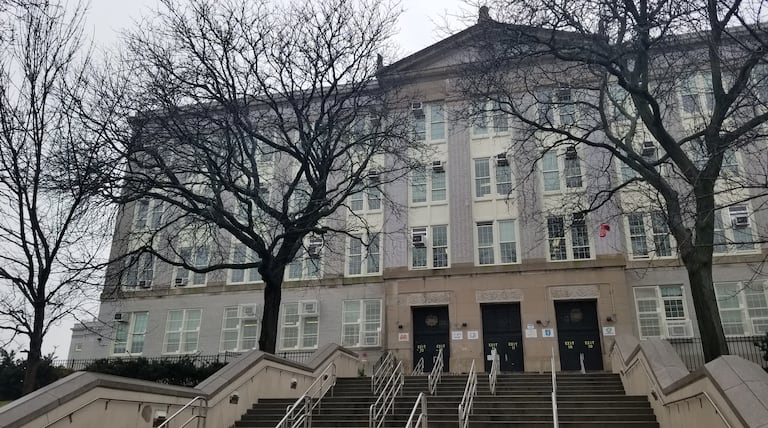
    I work inside the cave. Our students have separate water fountains and bathrooms even though it would be far easier for our students to use the “Harvest Fountains”. Security makes sure that our students walk upstairs to the “Legacy fountains and restrooms”. As one student said, “Wow, did anyone see that movie about the Civil Rights movement with the separate fountains? This is just like that.”

    Harvest does not speak to, greet, or often acknowledge Legacy staff. And before someone tells me about my prejudice. I have tried several times to at least have the elevator not feel like a ride up to prison. Sometimes they will speak to a student but this usual comes with ignoring the adult next to them.

    My kids know and feel what’s happening. They see how Harvest and Legacy are separated; they feel looked down upon from the Harvest Community. They feel the segregation and feel like failures – at times. Recently after an argument got loud a fellow student said, “see you act like this and that’s why our school is closing.”

    Perhaps it is not the new schools fault and it is totally the DOE’s handling of co-locations. But why does school leadership keep the kids so segregated. Kids don’t care what school someone attends. They will make friends with anyone and everyone. They are all in a battle to have the most Facebook friends.  I encouraged my kids to at least meet the new guys and they told me they didn’t think the Harvest folks would like that. So who put the idea in the students heads?

    But my bigger question is – if Ms. Burch and Mr. Lazar are so excellent. If these new small schools are so fabulous and able to make a successful school. Why couldn’t they just take 2 weeks in the summer and take over our school and make our kids as successful as I am sure the Harvest students will be? As a candidate for Senior Class President said, “I have had 3 different principals in 4 years. I will advocate for your rights and your futures”

    Perhaps the Harvest model wouldn’t work with our kids because we haven’t a single white student in our cohort, the majority of our students receive special education services of some type, we do have students who have been in and out of the justice system, and the majority of our parents would not have attended a  mandatory interview/orientation. But mostly the DOE has decided Legacy kids are no longer needed for their story of great educational success.

  • http://www.outsidethecave.org/ Stephen Lazar

    Thanks for the comments, Michael.  I think you raise good points.  I’m not sure, though, if there is a point any of us can take within the DOE that doesn’t make us participants in processes driven by agendas different than our own.  

  • http://www.outsidethecave.org/ Stephen Lazar

    Thanks for raising all these points, as they are important for people to understand.  

    When I first read this comment the other day, I was prepared to write that I haven’t observed any of my students make any negative comments so far.  Unfortunately, I can’t write that any more, observing two such comments in the past day.  I’ve addressed it with those students, and will bring this up to our entire school tomorrow.  

    If there are future concerns, please let your former colleagues know they can reach out to me as our Chapter Leader and I can work to resolve them.

  • http://www.outsidethecave.org/ Stephen Lazar

    Thank you for raising all these important points.  I would really like to discuss them further in person if you’re willing, in the hope that we can find a way to bring our teachers and students together to start building connections between our schools. I don’t have my own classroom, but am generally in Room 411 in the afternoons. 

  • Michael Fiorillo

    Exactly, Stephen, that was my point. We should be fighting the DOE and its neoliberal agenda as we struggle to do the best we can for the students in our classrooms, but by opening a new school at the expense of other students and teachers, can you honestly say you are doing that?

  • http://www.outsidethecave.org/ Stephen Lazar

    (In response to Michael’s second comment)

    I absolutely cannot – that was one of the points of the piece. I accept the criticism for being complicit in the school closing policy. I have made the decision that it’s more important to me to be able to create a new Coalition School.

  • Mr. Flerporillo

    Well that’s where you and Fiorillo are different.  Fiorilllo has never done, and will never do, anything “at the expense of other students and teachers.”  The rest of the world (complicit with “evil”) can only read that moral clarity and weep. 

  • Juggleandhope

    I agree with you that all our work involves ethical compromises and prioritization (and not just with NYCDOE but any work within a system of exploitation on what is literally blood-soaked (and gratefully rain-washed) land).  I also agree with your point that the dynamics of learning (and implicitly, actual experience) should be our focus rather than just the container politics (thanks for that word).  And I share your hope that your thoughtful and creative pedagogical relationships can make a big difference for some students (and adults) and that you can ameliorate the disheartening dynamics between the Legacy and Harvest students and staff.  Looking forward to further thoughtful posts about your work. 

  • Gos

    I agree W.C. Bryant High School was a good school to work  until Ms. Dwarka became principal. Now the only thing the administration does is go after veteran teachers, chase out teachers and intimidate them. How can demoralizing and putting down professionals with a good track record be beneficial for this school? That is their idea of turnaround make these leadership principals so powerful that students that do not deserve to pass will pass. and everybody will feel miserable to go to work under that kind of principals.

Tips, questions, feedback?

Contact us at .

Word from Our Sponsor

Follow GothamSchools

RSS
Subscribe to the daily email digest:

Chalk It Up

Recent Comments

25 comments so far today

Events Calendar

Archives

May 2013
M T W T F S S
« Apr  
 12345
6789101112
13141516171819
20212223242526
2728293031