GothamSchools — daily independent reporting on NYC public schools

one year later

Détente at Park Slope’s John Jay Campus, but no sea change

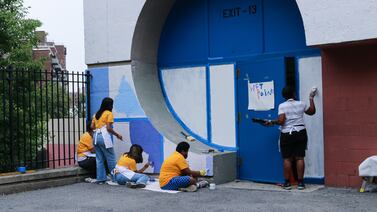
Students from Park Slope Collegiate and the Secondary School for Law, which are both housed at John Jay, teamed up to paint this mural at Park Slope Collegiate.

Wesley Weissberg has poured hours into Park Slope’s public schools, even serving as PTA president at the neighborhood’s popular elementary school, P.S. 321. But until this year, she hadn’t even considered trying to help the neighborhood’s only high schools.

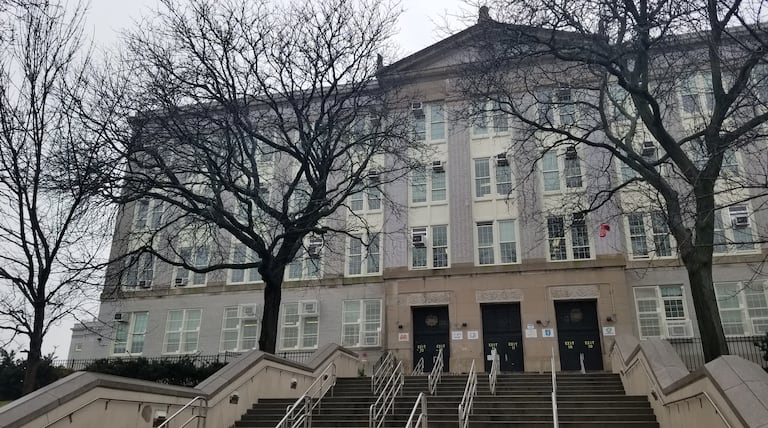
Housed in the John Jay Campus at the heart of Park Slope’s main shopping street, the high schools have never drawn many students from within the neighborhood’s brownstone-lined borders. Students who graduated from local middle schools mostly headed to private schools or Manhattan for ninth grade.

That was true well before Weissberg moved to Park Slope. More than a decade ago, the district’s school board president, Mark Peters, waged an effort to turn John Jay High School into a destination for the neighborhood’s middle-class families. As a result, the struggling high school was replaced by three smaller schools: two that had been located elsewhere in the district and one that grew out of John Jay’s relatively strong legal studies program.

But even with the overhaul, the new schools, which did not screen students, never attracted local students. And a decade after Peters engineered the building’s redesign, the Secondary School for Law; the Secondary School for Journalism; and the Secondary School for Research, which became Park Slope Collegiate in 2011, continued to struggle. Except for during the hours immediately after school, when some neighborhood shopkeepers would lock their doors to keep John Jay students out, there was little relationship between the building and its neighborhood.

Then, last year, tensions over the addition of a selective school billed as more likely to attract Park Slope’s high-performing students drew the neighborhood’s attention back to the campus — and volunteers like Weissberg into the building.

A year into Millennium Brooklyn’s uneasy co-location, it is not yet clear whether the building is on the way to becoming a Park Slope school, or whether the worst fears about Millennium’s presence will come to pass.

In protests and at city school board meetings, students and teachers from the John Jay schools charged that Millennium’s arrival could give rise to race and class segregation. Almost all students at the original three schools are black and Hispanic, but if Millennium turned out to be anything like its model in Manhattan, than half its students would be white and Asian.

The John Jay students urged the city to attract more diverse populations to the campus by investing in the three existing schools, rather than concentrating white and Asian students on a single floor. And in a letter to city officials, Park Slope Collegiate Principal Jill Bloomberg said it was hard to stomach a new school getting extra funding while her school was strapped by budget cuts.

Weissberg was one of several members of Congregation Beth Elohim, a synagogue located blocks from John Jay, who were unnerved by the tension Millennium wrought. So the congregation’s social action committee reached out to Learning Leaders, a non-profit that trains community members to volunteer in public schools.

This spring, 16 volunteers from Beth Elohim started working at John Jay — four at each school. The volunteers were each assigned to a teacher at one of the schools and spent at least two periods a week tutoring students, organizing classroom materials, and pitching in wherever they were needed.

“We were thinking about the relationship between all the schools and how we wanted to model the behavior in the type of relationships,” said Isabel Burton, the congregation’s director of social outreach. But she said the volunteers hardly “changed the world.”

Both volunteers and students said last year’s acute tensions had subsided. But they said Millennium doesn’t have much to do with the other schools, an outcome they feared from the start.

“Millennium doesn’t involve themselves with the rest of the school,” said Jelissa Fernandez, who graduated from the Secondary School for Journalism in June. The other schools play on the same sports teams, but Millennium competes with its sister school in Manhattan, Fernandez offered as an example.

The bulletin boards at the entrance of the building represent only the original three schools on John Jay's campus.

Millennium Brooklyn’s founding principal said the four schools do work together in many ways. In an email, Lisa Gioe said principals of the four schools meet once a week to strengthen ties. She said the Beth Elohim volunteers, a weekly cooking competition, and Millennium’s writing center also bring the schools together.

But the union is far from seamless. Bulletin boards at the entrance of the school feature only the original three schools. Students from all the schools must pass through metal detectors at the front doors, but Millennium students arrive earlier. And Millennium students can all leave the building for lunch, but the other schools have tighter rules.

And as predicted, the racial makeup of Millennium’s student body was very different from the three other schools’. At Millennium, 35 percent of the first class was white and another 18 percent was Asian.

Students from the other schools said they are forbidden from walking down to Millennium, although they can visit the other schools.

Giovanni Callao, who just finished eighth grade at Park Slope Collegiate in June and will begin high school there in September, said the Millennium students were “cool,” but he’s had limited contact with them.

“We’re allowed to go to other floors, but we’re not allowed to go there,” he said.

Volunteers have witnessed the disconnect between the schools but not bridged it. As a lead volunteer at the congregation, Weissberg met with the principals at all the schools. She said Gioe told her that students from the building’s other schools were welcome to use Millennium’s Writing Center.

But Weissberg, who volunteered biweekly in an English class at the Secondary School for Journalism and led a lunchtime book group, said she never saw the Writing Center or any other evidence that Millennium was sharing its space and resources.

“I’m really unaware of Millennium, and where they are,” she said. “I don’t know the politics of shared spaces, but I don’t see it.”

Burton said the largest effect of the work has been volunteers’ relationship with John Jay students, at least addressing some of the tensions that have plagued the school.

“Before they would walk by John Jay relatively fast, maybe be tentative about looking at the kids coming out of it in the eye,” she said. “But now they’re looking at them in the face.” The congregation aims to expand the Learning Leaders program this fall.

But community relations with John Jay have a long way to go, according to City Councilman Brad Lander. Lander said he lauds volunteer-led efforts such as Learning Leaders and Teen Battle Chef, a weekly cooking competition organized by a Park Slope resident, Veronica Guzman, and New York Methodist Hospital. But he said he would like to see more neighbors offer students opportunities for internships and resources.

And he said there are other ways the schools could be told they are part of the neighborhood.

“There’s just a strong police presence before and after school that I think contributes to some students feeling like they are less welcome in the community,” Lander said.

When Lander held a panel discussion at the campus about Stop and Frisk, the New York Police Department’s controversial policing strategy, a Park Slope Collegiate teacher said policing at the school only compounded other problems that they already face.

“So A, our school is underfunded,” the teacher said. “B, we have metal detectors. C, a new school comes in with more funding, D, we’re getting cameras. What’s E?”

She added, “It’s pretty obvious that the message that’s being sent to our students is they’re criminals.”

Other teachers say the building is changing for the better. Michael Salak, a social studies teacher at Park Slope Collegiate, said he likes seeing more community members at the school, and that the neighborhood has come along way since he began teaching at John Jay, when a restaurant across the street had a “No Students Allowed” sign posted in the window.

But Salak said the best way for community members to make an impact is to send their children to all of the schools in the building.

“Just try to join us is anyway possible,” he said. “Send your students here, too.”

And a decade after his push to turn the building into a desired school for local residents fizzled, Mark Peters says he still holds out hope for change. His daughter, whose birth first inspired him to take a look at the building, is now in middle school.

“I have no idea where she’s going to high school,” Peters said. “But wouldn’t it be cool if she went to John Jay?”

  • http://ednotesonline.blogspot.com/ Norm

    This is a very incisive report and captures the essence of cultural and physical segregation. People send their kids to schools like Millenium so that won’t be “contaminated” by other students. The metal detector issue and the earlier arrival of Millenium students is a very telling point.

  • Deborah Orr

    This article fails to mention the suspension school that was supposed to be temporary but has been housed on the JJ campus for many years. If the DOE is serious about making the four main schools more appealing to neighborhood families, they need to relocate the suspension school. Community leaders have requested the DOE move the school, but have gotten nowhere.

  • Anonymous

    In my day, an earlier arrival would keep some kids from being picked on and accosted by the worst of the other kids.

    Maybe the other schools need to impose selective admission criteria ‚ at least an interview to spot those who want to learn, no matter what their middle school average is.

  • Melnanine

    what an interesting article. what do you know Millennium Brooklyn is 35% white, wow, Park
    Slope is what 95% white? what is wrong with a school being less than half white anyway? and by the way, the school has been open only ONE full year, intergrating itself with the
    other schools in the building? why don’t you give them some time? 
    and By the WAy, any student of ANY color and socio-economic background can apply to
    Millennium Brooklyn as long as they have half decent grades and look like they are interested in going to school in the interview, they’ll probably get it. Not sure what 
    exactly is the problem?

  • Mr. Flerporillo

    No. Norm called it below. People send their kids to Millenium so they won’t be “contaminated” by minorities. In other words, they’re all racists. Norm is white, so clearly he’s not racist.

  • Guest

    I don’t get it, if white people don’t like diversity, why the heck are they living in New York City? It’s not fair to the others. If they like to see 100% white on their school’s demographics, then why can’t they move to a small suburban town full of white people instead of coming here, in the melting pot of racial diversity? They need to… Get out. Now.

  • James Rose

    y’all are missing some very obvious points here….

    first off; millennium isn’t 100% white. nowhere near it. when did 35% = 100% minotiry students thus make up 65% of the school. Having a good racial mix of kids is essential to developing  good understandings of the modern world we live in.  This school seems to do that.
    secondly; the population of park slope is predominately white.  i mean come on people.  you are looking for racism where none exists.
    thirdly; i worked at the Secondary School for Law for three years. The violence, drugs, and sex that goes on in that school on any given day is indicitave of the multiple failures of the three schools.  Why not let a new school try a different approach.

  • Leaving Cobble Hill

    “secondly; the population of park slope is predominately white.  i mean come on people.  you are looking for racism where none exists.”

    Wha??? That is truly the best example of an oxymoron, EVER!!

Tips, questions, feedback?

Contact us at .

Word from Our Sponsor

From Our Jobs Board

Featured Employers
Recent Jobs

Chalk It Up

Recent Comments

0 comments so far today

Archives

June 2013
M T W T F S S
« May  
 12
3456789
10111213141516
17181920212223
24252627282930