GothamSchools — daily independent reporting on NYC public schools

civil disagreement

City-state schism over challenge of needy students grows wider

New York City’s process for assigning students to schools still sets some of the schools up to fail, State Education Commission John King charged today.

“I continue to have concerns about enrollment,” King said. “I worry about the over-concentration of high-needs students in particular buildings without adequate supports to ensure success.”

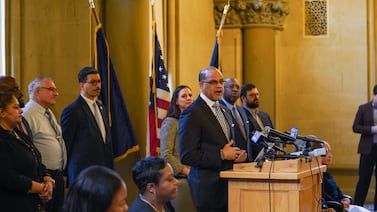
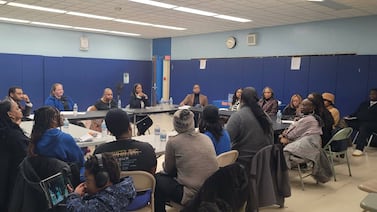
King made the comments to reporters during a break in a meeting of Gov. Andrew Cuomo’s state education reform commission, which met this morning in the Bronx.

City officials have acknowledged King’s concerns when petitioning the state for aid, but they have never conceded that high concentrations of needy students could hurt schools. Today, the Department of Education official in charge of enrollment said recent changes to the way some students are assigned to schools, made quietly last summer, were meant to increase choices for families, not respond to King’s concerns or help struggling schools.

King’s concerns reflect longstanding criticism about the Bloomberg administration’s school choice policies. For years, critics have charged that the department overloads some schools with needy students, making it hard for them to show progress or even sustain their past performance. An internal department report completed in 2008 and obtained by GothamSchools last year concluded that a high school’s size and concentration of low-achieving and overage students strongly predicts its graduation rate.

At many schools the city has closed, performance had fallen as populations of English language learners, poor students, low-scoring students, students with disabilities, and overage students increased, often after other nearby schools were shuttered.

But department officials say some schools have improved and even thrived despite having challenging student populations. The deputy chancellor in charge of enrollment, Marc Sternberg, told reporters today that some schools had gotten “outrageously better results” with similar students.

The argument is valid but not sufficient, King said.

“I agree with the city’s perspective that indeed there are schools that have very high concentrations of high-needs kids that are excelling,” he said. “The question is how do we ensure where there are concentrations of [those students], there are adequate supports. If not, how do we think about the enrollment system to make sure that students have access to schools that will provide the support that they need?”

King first expressed the concerns a year ago when awarding the city aid for schools it was closing and reopening. He said he wanted ”to ensure that schools receiving students who would otherwise have attended a phased out school are not negatively impacted as a result of their now enrolling an increased number of high-needs students,” a scenario that he noted had played out before in the city.

Today, he said his renewed criticism would not come as a surprise to city officials.

“Chancellor [Merryl] Tisch and I have raised concerns about this repeatedly with the city,” King said. “We think this issue of how you manage enrollment is critical to effectively managing a system of 1,700 schools, and I think ultimately the mayor, the chancellor, and the deputy chancellor, [Shael Polakow-Suransky] came to agree with that view.”

Last summer, the department quietly embarked on a pilot program to distribute students who enroll in the school system during the school year and summer over a wider swath of schools. Those students, known as “over-the-counters,” include immigrants and teens who have been incarcerated. The city gets about 20,000 high-school-aged over-the-counters each year, and last year, about 800 of them went to 54 high schools that had not been slated to accept midyear arrivals, according to a memo the city sent to the State Education Department last month.

The memo was aimed at smoothing the city’s chances of receiving federal School Improvement Grants for 24 struggling schools. King was responsible for distributing the aid, and he had pushed the city to explain how it make sure the school would enroll students whose needs mirrored the district’s as a whole.

In the memo, the city appeared to acknowledge that King’s concerns about student distribution had merit.

“We acknowledge that there is still more work to do,” the memo said. “Over the past 18 months, NYC has been working with the New York State Education Department to address its concerns about situations where our choice-based system may be leading to an over-concentration of students” with high needs.

But Sternberg said today that the recent changes were aimed at offering more choices to over-the-counter students and their families, not distributing high-need students more equitably.

“I think we acknowledge that the state has concerns … and we want to be sensitive to those concerns,” he said. “Our position is we want to provide families as many options as possible.”

He added, “I have a lot of respect for John King. If this is something that John is concerned about we want to be sensitive to that concern.”

King cited the city’s letter when he conditionally approved the federal grants last month, saying that the department had pledged to “aggressively manage” over-the-counter enrollment in the schools.

Today, he said those promises would have to be reassessed now that the city’s school “turnaround” plans, which would have received the funds, have collapsed.

“There are some things that the New York City DOE agreed to do based on their SIG application, but now all of that obviously has to be reviewed, revised, and revisited in light of the arbitrator’s and court’s decision,” King said. “But we’ll continue to have that conversation with the city because we want to be sure that we don’t have those over-concentration of high-needs kids.”

UFT President Michael Mulgrew said today that the changes to the over-the-counter policy were long overdue — and not extensive enough to repair the damage wrought by the city’s school choice policies. “Those are band-aids on this problem,” he said. “The only reason they are even slightly adjusting this is that John King is asking them to.”

King signaled that he had been discussing the issue with not only Sternberg, but with Chancellor Dennis Walcott and Polakow-Suransky as well. ”They have been open to discussions with us about how they might tweak enrollment policies to ensure that schools have the right supports in place,” King said.

Those changes are sorely needed, said Robert Hughes, the president of New Visions, a nonprofit that works in or operates dozens of city schools, including some that were eligible for School Improvement Grants.

“I think we do need to figure out a mechanism to ensure that that need is more equitably distributed,” Hughes said. “It’s pretty clear that concentration of student need, and a school’s ability to personalize instruction, has an impact on whether or not a school is successful.”

  • guest

    This has bveen going on for decades say in Brooklyn.   They had two lists of schools.  When the otc with very scanty records, if any, came in at high school age, they had one list of schools to send these kids to.  If the kid seemed to be a fairly good student, interpret that any way you want, they had a second list of schools to send the kids to.  There is a reason schools like Midwood, Madison, Murrow rarely received over the counter kids while Erasmus, Wingatel, Jefferson, Tilden and then later on South Shore and Canarsie did.  In this, as with so much else, Sternberg is a liar and he knowss it.  Nothing has changed.  Every time they murdered a school, they sent the kids who these “wonderful” new schools didn’t take to the next list of schools on their list they wished to destroy.  It’s the modern domino theory at work.  Everybody knows this has been going on and now that they’re caught, they try to deny it.  Give us a break.

  • old teach

    The problem that the state is addressing has been on going during the Bloomberg administration of the public schools. Sam Friedman of the NY Times wrote a piece about the impact that the closing Lafayette High School had on nearby Dewey High School, a school that the city tried to turnaround but has been stopped. This story can be seen at almost every  school the DOE has closed. The new smaller schools cherry pick their incoming classes and avoid students with hard or special needs in order to show statistical advancement that the DOE mandates or face closing. This policy will be one of the enduring legacies of the Bloomberg administration once he leaves office and the true story of his policies become known to the public. Commissioner King may have limired success with the DOE in correcting this problem but for the many students and communities effected there is only the fallacy that the DOE continues to impress upon the public. There is a racial as well as a social component to this policy as noted by the growing achievement gap within the city test scores recently released.

  • http://www.facebook.com/profile.php?id=100002397245457 Mary Conway-Spiegel

    It’s called “warehousing.”  For years all of us who advocate for “failing” schools have been telling everyone and anyone who will listen this is happening.  Columbus, Robeson, Jamaica, Lehman, and on and on and on.  My testimony, which never got heard today, even though I submitted it in advance and was in a seat an hour early:  
    “Make mandatory AND enforce enrollment of a cross-section of Level 1-4 students in all local High Schools, ending the practice of ‘warehousing’ students who happen to be the neediest and most academically challenged.”If Mr. Sternberg is referring to Truman High Schools’s success, (which is often cited as the premier example of “similar demographics, excelling and thriving…”) he is correct, but look at how Truman is nestled geographically inside Co-Op City and has an ELL population of 9.3%…Christopher Columbus High School has an ELL population of 16.2%…”But Sternberg said today that the recent changes were aimed at offering more choices to over-the-counter students and their families, not distributing high-need students more equitably.”  Many, not all, but many, O.T.C. students don’t have “families.”  They are homeless, live with cousins/friends, are recently released from prison, are emancipated adults, have children of their own, deal with abuse/violence in their “homes,” are afraid to go “home,” work a job to support their “family” while going to High School – wake up and smell the poverty.  This population doesn’t leave for school at 8:15 with breakfast in their belly, a bagged lunch in their backpack and close a white picket fence and walk to school.With All Due Respect it is ONLY through DISTRIBUTING/enrolling HIGH NEEDS STUDENTS MORE EQUITABLY that we will ever see the end of this type of segregation and authentic positive outcomes for the neediest youth of our great city. 

  • Youdontneedtoknow

     Guest (and Mary) ….. both correct! If John King really wants to see this plan in action all he has to do is visit the brand new shiny schools opening up this September and look at their enrollment data. Over the counters? Not. High Sp Ed?
    Absolutely not!

    If high needs students were equitably distributed across the district and charter schools, perhaps support services would be as common as having a teacher in the building. Until that happens, there will continue to be the “haves” and the “have-nots”.

  • BK

    What a joke this whole thing is. I mean this is not rocket science. If a team does not have good players, you do not expect a championship. I mean come on. It takes all these “experts” to argue this?? And Sternberg and the cronies know very well that the schools with needy kids that “succeed”, just cheat better. Crazy stuff.

  • BK

     Here is my problem, this is obvious. Where is the union.

  • Guest

    too busy protecting ineffective teachers

  • guest

    Yogi Berra was once aked, “What makes a good manager?”  The astute Mr. Berra thought about it for a moment and then out came his wisdom.   “Good ball players.”  What makes a good school?  “Good students.”  (And just to makie sure you understand, that doesn’t mean the kids have to be 3′s and 4′s.  It means the kids have to be civil and come to school daily prepared to make an effort to learn.  And 95% of the teachers can help them learn.  But when a teacher’s first role is to try to establish some sort of discipline that parents should have done before the kid reached school and when the parents don’t back up what the teacher is doing, nobody can be blamed for that kid not learning but the kid and his or her parents.

  • Amazing

    Sternberg has got to go. His lies here and his failure with the 24 closing schools should be enough to send him packing. Just how connected is his family to Bloomberg?

  • http://www.facebook.com/profile.php?id=100002397245457 Mary Conway-Spiegel

    …if that kid has “parents.”  

    95% of teachers can educate students who behave civilly and are prepared to learn, they cannot overcome poverty, disenfranchisement and culture shock, teach to the test and, oh yeah, educate a student.

  • insider knowledge

     Incorrect to a point old teach. I teach in a new school and was teaching in the old school the new school is in. We don’t cherry pick. Our ELL and special ed population is over 23%. We have one of the highest concentrations in the city. Oh and we are on the upper west side in the same campus as Frank McCourt HS.

  • guest

    This argument about the kids as the determining factor in a school’s success needs to stop.  Don’t you realize that if no one can be blamed or rewarded for the success of students, except the students themselves (even if true), then the public’s going to feel it justifiable to replace veteran teachers with cheap and inexperienced teachers?  That is what you’re essentially suggesting.  Why bloat up the public payrolls with great teachers if cheap new teachers can produce the same results in the environment you describe?      

  • old teach

    I do not question your schools progress however, check the data on many of the new schools that opened within schools the DOE closed. The majority avoided esl/ell and special needs students, and their numbers were inflated as the cohort of freshman after four years were diminished by administrative transfers, dropouts that may or may not have counted toward their graduation rates, and credit manipulation. Also, if the DOE ever really maintained accurate numbers the incidents regarding school safety sky rocketed in many of the high schools adversely effected by the closing of neighborhood schools.

  • BK

     Guest, no one said that teachers should not be held accountable, to a degree. But what is going on now is teachers are the ONLY ones accountable. Students are free to do as they please and still be given a pass. Parents are allowed to collect government checks while never even stepping foot in their child’s school. There needs to be accountability across the board.

  • guest

    How about getting rid of the gifted and talented schools, that also cherry pick their students?  Gifted schools bring a fortune to principals and assistant principals.  How about sharing the wealth and the gifted students distributed equally throughout the districts?  So, we could all have a taste of the pie.

  • insider knowledge

     The practice that you speak of was stopped a few years after the small schools initiative began. However an independent study used just those schools that were allowed to not take ells and special ed to claim that the small schools that opened were out performing the large HS that closed.

Tips, questions, feedback?

Contact us at .

Word from Our Sponsor

Follow GothamSchools

RSS
Subscribe to the daily email digest:

Chalk It Up

Recent Comments

0 comments so far today

Archives

May 2013
M T W T F S S
« Apr  
 12345
6789101112
13141516171819
20212223242526
2728293031