GothamSchools — daily independent reporting on NYC public schools

litmus test

City Council’s hearing on co-locations airs persistent concerns

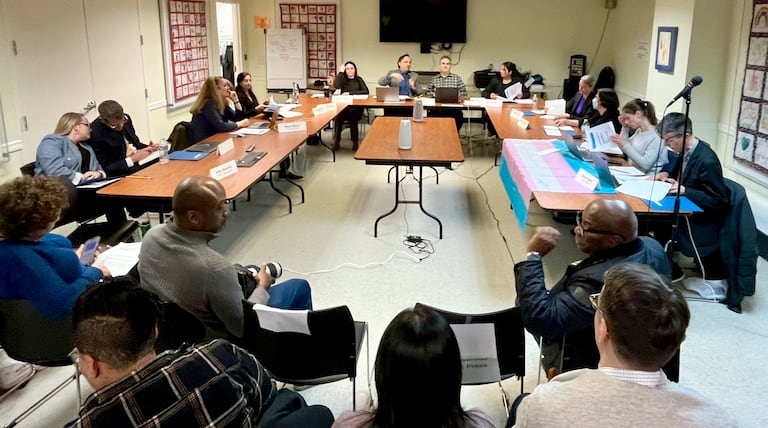
Department of Education officials Marc Sternberg and Paymon Rouhanifard address questions at a City Council hearing on school colocations.

Persistent concerns about school space-sharing got a fresh airing today at a City Council hearing about the Department of Education’s approach to co-locations.

The process by which multiple schools are placed in a shared building is at times controversial, most frequently when the department has proposed moving a privately managed charter school into an existing school’s building. It is also a cornerstone of the city’s efforts to expand school choice by opening hundreds of small schools.

Who decides where and when schools should share space could prove to be a litmus test for Democratic mayoral candidates, but so far, likely candidates have been hesitant to say where they stand. At a policy breakfast earlier this week, three of the candidates said they would consider giving district parent councils more of a decision-making role in school closures, openings, and colocations, but none said specifically that he would want the councils to be able to veto city plans.

Several State Assemblymen recently proposed a bill that would endow the councils with veto power. Separately, City Councilman Al Vann is drafting a city resolution that would call on the state legislators to amend the city’s school governance law to give the parent councils the ability to vote on both co-locations and school closure decisions.

At today’s City Council hearing, Education Committee Chair Robert Jackson argued that co-locations disrupt learning and exacerbate unequal distributions of resources.

“Problems can arise such as overcrowding, unsafe hallways, inadequate resources, friction over shared space, and a climate of mistrust and conflict,” Jackson said in his testimony. “Schools have to compete for use of common areas such as cafeterias, gyms, auditoriums, playgrounds and hallways. Scheduling becomes a nightmare.”

Jackson and several other city council members enumerated challenges at a handful of city schools where teachers and families have complained recently of colocation woes — among them the Spring Creek School, Brooklyn Community Arts and Media School, and P.S. 9. But Deputy Schools Chancellor Marc Sternberg and other Department of Education officials said that conflicts, when they exist, quickly fade away.

More than half of city schools — over 800 in total — share space with other schools, Sternberg said, but “we’ve talked today about just a half dozen. Regardless of the configuration of the school, when the adults show up to do school, the noise goes away.”

In response to the charge that colocated schools are squeezed for space, Sternberg referred councilmembers to the Blue Book, the city’s directory of building utilization data, and added, “Every school gets its fair share of space.”

And when Councilwoman Margaret Chin raised concerns about tension between school leaders at the Henry Street campus, which is preparing for Manhattan Charter School II to move in, Sternberg said, “We trust [all principals] to manage their schools, buildings and partnerships to put students first.”

Leo Casey, the teachers union vice president for high schools, was among the advocates and Community Education Council members who submitted testimony criticizing the current colocation process. In an interview, he told GothamSchools that he would like to see the city adopt a more judicious review process before proposing a colocation.

“Right now they throw the principals into untenable situations and then say it’s their responsibilities to make the best of it,” he said. “There clearly is another way to do it. We have great campuses in New York City. Julia Richman Schools includes three regular high schools, one transfer school, an elementary school, a D75 special needs program, and they all benefit from each other’s presence.”

  • Roma Giudetti

    The noises don’t go away, Mr. Sternberg just chooses not to hear them.  One signature characteristic of this DOE group is deafness to the complaints of parents, students, and teachers and a dogmatic insistence that everything they do works and makes schools better.

  • Ken Hirsh

    What are readers thoughts as to why colocations with charter schools are bad but colocations without charter schools are OK?  Can the argument be made in a manner that doesn’t attack charter schools for being charter schools?

    On a somewhat related note, is there an example of a colocation battle in which only regular traditional public schools (not D75 or transfer schools) are involved?

  • bee

     Co-locations are hard on everyone, no matter who’s sharing. The DOE’s idea of “usable space,” is laughable. With co-locations come lack of libraries, gym space, issues with lunch scheduling, and auditorium space, not to mention schools that are doing well have little or no room to expand.
    Public schools that are co-located tend to work out these issues a little more “amicably” than schools co-located with charter schools for obvious reasons that you apparently want to airbrush out.  Co-locations create unwanted competition for space and resources, and thwart schools from functioning optimally.

  • http://twitter.com/juniper9119 R

    I haven’t completely worked through my feelings on charters, but I am uncomfortable with charters getting space for free, colocated or not.

    I also don’t like that there is a recent track record of charters being granted in neighborhoods where there is a need for more seats, but very few families are interested in charters as an option.  I know that Success Academy is eying District 2 to open a charter school.  I went to 5 CEC rezoning hearings in the fall and heard hundreds of parents asking more seats and no one asked for charters; everyone wanted more zoned seats.  DoE reps at one meeting apologized for the lack of resources to create all the seats that were needed.  I don’t know how they can turn a deaf ear to parents and hand over scarce space to charters no one is asking for.

  • Michael M.

    Excellent first question.  
    My personal reason for bias is that I believe the DOE is biased.  I believe the DOE does not seem to be an impartial referree when one school is a charter.

    As to the last question, I would suggest that the reason there haven’t been non-charter co-location battles in the news is that either the news is biased, or the battles aren’t anywhere near as pitched. 

  • Michael M.

    Huzzah.

    DOE talks “choice,” but has selective hearing when parents voice same.

    Michael D. Markowitz, P.E.
    Member, CECD2

  • eme

    The problem is that charters are given preferential treatment by the DOE and there is zero accountability when it comes to charter school behavior in a co-location. They answer to no one while public school principals are under rigid control by the DOE.  THis is why colocations with charters are so problematic. 

  • Lisabdonlan

    I think, Ken, that  the comments below do a good job answering your question.
     Add to those that the DoE controls enrollment ( actual and projections) , which controls budget. DoE’s control of enrollment can be used to  create “underutilized” space. Charters are not restricted to the same admissions rules as district schools- such as district boundaries. That inequity can cause the charter to be the larger institution in a shared building which for DoE means rights to a bigger piece of the shared pie.DoE controlled admissions can also create higher percentage of students with high needs in district schools, while charters do not enroll a fair proportion of  high needs students.Charters can choose to cap class sizes.All of these factors which DoE could control to support our schools, can also be manipulated to set up a school for failure. Many people in the administration and in the larger community see evidence of a pattern whereby the DoE deliberately sets up schools to fail  in order to advance the political agenda of providing free rent to charter schools, as the ultimate favoritism. Add the lack of enforcement of the law passed in May 2010 stipulating that charter schools must recruit, enroll and retain an proportionate number of high needs students (ELL/ SWD/poverty) and you have more evidence of the uneven playing field the two types of schools compete on. District schools have similar budgetary concerns,  usually operate with  similar admissions policies and controls (controlled by DoE, generally via zoning) and are run buy school leaders who must follow the same play book and obey the same tyrannical bureaucracy that manages via fear and reprisal.Charter schools also  have a wholly different funding stream- they get paid several times  a year, based on enrollment updates, from  a different base amount calculated in a different year, and many times have access to large amounts of private resources that Boards and others interested in privatizing government bring to them. Lisa

  • Lisa Donlan

    Yes- a contentious charter co location  just approved by the PEP for a school opening in Sept 2012 is taking place in D1.
     There have been several media stories covering the parents, community and united elected officials’ opposition to the colocation of a charter w/ 3 district middles schools and a 6-12th grade school.
    No D75 or transfer school is involved but the community schools all serve a high percentage of high needs students- especially ELL and students with disabilities.

     The approved collocating school is a replication of a school that has operated on the LES about 1/2 mile away. The original charter school Manhattan Charter School serves NO ELL students. Not one. The school it has been taking space form since 2005 serves 13% ELL students, and the district average is 12%, while the citywide average is 14%.
     The charter reportedly serves 14% SWD,  all receiving only push in pull out or related services only, while our district average for students requiring CTT or self contained classroom teaching time is 19% w/ an additional 5-6 % for SETSS/ related services.

    Yet, despite the legal mandates for charters to recruit, enroll and retain a proportionate number of high needs students, this school was authorized to replicate: to serve a similar demographic w/ the same pedagogy and methodologies.

    Additionally, the charter school did very limited outreach in the community thus failing to engage the community in a through review and input process- perhaps because they knew legitimate questions and objections to these practices  would be raised. The charter management organization told electeds that they intended to rent private space when their budget had no provisions for rent and their application made clear their intention to colocate in a D1 public school.

    This charter fast track and skirting of the law was made possible by SUNY CSI . Interestingly many of the founding board members of this charter are from some of the big ed privitizers- Edison, SUNY CSI or CEI PEA., and include SUNY CSI acting Exec Director Susan Barker Miller.

  • Michael M. (parent still)

    Huzzah!

  • Roma Giudetti

    What are the protests against co-locations? Why not read the education petitions that thousands of parents across the city have signed to stop the various co-locations.  They give many reasons why parents don’t want their schools co-located with charters.  I would add, many times parents are not thrilled to have other public schools pushed into limited space.  The “noises” if that’s what you consider parents’ opinions, don’t go away, they are just ignored, but they are available to read on the Web  if anyone’s interested.  Here’s one petition folks signed to protest the co-location of Success on the Brandeis campus: http://www.change.org/petitions/stop-the-co-location-of-success-academy-charter-school-in-the-brandeis-high-school-building

Tips, questions, feedback?

Contact us at .

Word from Our Sponsor

Follow GothamSchools

RSS
Subscribe to the daily email digest:

Chalk It Up

Recent Comments

11 comments so far today

Archives

May 2013
M T W T F S S
« Apr  
 12345
6789101112
13141516171819
20212223242526
2728293031