GothamSchools — daily independent reporting on NYC public schools

among schoolchildren

Where digital natives roam, paper and pencil have a place, too

Back in September, when Nancy Amling first opened the doors to her new technology-themed high school in Chelsea, parents asked her what supplies they should buy. “I told them, ‘You don’t need supplies! We have laptops,’” Amling said.

Over the next few weeks, she and her staff learned that paper and pens have their place. But aside from the notebooks students carry around, almost nothing is traditional about Amling’s school.

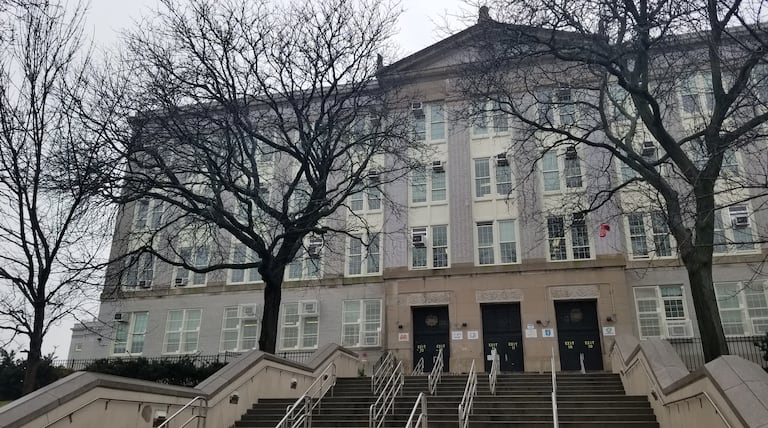
Located in the basement of the Bayard Rustin Education Complex, the Hudson High School of Learning Technologies is part of the city’s massive investment in technology and online learning, known as the iZone pilot. The pilot is funded with a combination of Race to the Top money, private donations, and city tax dollars.

Hudson High School is a “blended” school, which means its teachers combine face-to-face instruction with online courses and homework assignments. Each student has a laptop and every teacher has a webpage where they can upload assignments for students to access later.

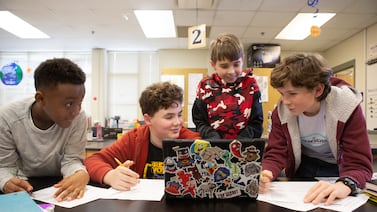
When I visited last week, students in a math class were progressing through a series of online word problems and drawing out graphs of the problems by hand. In a science class, groups of students were creating PowerPoint presentations about famous bacteria, such as the ones responsible for the bubonic plague, while the teacher floated from group-to-group.

Amling said one of the most surprising discoveries was finding how widely students’ Internet-savviness ranged. Of the 109 students in her freshman class, some showed up knowing how to design a web page, use Google Documents, and send emails with attachments. Others weren’t sure how to save a file to their laptop’s desktop.

“There is that expression: digital natives. But just because somebody knows how to send a text and get an email, doesn’t mean they know how to be digital learners,” Amling said.

Hudson High School is also textbook-less, a fact that has earned it considerable media attention. Instead of textbooks, students taking an Algebra class are enrolled in an online Algebra course. Through programs offered by Aventa and Compass, two companies that provide much of the city’s current online courseware, students can progress through a series of lessons at their own pace. The programs aren’t perfect, Amling said, and she hopes to eventually have her own teachers write online courses.

“What we find is the digital content is in its early stages right now,” Amling said. “Somebody once gave me the example of when they took radio shows and read them aloud on TV — in some way that’s what digital content looks like right now.”

Students mainly progress through the online courses at home, where the majority of them have Internet access. For the ones that have Internet but no laptops, the school has been able to give them take-home laptops that were donated. Amling said that some students’ parents had cable TV, but no Internet, and she’d been able to convince them to drop HBO in favor of getting their children online.

For all her enthusiasm about her school’s blended learning model, Amling said that if she had more money, she’d hire more teachers.

“Education is a combination of using the technology to support instruction, but it’s in the collaborative relationships where students are learning,” she said. “Because if that’s not where the important piece is, then why even have a school?”

  • Anonymous

    Technology will never replace teachers. And technology will not get that 40 watt bulb to emit 100 watts of power.

  • http://www.facebook.com/people/Leonie-Haimson/1094324158 Leonie Haimson

    Unfortunately, this model is being used by the DOE to replace the need for teachers and classrooms. And the state is enabling them by proposing to eliminate all requirements for seat time or class time. Its a disaster in the making.

  • Invictus

    No seat time requirement anymore and it is being advocated by the state? Then perhaps all sort of professionals who need to pass extensive tests and have years of on hands training would also be allowed to sign up for Izone anything….and be allowed to have the entire population as their “lab time.” Should we call this technology gone wild?

  • Digital Learner

    Oh please, that was a baseless retort.

  • Math Teacher

    So a math course can be taught by a computer. Seriously I teach math in public school, these math online programs are not helping but hurting the students. When these students get to college they will be sitting in my remedial math classes

  • Digital Learner

    Did you even read article? No one said computers were doing the teaching. I pity the students that do wind up in your remedial class.

  • Math Educator

    Actually, we’ve found that all this technology requires MORE teachers. Our math classes now have 2 certified math teachers in the classroom. Our roles as teachers have changed in the digital age. We are no longer the bank of knowledge (but perhaps this was the wrong way to look at education from the start!). Instead, we have to approach topics with “What does this mean in this case?” When comparing population growths between India and China within the past 50 years (we find all the data online AND have a conversation about reputable sources), we discuss what is the line of best fit? What does the rate of change/slope mean in this case? When will India’s and China’s population be the same? How do you know? Prove mathematically. (Yes, it’s a system of equations problem). These mini-projects are the basis of this digital math classroom.

    Math courses are absolutely NOT being taught by a computer. Rather, we set up a scenario such as the one above. We ask: what problem(s) or question(s) arise from this scenario? We all make predictions. And they set out to solve their own problems and questions with the aid of technology (and usually graph paper). To the contrary, we are developing math literate citizens aware of the many fascinating facets of mathematics!

  • Math Educator

    Actually, we’ve found that all this technology requires MORE teachers. Our math classes now have 2 certified math teachers in the classroom. Our roles as teachers have changed in the digital age. We are no longer the bank of knowledge (but perhaps this was the wrong way to look at education from the start!). Instead, we have to approach topics with “What does this mean in this case?” When comparing population growths between India and China within the past 50 years (we find all the data online AND have a conversation about reputable sources), we discuss what is the line of best fit? What does the rate of change/slope mean in this case? When will India’s and China’s population be the same? How do you know? Prove mathematically. (Yes, it’s a system of equations problem). These mini-projects are the basis of this digital math classroom.

    Math courses are absolutely NOT being taught by a computer. Rather, we set up a scenario such as the one above. We ask: what problem(s) or question(s) arise from this scenario? We all make predictions. And they set out to solve their own problems and questions with the aid of technology (and usually graph paper). To the contrary, we are developing math literate citizens aware of the many fascinating facets of mathematics!

  • Math Educator

    And students were NOT doing “word problems.” They had one big problem to solve: Will Willie Katchup catch up to Robin Banks? Given two pieces of info for each character, defend your answer. It’s a systems problem and it takes students a solid hour to predict, plan their course of action, and prove their solution mathematically in different ways (graphically, through a table, through equations).

  • Math Teacher

    Thank you for clarifying for me how these math programs are used at this school because at other schools they are used for credit recovery where they try to teach the material to the students.
    I actually agree with you Math educator because I use technology when I teach I use gizmos and geometers sketchpad and would love to make an online geometry course to complement and help teachers when teach geometry.
    But when I see the programs used in credit recovery and they pass and then end up in my remedial math classes in college where there are no calculators allowed and they are so dependent on the technology it bothers me.
    This actually sounds like a school I would like to work at.
    I’m sorry for comparing your program to other places that use this technology not the way it was attended to be used.

  • Math Teacher

    Why do you pity them all you need to get in the course is get below an 80 on the algebra regents, which most students get from credit recovery online programs similar to ones used by this school, but not used in the same way, which math educator clarified for me.
    Also after math educator clarified the article and looking at the schools website this actually sounds like a school I would like to teach at and us the technology to find ways to bring geometry and trig into my students lives.

  • Math Educator

    I also get frustrated with the “credit recovery” buzz and worry about mathematical understanding. We are in urgent need of rethinking mathematics education in the United States. We live in a time and place where it’s okay to happily say “I’m not good at math.” But Hudson HSLT is a very different place. We’re an inquiry-driven school that uses technology as a tool for deeper understanding and research. After all, students and adults have all the mathematical formulas they want at their fingertips via internet searches, et al. But now, our job as math educators needs to shift to meaning (both in practical and theoretical senses … not all math has to be real world!), problem solving, communication, and collaboration. What can we do in this situation? What is our prediction? How can we utilize all of our strengths in this problem?

    There is a great need for excellent mathematics digital content. I have worked through the content that has been offered so far and am VERY disappointed. This is why there is time set aside in my schedule to develop online curriculum with our amazing digital coach and co-math teacher. Please do create your geometry/trig digital content! (and share!)

    Also, you probably have already heard about Geogebra (free program available for download). We regularly use Geogebra (my fav program to use in class) and Excel (my co-teacher’s fav program to use in class) in class. More than ever, we need to share our resources and content!

  • Rcox375

    I can’t believe that teachers and educators are not supportive of digital learning. I am a student who uses these type of digital curriculum, and I LOVE IT. It is not to say that I no longer have a relationship with my teacher, rather I am able to work independently at my own pace and ask a question and get help from the teacher. Because of the technology I can now get one on one time, where in the traditional class, there was no hope. Unfortunately teachers far to often think about what is good for them, and not what the students like. Get with the program, we are surrounded by technology. Stop teaching like we are from the 1940′s.

  • http://sunsetspark.org Gaelen

    Light bulbs do not emit power. They emit light (lumens) and consume power (watts). Incandescent bulbs also emit heat, which, depending on the application, might be an unwanted by-product.

    Modern compact fluorescent and LED bulbs emit more lumens with less watts and no heat by-product. Their lm/W ratio is 3-5+ times greater than traditional light bulbs, making them much more energy efficient.

    So, technology can make a 40 watt bulb emit as much light as a 100 watt bulb. Maybe technology can help students learn more efficiently.

  • Rcox375

    Also, in regards to teachers creating their own content. They need to be honest with themselves. Nothing is going to be as good as a company can do. IF they think this, then why don’t kids create their own video games???

  • Math Educator

    Why not let kids brainstorm, design and create their own video games? If you can teach them how to do it, I’m sure it would be an adventure many would be willing to take on! What an amazing opportunity.

    Since the beginning of compulsory schooling, textbooks and their content have been controlled by school boards and companies. Teachers have been left out of the equation, and though there have been many reasons for this historically, I do not believe that lack of ability is one of them.

    Not all textbooks are created equal as I’m sure you have experienced as a student. To be frank, I think that most are horrendous. Some promote these awful “math tricks” that neglect true understanding of mathematics, some are drenched in pseudocontext, some claim to be real world but the problems are clearly forced and are counter to lived experience. There are some decent to amazing textbooks out there (in fact, I modify some of their activities for my classroom), but they often limit the teacher and the class to the textbook’s prescribed scope and sequence. And for all their prestige, textbook companies putting together work looks more like a factory (one person does this, another does t his) then any sort of collaboration, let alone scholarly collaboration.

    Given these hindrances, I think self-designed content is an amazing opportunity – for teachers and for students. It allows for deeper understanding of where you are and where you are going. I don’t include those awful “tricks” and steer away from false “real world” math examples. I design the sequence, activities, and labs the way my students need.

    Do not get me wrong – this is a lot of work! I work closely with my co-math teacher throughout the week and we often have GoogleDoc sessions where we brainstorm and put our ideas together during the weekend. Two amazing math coaches review my content, my principal reviews my content, our school coach reviews my content, the science teacher reviews my content. Together we make sure the content is right for our students and right for staff.

  • Math Teacher

    Is this school looking for more math teachers for next year because im getting tired of subbing do to this hiring freeze in most schools. I would love to send them my resume.

  • Rcox375

    Again, I don’t think you get it. Those companies (EA SPORTS) and digital providers have millions of dollars that they put into development that make them egnaging. I have seen teacher created things (Google Docs, Excel, Youtube, etc). It is not even close. Unfortunately it appears that you are doing what is best for you and not what the student would be engaged in.

  • Math Educator

    Rcox375 (I’m sorry it wouldn’t let me reply to your earlier comment). Perhaps my quest to gauge your interest in making your own video games didn’t properly show how short your analogy falls. IF textbook companies actually collaborated the same way, responded to feedback, and wanted to engage the same way that video game companies do, then I think we’d have less of a problem.

    But this is not the case. Textbook companies make millions of dollars yes, but they hardly put it back into creating these textbooks. Even worse, they are not updating their textbooks with new understandings or discoveries in the field, they simply use other textbooks and infuse the latest “fad” in education. On top of all that, math textbooks in this country stink!

    As Nobel Prize-winning physicist Richard Feynman said about math textbooks when CA asked them to assess them (he was not impressed) “The reason was that the books were so lousy. They were false. They were hurried. They would try to be rigorous, but they would use examples (like automobiles in the street for “sets”) which were almost OK, but in which there were always some subtleties. The definitions weren’t accurate. Everything was a little bit ambiguous — they weren’t smart enough to understand what was meant by “rigor.” They were faking it. They were teaching something they didn’t understand, and which was, in fact, useless, at that time, for the child.”

    There you have – textbooks “teaching something they didn’t understand”, “useless”, not “smart enough to understand what was meant by ‘rigor.’” This is not the content for our students! Especially when it has failed the majority of American math students.

    To the contrary to your statement, I am actually making it harder on myself and my colleagues. How much easier would it be to follow a textbook and supplement? Plenty! The resources you mention (YouTube, GoogleDocs, etc.) are a good start, but at our school we’ve got even cooler stuff – Geogebra (free download too!), homemade java apps, Adobe, and we’re working with video game design students at graduate schools for video game like immersion.

    For more information, please see http://www.popsci.com/scitech/article/2002-07/why-johnny-thinks-emc3 (follow the link for review of textbooks) or do a google search yourself. Educate yourself, Rcox375, be a digital learner!

  • Math Educator

    Rcox375 (I’m sorry it wouldn’t let me reply to your earlier comment). Perhaps my quest to gauge your interest in making your own video games didn’t properly show how short your analogy falls. IF textbook companies actually collaborated the same way, responded to feedback, and wanted to engage the same way that video game companies do, then I think we’d have less of a problem.

    But this is not the case. Textbook companies make millions of dollars yes, but they hardly put it back into creating these textbooks. Even worse, they are not updating their textbooks with new understandings or discoveries in the field, they simply use other textbooks and infuse the latest “fad” in education. On top of all that, math textbooks in this country stink!

    As Nobel Prize-winning physicist Richard Feynman said about math textbooks when CA asked them to assess them (he was not impressed) “The reason was that the books were so lousy. They were false. They were hurried. They would try to be rigorous, but they would use examples (like automobiles in the street for “sets”) which were almost OK, but in which there were always some subtleties. The definitions weren’t accurate. Everything was a little bit ambiguous — they weren’t smart enough to understand what was meant by “rigor.” They were faking it. They were teaching something they didn’t understand, and which was, in fact, useless, at that time, for the child.”

    There you have – textbooks “teaching something they didn’t understand”, “useless”, not “smart enough to understand what was meant by ‘rigor.’” This is not the content for our students! Especially when it has failed the majority of American math students.

    To the contrary to your statement, I am actually making it harder on myself and my colleagues. How much easier would it be to follow a textbook and supplement? Plenty! The resources you mention (YouTube, GoogleDocs, etc.) are a good start, but at our school we’ve got even cooler stuff – Geogebra (free download too!), homemade java apps, Adobe, and we’re working with video game design students at graduate schools for video game like immersion.

    For more information, please see http://www.popsci.com/scitech/article/2002-07/why-johnny-thinks-emc3 (follow the link for review of textbooks) or do a google search yourself. Educate yourself, Rcox375, be a digital learner!

  • Math Educator

    We are hiring for next year and will start the interview process within the next month. For more information, please see: http://www.hudsonhs.com/employment

  • Mathematics Teacher

    I’ve had the same experience regarding how disappointing most digital content is. However, I have discovered several quite decent ones.

    First is http://www.aleks.com/ which I have used with considerable success with a number of students. I wasn’t able to use it with all of my students because of the cost and my administration’s and department head’s insistence on sticking with their textbook driven curriculum. The one student, after using ALEKS for several weeks, told me that she used to hate math but with ALEKS she enjoys it because ALEKS gives her all the time she needs to learn at her own pace. All solutions must be entered by the student, including units when applicable. Not multiple choice like Compass’ Equation Invasion nonsense.

    I haven’t used this one personally. Heymath Algebra 1 and Algebra 2 were developed in coordination with the Westport Public Schools http://www.heymath.com/web/caseStudies/west_port.jsp?sourceID=US
    Here’s the link to their products page: http://www.heymath.com/web/products/productUS.jsp

    The previous digital content is web based. Neufeld Math: http://www.neufeldmath.com/ is server based and is more socially oriented in that 3 students work together cooperatively in a discovery manner on the concepts. Theirs is a blend of company prepared worksheets leading the discovery and computer.

    Check these links out for yourself. They may even be willing to offer a PILOT considering your somewhat unique situation.

  • Anonymous

    “But aside from the notebooks students carry around, almost nothing is traditional..”

    Pen and paper note taking in classrooms needs to be reexamined because it still exists out of tradition, not because it’s the best way. So the question is – what will replace pen and paper note taking? There are few digital options available, but mind mapping (visual organization and connection of key concepts) looks most promising and it’s already being used successfully by students.

  • Rcox375

    Math Educator….I completely agree with textbook companies. However, are textbook companies the same as digital curriculum companies? Like the one we use at our school. I believe there is a major difference. You are comparing the old with the new. To educate yourself, check out this recent testimony by Michael Horn (co-author of “Disrupting Class”) in front of the Oregon House Education Comittee. See http://www.cascadepolicy.org/2011/02/18/michael-horn-testimony-before-oregon%E2%80%99s-house-education-committee/.

    Also, I think it is great you are exploring ways to develop the digital content yourself and collaborating with others. You are WAY ahead of the curve than other teachers. All I would suggest is to ensure that what you are doing is better and provides better results than what a company may be producing.

  • Pingback: Where digital natives roam, paper and pencil have a place, too | GothamSchools « pedagogical ruckus

  • Math Educator

    In my experience with digital curriculum companies, yes, they are the same as textbook companies. It’s like taking a 1970s textbook and putting it online! (or as Amling said above, “Somebody once gave me the example of when they took radio shows and read them aloud on TV — in some way that’s what digital content looks like right now.”) Our school keeps searching for a digital company but to no avail. Some provide excellent video (along with the bells and whistle) but aren’t much more than that. Some are so dense in text. There is little to no customization available. Educators were not involved in the process and we’re back to the issue of textbook companies.

    We’ve tried contacting these companies to let them know when there has been a mistake here or there or when a video misrepresents a math concept, but we get no response and the digital content remains the same.

    As for Michael Horn, I’d just say business models don’t map on to learning models as well as he may think. And having explored my share of digital curriculum, his testimony, though moving in the sense that education is changing, does not invest me in prescribed digital curriculum.

    I’m certainly glad that you enjoy your digital curriculum, but we have not found such a digital curriculum that meet our needs. In the mean time, we’re building our own!

  • Pingback: On Our Minds @ Scholastic » In Our Feeds: Teacher pay, apps, protests, textbook-less schools

  • Jane Anderson

    This is a amazing concept. It would be wonderful to include even some small part of these progressive techniques of learning to our school district.

  • Pingback: February 27 2011 « bibblebabble

  • PatieV

    PatieV
    I love this concept and have been using some of these ideas for several years….and they work. I especially love how engrossed and involved the students become in their project based learning. I have created several STEM (Science/Technology/Engineering/Math)
    projects for grades 5-8 and the learning curve on the curriculum combined with the exceptional thinking out of the box that happens, is a joy to watch as a teacher. I usually form teams due to the fact that I do not get to have my students in class more than once a week.
    Last year some of my 6 grade students created a Wii game project. Another 8 grade group redesigned Coney Island, complete with robots running around a 12 foot by 4 foot 3D floor plan. Unfortunately the robots did not talk so they fund raised and bought 3 tiny recorders and tape them to the robots…..then people could take a complete robotic guided tour of the site.

    I use online courses for technology and now we have added Math and Science.

    As far as teachers not being able to do better than a company in creating online courses, I disagree. Give me a teacher with hands on classroom experience for several successful years and that teacher can create an awesome, meaningful online curriculum that will be embraced by the students. That teacher will know the demographics of the school, the background of the families, etc. and can integrate lots of funny, meaningful and rememberable moments in that online class that no outside, objective company could. That teacher will reach the students on a one-on-one sharing basis. This cannot be bought.

    Just some thoughts

  • http://twitter.com/JustineLom Justine Lombardi

    I agree with your assessment of text books. When I was a social studies classroom teacher my students had reading assignments but the text book was only brought out to punish misbehavior. History text books do not encourage critical thinking or seeing history from multiple points of view. the most common history text books in school are just well boring…
    Some how every year the texts get thicker and heavier with out actually adding anything of value. There are great products out there like Project look sharp but they are not sold by the main stream text book companies. http://www.ithaca.edu/looksharp/

  • http://twitter.com/JustineLom Justine Lombardi

    Some digital content companies are text book companies NovaNet is owned by Pearson. Their new content is rehash of the text books. Additional, it is one of the worse digital content packages to navigate through. The best digital content is from PowerSpeak, Aventa, Advanced Academics, FLVS, and OdysseyWare in my opinion and they are not owned by text book companies.

Tips, questions, feedback?

Contact us at .

Word from Our Sponsor

Follow GothamSchools

RSS
Subscribe to the daily email digest:

Chalk It Up

Recent Comments

14 comments so far today

Archives

May 2013
M T W T F S S
« Apr  
 12345
6789101112
13141516171819
20212223242526
2728293031