GothamSchools — daily independent reporting on NYC public schools

school closing season

Scenes from three hearings: Jamaica, Columbus and Robeson

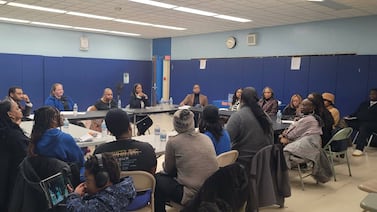
Jamaica High School students, teachers and parents cheer a speaker at the school's closure hearing last week.

Jamaica High School students, teachers and parents cheer a speaker at the school

For the past two weeks, education officials have spent nearly every weeknight holding public hearings at each of the 25 district schools the city wants to close next year. Seventeen of the schools are in this for the second go-around, after a union lawsuit foiled the department’s attempt to close them last year.

As a result, this year’s hearings are both formatted differently — part of an attempt to better explain the closure decisions and avoid another lawsuit — and less emotional, despite communities’ still-simmering anger and frustration.

GothamSchools reporters recently attended three of these hearings.

Jamaica High School

The group of students, teachers and parents that gathered in Jamaica High School’s auditorium was smaller than the large, boisterous crowd that packed last year’s hearing.

But, as several students pointed out, the school is also smaller this year. After the courts blocked the city from closing Jamaica and 18 other high schools last year, the size of the incoming freshman class shrunk dramatically.

Even before the school’s enrollment fell this year, students and teachers argued, Jamaica’s academics suffered from cuts that have forced teachers to salvage copy paper and reuse Scantron sheets for tests. When enrollment plummeted this year, the school was hit even harder, losing many of its teachers.

“Bring back Ms. Gordon!” students yelled as Dena Gordon, a former social studies teacher at Jamaica who was excessed last year after the school’s enrollment dropped, rose to speak.

Gordon compared her experience at Jamaica to the East-West School of International Studies, the small school where she teaches now. At Jamaica, she struggled to find basic supplies for her students; at the small school, she can summon a cart full of laptops for her students to use on short notice.

“I didn’t become a better teacher because I went from Jamaica to an A-rated school,” Gordon said later. “I am the same teacher. I am the same person. I bring the same skill set with me. The point is, you can’t say it’s the teachers or the students — it’s the way [the DOE] services Jamaica.”

Deputy Chancellor John White responded to the charges of inequitable funding by pointing out that all city schools receive their funding through a formula determined by the number of students each school enrolls. Other schools that receive the same amount of money per student boost student achievement far higher, he said.

“We know that we can do better here because there is proof that we can do better here,” White said.

Several teachers also suggested that one reason Jamaica’s graduation rates have fallen behind those of other city high schools is that the staff refuses to give students passing grades they haven’t earned. Teachers often repeat anecdotal stories about being pressured into granting students passing grades in order to boost schools’ ratings in the city’s accountability system, and the practice drew renewed attention last week after the city opened an investigation into grade inflation at the Theater Arts Production Company School following a report in the New York Times.

Signs waved in the Jamaica’s audience read “Persistently honest diploma” (a play on the “persistently lowest achieving” status that has been assigned to Jamaica).

Ali Khawaja and Vasudeo Ramsoroop, two juniors at the school, said that they thought the smaller schools that share Jamaica’s building were giving their students a better education than many students at Jamaica receive.

“But they have way more resources, and it kind of increases their motivation to do better,” Ramsoroop said.

And, the two said, they preferred to have the city fix Jamaica while they are still enrolled than to provide new options for future students.

“I’ve been here for three years. Why can’t they just make our program better?” Khawaja said. “Why do they have to make a new one and put more money into that? They work on grants; why can’t they get a grant for us?”  —Maura Walz

Columbus High School

Last year, when staff and students at Columbus High School in the Bronx fought against closure the first time, the hearing went until midnight. This year’s hearing fell two hours short of that mark. This was due in part to some school-closure-fatigue students and teachers said they felt after fighting with the city for nearly two years.

But it was also because Columbus’s principal Lisa Fuentes is trying to convert the district-run high school into a charter school, giving the schools’ defenders hope and lessening their anger and resentment. Only once did students’ yells overpower the voice of a city official — at many closure hearings, the booing is a near-constant. People mostly did not have to be reminded that their time at the mic was up. A few students taunted Department of Education officials for spending too much time on their Blackberrys or (appearing to) be asleep. But in general the crowd was passionate, not hostile.

For their part, DOE officials let the hearing take its course as though it was an act of catharsis they were administering. They answered questions in a quiet monotone and avoided contradicting speakers’ claims.

Columbus’s School Leadership Team focused not on the school’s possible closure, but on trying to convince the panel of city officials before them that becoming a charter school would change Columbus for the better. They argued that Columbus has been given the highest concentration of needy students of any high school in the city and few resources to help them. As a charter school, they wouldn’t have to admit over-the-counter students who show up after school has begun and are often years behind academically.

“Charter conversions are public schools that have sought to do things differently and have found that the benefits of independence outweigh the additional responsibilities,” Fuentes told the city officials. “That’s exactly what we’d like to have the opportunity to do.”

It will take more than the city’s approval for Columbus to get the go-ahead to convert into a charter school. By law, more than half of students’ parents have to vote in favor of the proposal.

Columbus teacher Christine Rowland came prepared to the hearing with a handful of her students’ papers. The city had compared Columbus to Truman High School “unfavorably,” she said, but Columbus has more low-incomes students, which makes a difference in the classroom. She’d asked her students to write brief responses to why they hadn’t done their homework and she read these aloud.

One student wrote: “I didn’t make my homework because I work. I have a little job. I work after school in the Bronx. I only work in the Bronx two days: Monday and Tuesday. And I have my break day Wednesday. Also, I have another job in Yonkers, where I work Thursday, Friday, Saturday, and Sunday.”

Another answered: “I recently lost a brother and I’m not living in my own home. I’m staying with my grandparents and with family. It’s been so crowded, I haven’t really been able to do my homework. It’s not peaceful.”

State Senator Jeff Klein, a Columbus graduate, also put in an appearance at the hearing to back Fuentes’ charter school plans.

“This could bring, I think, a new renaissance to Columbus high school,” he said. ”Bring Columbus High School back to the way it used to be. We still have the students. Their names may have changed, but they’re still the type of kids that we want to make sure are our future.” — Anna Phillips

Paul Robeson High School

Many of the 100 people who turned out for Paul Robeson High School’s closure hearing on Friday seemed resigned to the school’s fate.

“It’s a done deal,” said a parent. “We all know it’s a done deal.”

Like Jamaica and Columbus, Robeson is one of 17 schools that the city is trying for the second time to close, after a judge voided the closure decision last year for procedural reasons. “Roughly half of the kids who come to this school will graduate,” Deputy Chancellor John White said at the hearing. “Our goal is to change the outcome for kids.”

But academic performance wasn’t the focus for most of the roughly 50 people who spoke at Friday’s hearing. Instead, opponents of the closure plan, many wearing black armbands, took aim at the process by which the city has moved to close the school. Teachers charged that efforts the city said it had made to help the school never happened, and an assistant principal pointed out that the city isn’t trying to close other nearby high schools with lower graduation rates.

Department officials said they would provide evidence that the city tried to help Robeson improve before the Panel for Educational Policy’s closure vote scheduled for February 1.

If the panel approves the city’s closure plan, Robeson’s building could soon be home to a technology-themed school. According to an internal DOE document obtained by the New York Times, the city is planning to install a new, IBM-supported school that goes up to Grade 14 in the space that would open up as Robeson phases out.

More than a few community members expressed concern for the students who would attend Robeson during the phase out. One man, who claimed to be a teacher from a current phase-out school, described his job as “one of the worst experiences of my life.” Teacher Stephanie Siegel asked how the phase-out would affect neighboring schools.

During the question and answer session, White addressed these concerns. “The challenges next year will be the same as the challenges Robeson faces this year,” he said.

Many in the audience were audibly unsatisfied with his response. — C.W. Arp

  • Ellen

    the city is planning to install a new, IBM-supported school that goes up to Grade 14 …
    I am confused, grade 14, does this mean a junior college as well?

  • Math Teacher

    yes

  • Bronxactivist

    This is sad that these public officials that are not parents, educators or students are so bold headed to ignore the community to prove a point. That they will do as they please because they are the bosses. They rule and the community is ignorant for just wanting more resources. That is a flaw in the funding formula that its per student as opposed to need. A high poverty area would need to provide rap around services as opposed to a population that has already more services and stable households. Instead schools in high poverty areas are penalized and in essence are doing more with less because need is greater. Do not worry i believe in karma and what goes around will come around.

  • SLT Member

    I remember when Mr. Nadelstern came to visit Christopher Columbus High School back in 2001. He met with the principal at the time along with the SLT and students. His plan was to destroy Columbus and chop it up. He told the principal (behind closed doors) that if he wanted the school to remain open, he would agree to the small schools coming in. It was his job OR the mini schools. Mr. Nadelstern made this very clear and here we are 10 years later. This is the honest truth and I hope Eric is reading this because he will clearly remember that day as he sat in the principals office and ignored everything. Its stories like this that are real and not fabricated. I was there, sitting in that office when his plan to destroy Columbus was evident. Those of you reading this should know that Christopher Columbus High School was set up personaly by Mr. Nadelstern. In 2001, the school was thriving and we were viewed as a powerhouse with a strong community from the Pelham Parkway area. Now we are closing because the other mini schools in OUR building that Mr. Nadelstern created, took OUR top students and became A schools. We then started taking over-the-counter kids from an hour away, fresh out of facilities, and fresh off the planes from other countries, thus becoming a D school. I remember that day 10 years ago when that decision was made before the meeting even took place. The principal at the time was set up and the principal now received the same treatment. 10 years later – same story.

  • http://pfsany.org Mary Conway-Spiegel

    Any parent/guardian, educator, policy maker or humanitarian would have been moved by the testimonials, passionate statements, the Christopher Columbus Charter Proposal, the Live Marching Band and and Cheer Squad at Columbus last week.  It was heart wrenching to feel such pride, deep sadness and frustration all at the same time–these hearings hurt, this process hurts…right down to the core.  How can so many be wrong and so few be right?

  • Retired CCHS Teacher

    @SLT,
    That is a great story and it actually is true as it was just confirmed by a very reliable source. I dare Mr. Nadelstern or any other official from back then (Mr. Wexler, Ms. Rodriguez, Etc) to challenge this. Just wait until it really breaks on February 3rd and Columbus is annonced as closing. You will then hear everything that happened to this school which is limited knowledge. You will be amazed what will be written on Gotham and beyond the morning of February 4th!

  • Mrs. N.

    Wow nobody wrote anything after that statement huh?

Tips, questions, feedback?

Contact us at .

Follow GothamSchools

RSS

Chalk It Up

Recent Comments

0 comments so far today

Events Calendar

Our Twitter Updates

Archives

February 2012
M T W T F S S
« Jan  
 12345
6789101112
13141516171819
20212223242526
272829