GothamSchools — daily independent reporting on NYC public schools

talking points

City official and biggest critic find slivers of common ground

Put the Department of Education’s Deputy Chancellor for Accountability Shael Polakow-Suransky in a room with Diane Ravitch, one of the city’s most outspoken critics, and you might reasonably expect sparks to fly.

But when NYU’s Wagner Education Policy Studies Association put them together on a panel earlier this week, where they agreed turned out to be notable.

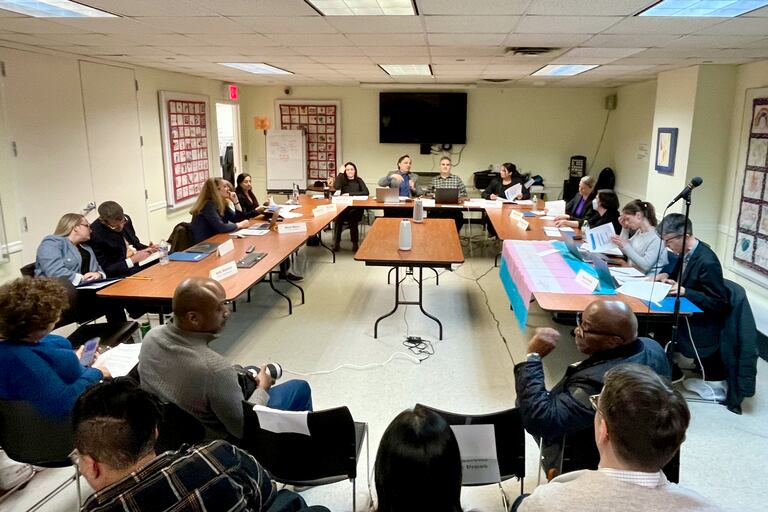
The topic of the panel was how federal involvement shapes local education policy. (I moderated the panel; Evan Stone, the founder of Educators 4 Excellence, also spoke.)

Ravitch opened by sharply criticizing the move to hold teachers and schools accountable for their students’ scores on standardized tests. But when talk turned to how future standardized tests should be built, Ravitch and Suransky agreed with each other. Ravitch said:

I’m very supportive of the idea of developing new assessments, and I think it’s a very important thing. But it will take years.

Just as these common core standards were written in a little over a year — it took me three years working on the California history standards. I worked on history standards in other states, and it was never done in only a year. So I would like to think that it’s going to take a lot of time to do this well because anything that’s done hurriedly is not going to survive….

I’m very happy that there’s money out there to develop new tests, but don’t think that they’re going to be available next year or the year after. If they’re good tests, it could be three to five years. And then they have to be tried out….So this is not going to be in time for the next election.

Suransky, who is working with one of the groups of states using federal funds to design new tests, responded:

I would agree with that statement, and I think we might have actually some common ground on those points.

The one point I would like to emphasize, though, is at the same time that this work is underway — you can only get to good assessments through going through the deep process that you describe. That has to happen and that work has begun. And so I think that’s promising.

There’s no reason why we have to wait to begin working with teachers and kids on the kinds of skills and the kind of practices that they to engage in. And so I think that even though it will take time for the state to get its act together and for the national consortium to field test — and that’s why it’s going to take four years — there’s nothing that prevents schools and school districts from engaging deeply on this work now.

And I think that’s part of that intent, because ultimately the reason for assessment is to motivate what happens in the classroom. If it doesn’t actually lead to good practice in the classroom then it’s undermining practice in the classroom. And so this is an opportunity. This is a moment where there’s an opportunity to shift the direction of practice in the classroom and to push on the level of rigor and to actually figure out what is it that kids and teachers need in order to engage in that type of practice.

Ravitch and Suransky also weighed in on whether the city should release the names and performance ratings of thousands of city teachers. After several city news outlets requested the scores through freedom of information requests, the teachers union sued to stop the city from releasing the ratings. The city agreed to wait to release the scores until a hearing in court next month, but Chancellor Joel Klein has come out strongly in favor of publicizing the ratings.

Suransky explained why the city had been hesitant to release the scores with teachers’ names in the past, but why he thinks it should do so now:

We’ve had the scores for two and a half years and we haven’t made them public up until now because of two reasons. One, we don’t want an individual teacher to get called out in public in a way that is disrespectful and attacking them; and second, we know there is a tremendous amount of context that needs to be understood around the scores and we were still working on fine-tuning the tools. And they’ve gotten a lot better based on the feedback of principals like [P.S. 321's] Liz Phillips….

But if it does come out I think that what we will show when we release it is: we’ll show those confidence intervals, we’ll show what the error band is around each teacher’s scores, we’ll talk about how schools are using that data; and I think that it may have a value for many parents. Because honestly if I was a parent, I don’t know that I would feel good about the Department of Education deciding that I wasn’t smart enough to figure out the nuances of this data. And I think that a lot of parents would like to know it, and so we’ll need to work with the community to help them understand it. That isn’t the choice that we would have ultimately made, but it seems to be the choice that we’re bound to make under the law.

Ravitch responded that while she does think teachers’ value-added scores have some use, they should not be published in newspapers:

It’s the release of the names that I find objectionable. Because suppose you then have smart parents — and by the way, the DOE has never cared about what parents think about anything up to now, except to get the names and test score data for their teachers — but supposing parents are really smart, and 90 percent of the parents want 10 percent of the teachers. This seems to me it’s going to be a problem….

I think the supervisor should use these numbers to make judgments about tenure, to make judgments about who gets due process and who doesn’t, who should be fired and who shouldn’t — it seems appropriate to me, in the context of having sat in the persons class. But to make them public creates the kind o situation that the LA Times did, where — you may or may not know this — a teacher there committed suicide.  And he had been rated less effective by the Los Angeles Times, not by his supervisors. The deputy superintendent John Deasy said that his personnel files showed that he had very high ratings; he was considered one of the best teachers in the school. And he took it very seriously when there was a published database calling him a less effective teacher.

Now maybe he committed suicide for some other reason but his family and colleagues said this was incredibly depressing to him. He was working in a gang infested neighborhood, fifth grade teacher for 14 years, and his colleagues said he was the one who went after the toughest kids and brought them back. And he committed suicide. Was that because of publishing his score and humiliating him? I don’t know, but I think you have to think about all the consequences not just the ones you intend.

  • Smith

    I know I’ve said this before, but I love how the DOE’s “accountability” guy was the one who wrote a piece for this blog and then refused to answer our questions.

  • Pingback: Spider Pictures | Car Scratch Remover What You Need to Know About Avoiding the Most Common Type of Car Scratches | Spider Pictures

  • Mustafa

    What qualifies Evan Stone to speak on anything related to education? His hedge fund TFA backers? The fact that he taught for two years before leaving the system this year? (Sarcasm alert.)

  • Ellen

    Only if the City releases the “scores” or “measurements” used to determine the effectiveness of every City employee…by name and title….that’s when the teachers scores should be released.
    And I am not at all sure about the number of FOIL requests from media outlets. Do two papers owned and operated (and I use that word loosely) by Rupert Murdoch meet the criteria for media outlets or for jingoism?

  • I noticed that…

    Mustafa,

    Give Evan Stone (founder of Educators 4 Excellence) two more years and he’ll be deputy chancellor of the Development of Education Pomposity and Haughtiness. His program will work with TFAs with less than 3 years in the system. Those candidates will pay dues to his organization and not to the UFT. By doing this they will have a guaranteed seat in his program, which is aligned to Klein’s Leadership Academy.

    In 5 years this will be the only program where TFAs will run the DoE, traditionally trained teachers in the trenches will have a job, but it will not be guaranteed. Eventually, no tenure, no seniority rule, no union, and the turnover rate at the end of each school year will be at 100%.

    So this is the devolution of teaching, education and the union!

  • http://www.charterreformer.blogspot.com John

    I usually like what Ravitch has to say, but arguing against the release of value added scores because an L.A. teacher committed suicide seems like one of the weakest arguments. Should newspapers not publish any information that could be upsetting or embarrassing? Obviously not. In addition, no one knows what that man was thinking when he decided to take his life.

    Here are 3 much stronger argumenst against the release of value added scores with teacher names attached.

    1. It would subject teachers to a level of public scrutiny that no other public employees face. I would like to know the number of civilian complaints each police officer has accumulated. I would like to know about the performance of surgeons in public hospitals, and I would like to know the physical fitness test results of fire fighters in my neighborhood. Teachers deserve the same right to privacy in their jobs as any other publicly funded employee. If teacher’s performance ratings are released publicly, than so should every other publicly funded or supported employee.

    2. The scores don’t take into account many other people’s ratings that are “hidden” within one teacher’s value added score. An 8th grade student will do better in English if they have an effective social studies teacher that has the student’s reading and writing in their class. If the social studies teacher is ineffective that will have a negative influence on the English teacher’s value added score. The same applies to administrators hidden value added scores. Having an administrator that loads a class with emotionally disturbed children, or insists that a teacher uses books inappropriate for the students will negatively affect the teachers value added score. This problem is exacerbated by the fact that the only teachers whose value added scores are measured are the English and Math teachers. If we believe that all teachers play a role in shaping students than it is not unfair that many other teachers, guidance counselors, social workers administrators and deans scores will be hidden within the English and Math teachers scores.

    3. Releasing these scores would create an unmanageable situation in schools. Parents would request specific teachers for their children. Not every child will fit into the the highest scoring teacher’s classroom. In addition, the highest scoring teachers should be the one teaching the student’s whose parents are not involved in their education. I would also imagine a bit of a self fulfilling prophecy for students in the low scoring teachers classrooms. Students and the parents of students in those classrooms will have an easy excuse for not performing to the best of their ability. They will have the same excuse that politicians, and district administrators use for their poor performance in managing schools. “It’s the teacher’s fault.”

    4. Value added scores are notoriously unreliable with something like a 30% margin of error.

    5. With so much riding on one standardized test, teacher’s game the system, focusing exclusively on getting students to pass the test. Forget critical thinking, original thought or authentic skills necessary for success in the world, students are only taught strategies to beat a test. I know, I did this. I taught my students an introductory paragraph for a regents essay with a ___________ in it where they could fill in the theme. Does it help them pass a test, Yes. Does it help them do anything else, No.

  • http://www.charterreformer.blogspot.com John

    oops… 5 stronger arguments.

  • I noticed that…

    John,

    You brought out the best arguements so far why everyone should be “against the release of value added scores with teacher names attached”. Argument #1 makes a very strong point. Thank you.

  • jodama

    Yes, I agree.  I thought Ravitch’s response was weak.  The fact is that as a parent, Joel Klein hasn’t given a hoot what I think or feel about my child’s education.  I’m lucky to have a good school to send him to, and I’m quite happy with his teachers and the principal.  If I wasn’t, I’m sure I would have no recourse.  So why if he hasn’t cared about what parents had to say for 9 years, suddenly is it so important for us to know the scores of the teachers who work with our children?  It’s ridiculous.

  • HM

    And how about educating children in and on toxic buildings and grounds??? The public seems content with this. Strange!

  • stunned

    Why are teachers dancing around the most important point regarding this entire mess? While teachers may have some impact on individual students, it is primarily the parents who have the most profound effect on their own children. Accepting the premise that a teacher has more profound influence than the parents on any one of the 30 plus students in any class over a span of 45 or so minutes per day is ludicrous, at best. Even the best teachers among us can’t spend more than a few precious seconds with any single student before all whine for our individual attention. We need to reject the argument that places us in the societal crosshairs as public enemies. But again, given inordinately high divorce rates, parents competing with their children to be young and hip, parents placating children by giving them everything they want while requiring nothing in return and generally avoiding any meaningful disciplinary role, parents know deep down that they are guilty of poor parenting. It is no surprise, at least to me, that many of these parents are eager to shift the blame for this problem onto someone else’s shoulders even though they bear responsibility for raising nasty, disrespectful and unmotivated children.

  • miss teacher

    Stunned, I don’t think any teachers are dancing around the issue of the students’ home lives and the challenges they present. But the mayor and chancellor aren’t interested. And it’s not very P.C. to point fingers, so the media stays away from that issue as well. As a teacher who’s tired of being beat up, I really don’t want to see the same happen to parents but I do with more was done to encourage and support their participation on the part of the mayor and the city.

    I would have liked to hear what Evan Stone had to say. As someone who taught for a few years and then left, he must have some wisdom to impart on us experienced veterans.

  • http://charterreformer.blogspot.com John

    Teachers aren’t dancing around that issue, but at least one principal with a regular column here is.

    See: http://gothamschools.org/2010/10/20/teacher-leadership-and-change/

  • http://ednotesonline.blogspot.com/ norm

    So Evan Stone is invited to speak on a panel with Diane Ravitch and Suransky, a compliment to the bias shone in Elizabeth Green’s NY Times mag article on teacher training where she also seemed to lose the names and numbers of the enormous number of experienced teacher bloggers in NYC. How about Mrs. Mimi from Flowers and Sausages or Arthur Goldstein or Julie Cavanagh – I could go on.

Tips, questions, feedback?

Contact us at .

Word from Our Sponsor

Follow GothamSchools

RSS
Subscribe to the daily email digest:

Chalk It Up

Recent Comments

0 comments so far today

Archives

May 2013
M T W T F S S
« Apr  
 12345
6789101112
13141516171819
20212223242526
2728293031