GothamSchools — daily independent reporting on NYC public schools

guest perspective

In Our Online Learning Experience, More Ups Than Downs

The comments left on GothamSchools’ recent coverage of the Innovation Zone raised questions about the value of online learning similar to those we hear from our students and their families. As co-principals of the iSchool, a two-year-old school built around using online courses to individualize student learning, we thought it might be worthwhile to share the reasons we use online learning and how it works in our school.

Online learning means many different things at different schools. At the iSchool, we use the term to refer to courses where the content is delivered online only, and the teacher and student are not online at the same time. Each of our online courses is facilitated by an iSchool teacher, licensed in that content area, who designs the course, tracks student progress, and meets with students individually and in small groups when necessary. Our students spend about seven hours a week learning online at their own pace. Because of state regulations about awarding credit, these hours take place during the school day.

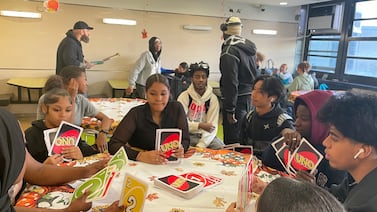
What does this look like inside our classrooms? Picture a traditional classroom with 34 students sitting in rows. Each student has a computer out on his/her desk and a notebook for taking notes. Each student is doing something different — some are watching a video of a teacher lecturing about the First Constitutional Convention (which students are pausing each time they take notes), some students are working on math problems, some are reading literature texts, and some are labeling the parts of a cell on a digital image.

We chose to incorporate online learning in our model for several important reasons:

  1. Learning online is — and will continue to be — a reality for the world in which our students are growing up. Our students will be required to learn online during their college and graduate school experiences, as well as throughout their careers. If we are to prepare them to be successful in their future endeavors, we must prepare them to be successful online learners.
  2. Learning to make sense of online texts and resources is a critical skill for our students’ academic success as well as their ability to be literate citizens of the 21st-century workplace and global community. Reading and analyzing online material requires development of the same skills that will facilitate their success with more traditional paper-and-pencil academic tasks and standardized tests.
  3. Online learning supports one important tenet of iSchool’s mission: to individualize our students’ high school experiences. Online learning enables students to progress through coursework at their own pace, to take courses when they are ready, and to more easily and readily have their learning presented in ways suited to their style and needs, through the use of audio and visual features.
  4. Finally, online courses broaden the curricular options available for our students. As a small school, we are limited both in funds and personnel. By offering our students the opportunity to take coursework online, we can offer Advanced Placement and college-level courses in any area to our students. This means that our students can pursue in greater depths those subjects of interest to them. It also means that our students will enter college ahead in credits and graduation requirements, increasing the likelihood that they will be successful in and complete college in four years.

While the argument for incorporating online instruction into students’ high school experience is compelling and strong, online learning isn’t easy for the teacher or student. Our students often tell us it would be so much easier if someone would just lecture at them and tell them what to memorize. Indeed, it would be easier, but we don’t embrace online learning at the iSchool to make learning easier. Of course, online learning does not in and of itself make classes rigorous, but used correctly, online learning enables each student to work on the content on which he needs to work — providing a level of individualization that is just not possible in a classroom with even the most gifted or experienced teacher.

At the iSchool we spend a great deal of time determining what kind of content is appropriate to put online, and what learning can best occur when directly facilitated by a teacher. What we’ve learned is that students do not need teachers to help them memorize low level content (e.g. that 2×2=4), but teachers are necessary to help students understand the reasons for (e.g. why 2×2=4) or the application (e.g. what we can do with this understanding) of this low-level content. Our students don’t spend less time in classrooms with teachers because of their online coursework; instead, time in classrooms focuses on developing students’ higher-order thinking skills (synthesis and application), rather than on drilling on content. We know that a computer will (likely) never be able to pass on the kinds of discussions, interaction, and skill development that can occur in the presence of a great teacher, but why waste our great teachers and valuable time on memorization and test prep?

As with any new instructional approach, we all have much to learn as we begin to implement it. Many of the concerns raised by GothamSchools’ readers are real and reflect the type of challenges teachers deal with every day, although they are not dissimilar to those faced by teachers in traditional classrooms. In fact, while students easily grasp the reasons and benefits of online learning, they experience much more difficulty adapting to the role of online learner. Online learning requires significantly more independence, self-discipline, and time management than has likely been required of students in their previous education and many of them struggle with this at first. During the past year, we have discovered several common factors that cause an iSchool student to struggle in their online classes:

  • Students look at the timeline presented in the course, but do not abide by it, thinking there is no “class” to attend.
  • Students think that they are invisible to the teacher and do not have to participate according to the guidelines.
  • Students don’t use the available tools to track their progress and access help when required.
  • Students forget that a real person is evaluating them, and may be tempted to turn in lower-quality work, use others’ work, or skip assignments altogether, thinking that nothing is “due.”
  • Students forget that online classes also have homework and don’t spend the time required.

After noticing the pattern of these common struggles, we put in place several structures to support students as they develop their online learning skills:

  • Each online course has built-in hints and tips to provide immediate assistance when a student is “stuck.”
  • Each online period has a proctor, who can assist students with technical issues, or provide general course help.
  • Online course teachers are available during office hours for students who wish to “drop in”; teachers also regularly mandate students to attend special online support sessions during office hours.
  • Students participated in tutorials at the beginning of the year with hints and strategies for online success; ninth-grade students spent additional time in class discussing online learning and strategies for success.
  • Students reviewed expectations for online coursework in Advisory, and were asked to sign an online learning contract.

While we have figured a few things out, we still have much to learn about how to be more effective online instructors and learners. For the iSchool, the benefit of the new iZone is that we will now have a community of schools who are thinking of the inherent challenges (which are far outweighed by the benefits of online learning) and working together to come up with solutions. We will also be working together to develop the best online curricula that will provide a broader range of courses and a more personalized high school experience for New York City students. Having teachers from different schools work together on curricula and pilot them with students in a variety of contexts will allow us to more efficiently design curricula that are effective across the broad range of the city’s student populations. Working together, with systemic support for the development of more innovative learning experiences, will enable all of us to do a better job of preparing our students for college and the future.

  • Redpoint

    What kind of student/personality most benefits from this kind of system? For example, I’d imagine a socially timid student would gravitate to this system, and might do well academically, but it might not be the thing he/she needs to grow personally. I understand your school also has group projects and discussions to balance things. But have you noticed a pattern with certain types of children thriving and certain floundering? and not just academically.

    I also have to add that when I toured the school with my daughter last Fall, the thing that bothered me about the curriculum was the kids studying world languages with Rosetta Stone.

    One more thing–I think the rote-learning tasks, test prep, etc. at the high school level should be done as homework, not during class time anyway. Class time should all be about higher-level work anyway . . . so is this really a benefit at the ischool?

  • http://www.classsizematters.org leonie haimson

    I agree with Redpoint. Apparently, the principle behind online learning, according to the above, is to spend “time in classrooms …on developing students’ higher-order thinking skills (synthesis and application), rather than on drilling on content” and the authors agree that “a computer will (likely) never be able to pass on the kinds of discussions, interaction, and skill development that can occur in the presence of a great teacher, but why waste our great teachers and valuable time on memorization and test prep?” Then why waste time in school on memorization and test prep at all? Here it is clear that the online courses do not require more “rigor” as its supporters maintain; but are simply a way to save money — to offload students onto computers to perform grunt work and test prep that should not be taking up classroom time in the first place. Again, these people skirt the real issue. How much classroom time are kids getting with an actual classroom teacher in these schools? Could the authors respond? It seems to me that a quality education depends on receiving individualized and ongoing instruction from a real-life, bonafide qualified teacher, and not from an online tutor of questionable competence or a software program. But that would require smaller classes, which the DOE remains fundamentally opposed to providing, despite the law that requires them to do so. Instead, they are resolutely moving in the opposite direction.

  • http://www.SpecialEducationMuckraker.com Dee Alpert

    Obviously I “do” on line learning, since I’ve read (and presumably digested the contents of) your piece and am responding, both in an on line environment.

    Since you’re in Year 2 of your project-pilot-school, you should already have data available showing how it’s going. Much of this would be required to be reported publicly at some point anyway, with proper student confidentiality protections in place, so why not make it public now and let us all watch how this experiment goes, and grows, in an informed way.

    Kids take any of these courses and pass any mandated tests? Kids drop out or be discharged, to go elsewhere, because this model doesn’t work for them? Type(s) of kid(s) it seems can v. cannot handle this kind of learning environment? Progress – however you measure it – for kids who scored at various levels on prior ELA and math tests? In-person physical attendance in your school? Undsoweiter.

    Without the numbers, I’m afraid that folks who support, as well as folks who oppose, on line earning programs will be able to make your school a pawn in their collective argument.

  • anonymous

    Dee- The school is a high school in it’s second year. Last year it would’ve only had ninth-graders last year, so the available performance data would be pretty limited. What exists, in terms of comparable data, is on the school’s progress report which is on the school’s website. i was curious and looked it up after seeing your post. 93% of kids earned 10+ credits last year; 90% of kids in the bottom third earned 10+ credits. The school outperformed peer schools and the city on both these measures. About half the kids passed regents in math and science and about 70% passed global history. That’s about average for math and science compared to peer schools, it’s somewhat above average for peer schools in terms of global. The school outperformed the city in all those subjects, which is not terribly surprising as it is a screened school with a relatively high-performing group of kids on enrollment. The peer score was 3.19, which means most entering students last year were low-level three in math & ELA. The peer group, however, includes other high-performing schools like NEST+M, Eleanor Roosevelt, and Beacon (to name just a few).

    It sounds to me like the school is doing pretty well, not extraordinarily well, but reasonably well, based on limited available data. At the same time, I think there’s no great surprise that the school hasn’t released any sort of major evaluation because it’s too early. And the fact that the DOE wants to replicate it at this relatively early stage isn’t terribly surprising because a fair and thorough evaluation would benefit from analysis of the model at a scale beyond one school.

    The thing about this model is that it makes me terribly squeamish, but at the same time, I look at my own kids, and recognize that there is something about computer-based learning that attracts them and engages them in a really profound way. I find it a little disturbing personally because it’s not what engages me, but I also recognize that their interest and enthusiasm for computing ultimately translated into appreciation of the things that I do value. For example, both my kids learned to become proficient readers at an early age (before kindergarten) through computer-aided learning. And now, they’re both voracious readers of BOOKS…and they’re more than capable of having deep thoughts about those texts, which they sometimes discuss with friends online.

  • http://www.classsizematters.org leonie haimson

    Anonymous: I agree that it is too early to base anything on the results of this school, which is even more reason to wait until we do have reliable results before expanding the model; though DOE seems intent on replication before any evidence is in. But I disagree with your point about credit accumulation. Credit accumulation at any school but particularly this one has become meaningless since DOE does not report on credit recovery. In fact, the methods that other schools use for credit recovery may be used at this school for earning credits in the first palce; ie students answering multiple choice questions on computers till they get the answers right. This is one of the reasons this model is so dangerous; it tthreatens to take the human element out of teaching altogether– and evaluation of whether students are actually learning, before passing them along. I find the notion that Vanderveen expressed on an earlier GS article absurd to the point of fantasy– that online learning makes credit recovery somehow more “rigorous”.

  • I noticed that…

    I posted my comment in the segment “What is on-line learning? Two principals explain”.

    I love technology. I use the SMARTBOARD everyday. Technology does have a place in education.

    However, the promoters of the “on line” methodology to teaching and learning are making the assumption that students are at an on par reading and comprehension level where a teacher’s assistance is at a minimum. Unfortunately, there’s a reality. Students still need to master basic reading skills before any innovative teaching and learning approach can be implemented.

    Presently, in the school where I teach, students are assigned to an Aventa On-Line credit recovery course, but they are unsuccessful in completing the work. They don’t understand the material and cannot finish the work. It’s unfortunate for these students who are unable to accumulate the credits needed to graduate, but the iZone for them is more like the Twilight Zone.

    To add to this segment of the blog. Leonie, brings out a salient point that the DoE does not report how many students have taken these credit recovery programs. Although Santiago Taveras, Deputy Chancellor of Teaching Learning, I.A., sent a memo to all the principals that it must be indicated with a CR on the transcripts of those students who are programmed to take Credit Recovery. How many principals will actually make sure that this procedure is followed? Once again, there are NO consequences or penalty against the principal who fails to adhere to these guidelines. The question goes back to these on-line credit recovery programs at the high school level. Do these on-line credit recovery programs “threatens to take the human element out of teaching altogether– and evaluation of whether students are actually learning, before passing them along”? Leonie states this concern clearly and are we once again ignoring the signs of not preparing our students for the challenges of the 21st century? Do we want to see inflated, questionable stats or we want our children to learn and be prepared for the rigor of college? Technology is only one of many various aspects used to help children reach their full potential.

    The internet goes down and the computers are malfunctioning. Yet, it’s good to know that there’s a teacher, a blackboard, and a chalk that are the best back-up plan to ensure that every child is educated especially when all else fails.

  • Response

    As a student at the iSchool, it’s hard to read all the responses. Most of the responses were criticism, where they only show the aspect of on-line learning that as being limited and not reliable. For some advice to some of the posters, why don’t you try on-line learning for two years with the same classes that I have and are taking? Sure you have results of SOME student but, how can you post such criticism when you haven’t experienced it by yourself. With the teachers that are posting how on-line learning is not as effective as traditional textbooks and chalkboard, YOU are the teacher. Because your students are taking an on-line class (referring to the post above), you should know that there is more than just the “Aventa On-Line credit recovery” course and that the internet is full of resources. For example, my math teacher assigns on-line math homework every week, in addition to my regular math homework. The on-line math program understands that some questions will be hard so they created the “Help me out” button which teaches you step-by-step the easy way to solve the question and then gives a similar question for you to try on your own. And don’t worry, the “Help me out” button can be used on that follow-up question so if students still do not understand the question, they can click the button. An alternative for the student to understand, as I said, is the internet itself. It’s full of many resources that teach in different perspectives, so there’s not only one way to learn. My math teacher recommended a great website for any math help; http://www.brightstorm.com. Along with the internet, there’s always office hours at school! I don’t know if your school offers office hours but, if it doesn’t, YOU should be the one responsible. Your the teacher so you pass on the learning to students, and if the “Aventa” program doesn’t work, encourage your students to stay after-school to teach it to them! Although most of my peers do not need recommendation, I see many of them in office hours to more understand what’s confusing them, which shows perseverance. Plus, we have office hours for foreign language, so one does not have to depend on Rosetta Stone
    In limited words, I have to say I’m ashamed at the adults and teachers in the posts. My classmates, when criticizing, always compliment first, which should be the first rule of posting. The iSchool faculty is, honestly, the best one because everyone’s so close. I’m honored to have two of the best principals in the world because they are amiable. Whether or not you want to complain more after reading the post, it’s up to you but, for one iSchool student, I’m honored to be a part of the iSchool family. (Class of ’12 is the best)

    [P.S., (random) I like Columbia University =) ]
    -BW

  • Pingback: Virtual Schools and the “Dichotomy” Problem | Tom Liam Lynch :: New Literacies, New Literatures

  • Rozella kirchgaessner

    I want to congratulate the iSchool student who responded to the earlier posts. This student displays excellect CBI literacy skills. As a online student and as a classroom teacher, I challenge the concept that the teacher is absent in virtual courses. There is an extremely intimate relationship between learner and instructor in online instruction. In the face to face classroom there are frequently times exen students are not engaged a d in a room full of 34 students, o have no time or way to find out why. In the online environment I have the time to probe and ask privately what is getting in the way. I sm still the same person whether I am communicating face to face or online, but on line I can individualize and take the time that is never available in the classroom. I can challenge students to dig deeper, think out the implications of a comment and respond in the discussion rooms to the comments of others in the class. That is where the rigor exists and can be extended in an uncinate number of ways.

  • Akademos

    “extended in an uncinate number of ways.”

    You mean, extended as one might add vertebrae to a spine or links to a chain?

    Or is a ‘hook-shaped’ number a reference to infinity? Or is that a massive/conceptual typo on ‘infinite’?

    This uncinately leaves me with an uncinate number of questions.

  • http://www.learnquebec.ca Michael Canuel

    The posts here are very interesting and whether one agrees or not, it certainly helps to make clear how online/blended learning can play a role in our schools.  I am especially inspired by the iSchool student who came to the defence of the school’s program and who even explained some basic netiquette.  How significant is that?

Tips, questions, feedback?

Contact us at .

Word from Our Sponsor

Follow GothamSchools

RSS
Subscribe to the daily email digest:

Chalk It Up

Recent Comments

0 comments so far today

Archives

May 2013
M T W T F S S
« Apr  
 12345
6789101112
13141516171819
20212223242526
2728293031