GothamSchools — daily independent reporting on NYC public schools

a thousand words

One way to spend RttT funds: lengthening the school day

dsc_0795

From left to right: Councilman-elect Jumaane Williams, UFT president Michael Mulgrew, and Councilwoman Letitia James, attended a rally in support of lengthening the school day.

New York State is months from knowing whether it will win coveted Race to the Top funds, but already community groups are offering ideas for how to spend the money.

The Coalition for Educational Justice held a rally on the steps of Tweed Courthouse today calling for the federal stimulus funds to be spent on lengthening the school year and increasing the school day by 30 percent for low-performing schools. The proposal also calls for schools to place less emphasis on standardized tests and to offer more arts education and Advanced Placement courses.

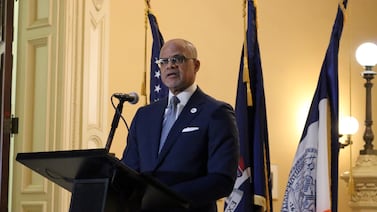
Teachers union president Michael Mulgrew, who seems invigorated by UFT’s renewed war with the Department of Education, criticized the department for ending a program that had given some schools extended days. “The city does not have a plan to help these students,” he said.

  • I noticed that…

    Thank you Michael for bringing up that issue of the DoE’s unwise decision of ending extended days in certain schools, formerly called the Chancellor’s District.

    The Chancellor’s District was one of the best programs that provided the schools with resources, time, and PD so that teachers can help students succeed.

    But the DoE is so determined to destroy the UFT that it will eliminate any program that works and helps students to earn a diploma.

    The DoE’s plan is to have no plan in place.

  • QueensParent

    Not so fast there. The Chancellor’s District seemed to be a way to pad teachers and staff pockets with extra money. What was so great about it? Schools in the CD would go from 20% proficient to 40% proficient, with enormous sums spent for that paltry progress. What’s so great about that tremedous waste of money? Again, seems to have been a great program for adults, a waste for kids.

  • Pingback: If you had to build a portfolio with ONLY Exchange Traded funds? | ETF Trading Course

  • I noticed that…

    QP, Do you know how many schools were able to get off the SURR list because of the CD? Why is it that you always attack teachers when we are paid to work over the nornal hours? When you hear that CEOs are getting millions as bonuses and yet the economy went down the drain because of their exploitation of the system, do you attack them, too, as you do with teachers? So no one is allowed to work overtime and get paid for it. By the way, that is a 100% increase when schools go from 20% proficiency to 40%. Then you justify the importance of having the CD. Money well invested if the data shows a 100% increase.

  • http://www.publicschoolinsights.org Claus

    This story also gives the lie to the common perception that unions are a barrier to lengthening the school day. Certain members of the business community have traditionally been stronger opponents of reform measure.

  • Joe Schmo

    Hold up here. I currently teach in a low performing school. (15 years in the system) However, if my day is going to be extended by 30%, I will transfer for sure. I work very hard and get to school an hour early every day on my own time as well as putting in tons of work time at home. I would rather get paid the amount I am currently making as opposed to being forced to work an extra 30% of time. If teachers want to work in a school that is extended by 30%, that is great. Simply have the UFT/DOE set up a fair and balanced transfer system and go for it. (No simple task) Just don’t push it on every single teacher who happens to work in a low performing school.

  • http://themortonschool.blogspot.com Miss Eyre

    Simply extending the school day is not the answer. More time in school overall may be *an* answer for *some* children that may be effective within a *certain* kind of school model, like the Generation School (I believe that is the name of it) in Brooklyn. But simply more seat time and more test prep (because that’s what most extended day programs come down to now) will not make children better students who are less likely to drop out, nor will it improve instruction.

    Now, on the other hand, if you had a school day that included more professional development and collaboration for teachers, less time babysitting (yeah, I said that), a day that included more sports, physical activity, life skills, arts opportunities, one-on-one tutoring, even maybe just some time for kids to go to the library and read or do research, that might work, particularly for disadvantaged students who experience little to none of the aforementioned in their usual lives. That might help more students feel engaged with and confident and happy in their schools, which in turn might lead to higher achievement and fewer dropouts. But I currently work in an extended day program, and simply doing reading skills with my students–even with high-interest texts, group work, games, whatever–is not flying. They are absolutely done by 4:00 and want nothing more than to go home.
    Extending the school day alone, without broadening the scope of what is offered for students and giving teachers more breathing room, will just give you burned-out teachers and frustrated, tired kids.

  • District 13 parent

    I agree with Miss Eyre and also feel very uncomfortable about changes to the school day that will, essentially, only exacerbate the differences in the education (or “education”) received by students in poor areas, most of them minorities, and students in middle class districts.

  • http://www.sinksalive.blogspot.com KitchenSink

    Why all the hubbub?

    It’s a no-brainer that a longer school day means more education…unless, of course, what the school is offering is doing more harm than good, in which case I would argue to SHORTEN the school day.

    Like every other reform initiative, as one poster implied, “more time” is no silver bullet. It takes a purposeful, community-wide investment in a full set of reforms to move forward, not a magic wand reform.

    Just curious: from the Mulgrew perspective, why this particular initiative, now, and not, say, smaller class size, or peer review, or something else?

  • Laura

    I noticed that…Actually, a study showed that the Chancellor’s District schools did no better on math than SURR schools not in the CD during the same period. They did slightly better on reading, but certainly not so much better when you consider how much money more was spent in the CD schools and the extent of interventions in the CD (longer school day and year, smaller classes, incentives to recruit and retain experienced teachers, coaches, PD, etc.). Additionally the CD schools had significantly smaller special ed populations than the SURR schools that weren’t in the CD. And yes, some CD schools did get off the SURR list, but similar numbers of SURR schools not in the CD got off the list. Frankly, I find it kind of overwhelming to consider that all those interventions and all that money had such limited effect in helping kids to succeed.

  • Karen Sherwood

    I am going to take a giant leap here (risking the enmity of millions) and say that we should ban the misleading phrases “low performing schools” and “failing schools.” When did we stop talking about low-perfoming students or failing students?—Probably about the time that Bloomberg and Klein took over. Of course some schools had (or have) problems, with teachers, administrators, or the physical plant, but that is certainly not the situation with the majority of schools that are being closed down. Columbus, for example, has very nice classrooms, a cheerful cafeteria, and a newly renovated library. Our staff is made up of experienced, highly educated teachers who love their subject areas and who spend endless hours writing lessons plans, making up tests, and preparing special projects. Most of our students appreciate our efforts and are serious about their work, but there all also many–too many–who constantly cut class or who come to school just to socialize. Some students have jobs that conflict with their school schedules–and they choose their job over school, while other students take weeks off for long family vacations or to go to out-of-town funerals. Is this the fault of the school or the faculty? Of course not, except in the eyes of Mayor Bloomberg. Our students are not babies; they are young men and women, and some of them make very bad choices. When we also add in our new immigrants, many of whom had little or no schooling in their native countries, the result is a set of statistics that are less than excellent. However, the Columbus staff never gives up; we keep looking for new ways to help struggling learners to succeed and to give failing students a second or even third chance to get their lives back on track. So, no matter what Bloomberg’s numbers say, Columbus is NOT a “failing school” ; in fact, I would say that we are succeeding admirably in our efforts to offer a quality education to an extremely diverse and challenging population.

  • Pogue

    Beautifully said, Ms. Sherwood, now where do we begin the fight?

  • dotty

    Laura, I am an author of the CD study you cited. We looked at all the relevant city and state the data and found that there was a statistically significant improvement in student learning in literacy among students attending CD elementary schools. This improvement was NOT a result of the usual games the school system played to show “improvement” in these schools when there was none.
    The CD was a comprehensive intervention that provided small class sizes; repairs to the physical plant, if needed; replacing principals, if needed; removing some ineffective teachers; a LOT of professional development with on-site coaches and strong district-level support; an extended day program; a combination of literacy strategies — costing about $2500 per student more than the cost of the “average” student’s education. If the school was overloaded with special needs children (a primary cause of schools winding up on the SURR list), the # of special ed kids in the CD school was reduced to an “average” level.

    The lack of improvement in math in CD schools we attributed to the fact that the CD intervention at first did not include a focus on math. In fact, the intense focus on literacy probably crowded out math instruction. In sum, our research team found the CD Initiative to be an effective intervention in NYC elementary schools. Nevertheless, it was terminated in 2003 by Chancellor Klein.

  • http://perdidostreetschool.blogspot.com reality-based educator

    Obama, Duncan, all the hedge fund managers/education reformers, Bloomberg, Klein, Paterson – they all want to socialize poor and middle class kids to expect 9 hour work days and 6 day work weeks when they grow up. You can be sure this will happen, and they’re not really going to trouble themselves to pay teachers all that much to work the extra 15 hours a week. They’ll just look at your test scores, say they’re not so good and you have to work the extra 15 hours or go find another area of work.

    Interestingly, none of these folks send or have sent their own kids to public schools with extended school days and years. Obama’s offspring attend a very progressive school with lots of play time built into the day and, surprise, surprise, no test prep.

  • laura

    Dotty – I don’t think what I said is contradicted by what you said. You found statistically significant literacy gains in the CD versus the SURR schools not in the CD. But while those gains were statistically significant, they were hardly dramatic, particularly when you consider the level of investment or the scope of interventions there (and I suspect that cost figure you cited doesn’t account for facilities improvements because those costs are in capital budgets not school budgets). I actually find it very disturbing that a potential explanation for the lack of gains in math was due to the intensive literacy focus during the initial years of the CD. We’re talking about actual children moving through school here. They need quality math and literacy programs (and much beyond those disciplines) every single year – period. One would think that with the scale of investment in the CD — smaller classes, professional development, curriculum, coaching — that the educators could have begun tackling both these considerations from the jump. That is what the students deserved, and more importantly, what they needed.

    Meanwhile, while there were modestly better gains in the CD schools vs. non CD SURR schools, it’s in no way clear what drove those gains. Was it reduced class size? Teacher quality? Extended day? Did each of those things contribute incrementally or was one intervention particularly making a difference. In a world of limited resources, that question is essential — because if one of the interventions was the primary driver of improvements, you’d want to focus on scaling that intervention up rather than replicating the entire, uber-expensive, not wildly successful slate of reforms in the CD. And this is even more true when you consider that both the groups of schools you looked at served gradually lower-need populations each year, which may in itself have been the primary driver of schoolwide gains (though not necessarily improved individual student achievement) in both groups.

    Finally, my biggest problem with all of this is that in trying to figure out what works, I’d rather look to the schools serving high-need kids that never landed on the SURR list in the first place. Those schools existed in 1998-99 and they exist today, and frankly, those are the models where I think you’re likely to find evidence for what really works to help all students succeed. (Based on my anecdotal experience as a parent and educator, my totally unscientific guess would be that the most successful schools have excellent educators and leaders, who work collaboratively to plan curriculum across disciplines and grades.)

  • Leslie

    Dear Mrs. Sherwood:

    When I was a public school student 10 years ago, I often witnessed lack of interest and creativity on the teachers behalf in my High School. They failed to motivate, engage and educate us properly. I also noticed, however, the lack of respect from students to teachers, the lack of personal motivation students had, and as you mentioned a number of other personal problems they brought to school with them that are typical within their impoverish neighborhoods.

    But the most significant problem I noticed, was the disconnect between NYC students (mostly from minority groups) and their white teachers. I’m not sure how things are now a days but the communication simply wasn’t good back then. How can you teach when you fail to communicate? How can you teach if there isn’t a mutual understanding? How can you expect excellent grades when you fail to motivate?

    I agree with you, that is often not the administrators’ or teachers’ fault but if are having the same problems with a significant amount of students I believe the school needs to address it. To your defense, often these problems should begging to be noticed at the High School level, but from primary education. It is just ridiculous and unfair to HS administrators and teachers, but if that’s the case then you need to strike back with a good plan to solve it and that’s what make it a good administration. You can’t just blame the students for their failure, the school is the institution that is supposed to guide them through the whole process of becoming educated.

    Students can be motivated a number of ways, through programs that would address their needs, through activities they can enjoy while learning and by encouraging and rewarding participation. Basically offering them the support and resources they need and empowering them. The teachers should have the assistance and resources they need to make it happen as well. Is a collaborate effort. I believe both the teacher and the students carry the responsibility of making it work and neither is completely “guilty” of the failure.

    You said: “When we also add in our new immigrants, many of whom had little or no schooling in their native countries, the result is a set of statistics that are less than excellent.”

    Well, but have you thought about the language barrier? That’s is most likely the main issue there, not education. Communication (again) is absolutely one of the largest barrier when it comes to learning. I’m a new immigrant, a proud citizen now. I completed 5th, 8th, then 9th-12th grades here in the United States. In 5th grade, I dealt with a slight culture shock, and the teasing from other Hispanics kids at school because I didn’t speak English at a school without an ESL program. I was placed in an English only class because my local school was not accepting more students. I struggled! my excitement of being in America became a nightmare every time I had to go to school. An English teacher humiliated me in the classroom in 8th grade, but of course a timid student that I was I didn’t stand up for myself. Instead, I became more timid in class and learning was no longer my main concern but rather being fearful of being humiliated again. I innocently thought any learning difficulties I endured was through fault of my own. The teacher was just projecting her frustration on to me because she was upset I had been placed in her class not knowing how to properly read or understand “big words” (in English). I was excellent reader in Spanish, in fact it was one of my hobbies, so it was no my education getting in the way it was the language.

    Have you any idea how difficult it was? Have you any idea of all the resources and information i missed out during my youth that could have helped become a successful person? Education was not my issue, it was language. Education was not my issue, it was attending the wrong school. Education was not the issue, it was not having the right mentors. My father was a great mentor, but what does he know? He was a new immigrant himself. He can only motivate me to finish a career and do well in school. He relied on the school to guide me through and he offered me support.

    With all due respect, I would like for you to consider those issues when dealing with your students. Marketing companies conduct primary research such as surveys and focus groups to get to know their customers better, perhaps schools should do the same. If something is not working I think they first step would be to improve the communication you have with the students and then address those needs. Not every model fits every school.

  • Leslie

    Correction on the 3 paragraph: To your defense, often these problems should NOT* begin to get noticed at the High School level, but from the primary education.

Tips, questions, feedback?

Contact us at .

Follow GothamSchools

RSS

Feb. 10: You’re invited!

Chalk It Up

Recent Comments

22 comments so far today

Our Twitter Updates

Archives

February 2012
M T W T F S S
« Jan  
 12345
6789101112
13141516171819
20212223242526
272829