GothamSchools — daily independent reporting on NYC public schools

turf wars

Girls Prep charter wants more space, but doesn’t want a fight

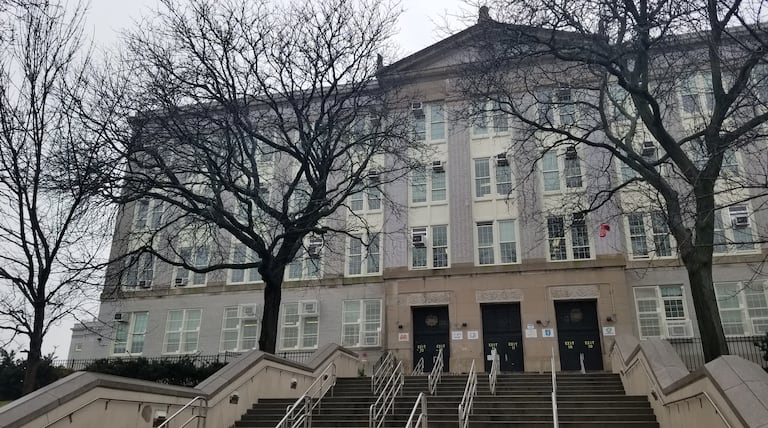
In the tug-of-war between charter school advocates and opponents over building space for the city’s charter schools, emotions frequently churn and bubble over; protests and shouting matches are not unheard of. But it doesn’t necessarily have to be that way, a team of district and charter school administrators who share a Lower East Side building said today.

Gearing up for a community meeting tonight about space issues in Manhattan’s District 1 that will feature their own building, administrators said they want to emphasize the need for a neighborly conversation.

“I’m not going to say it’s easy,” said Mary Pree, the principal of P.S. 188, which shares space with another district school and the Girls Prep Charter School. “Everyone would always like 10 extra classrooms.”

But Pree emphasized that her school’s relationship with the two schools is vibrant, and that the schools are working to develop even stronger connections between the parent associations at the school. “We’re a place where this collaboration is working,” she said.

Girls Prep is requesting more space in the district to expand its middle school program. The middle school launched this August with one fifth-grade class of 25 students.

While the school’s request is not specifically on tonight’s agenda, Girls Prep administrators said they wanted to take the opportunity to spread information about their needs and plans for more space.

“We’re going to explain our plans for expansion and parents will speak to how much we want to be part of this neighborhood,” said Girls Prep founder Miriam Raccah.

The school is requesting space not in the current building they share with P.S. 188 and P.S. 94, a special-needs school for students with autism, but rather elsewhere in the district, school administrators said.

The school had to turn away 50 fifth-grade students this year for lack of space, administrators said. And Raccah pointed out that next year, as 50 current fourth-graders graduate into the middle school program, the need for space will intensify.

“Space is a challenge. It is the challenge,” said Girls Prep middle school principal Kimberly Morcate. “It affects instruction. It affects how we can get the girls to focus.”

The middle school occupies one room of the third floor wing of the building that Girls Prep shares with the two other schools. The elementary school classes and an administrative office take up the rest of the wing, as well as a portion of the second floor of the building.

Today, Morcate led half of the fifth-grade class in a discussion of how to draw conclusions from inferences in a reading passage. The rest of the class was divided into two smaller groups, who worked on practice worksheets in circles on the floor of the school’s yoga classroom around the corner.

The class breaks into small groups like this every Wednesday, but Morcate and teachers said that usually the yoga room is used by the elementary school students. On those days, the students break into small groups at tables tucked into corners of the hallways.

The single classroom must fill the functions of an entire school for the fifth-graders in it. Desks are gathered towards the front of the room, to make room for a “library” area fitted with a couch and bookshelves in the back. All four of the middle school teachers share desk space in the back of the classroom as well.

Girls Prep administrators and teachers said that they wanted the middle school program to stay in the Lower East Side. Fourth grade teacher Elizabeth Ballard said that when she visited families of children slated to move to middle school next year, a main concern was that the school would have to move out of the neighborhood. Just under half of the school’s students live in District 1.

Girls Prep teachers and administrators said they wanted to highlight the school’s relationship with the community at the meeting tonight.

Pree said that she also planned to attend tonight’s meeting, to emphasize that there are civil and productive ways that schools can share space together.

“I want these kids to look back and say, ‘I know that diverse communities, with sometimes conflicting needs, can work together well,’” Pree said. “And I want them to say, ‘I know that because I lived that.’”

  • http://thejosevilson.com/blog Jose

    This is around my neighborhood, so I gotta tell you how interesting this is all turning out. By all accounts, Girls Prep is actually a well-oiled machine and does good things with the girls they have. Of course, they remind me of the Catholic school girls’ program a few blocks away, Holy Child. Yet, this is just another example of how the NYCDOE is playing divide-and-conquer. PS 188 and all the other schools in the area have had to give way to the charter school movement’s will. Where is the “public option” for kids around there? See: NEST.

  • Versha

    Girls Prep is a public school.

  • Elizabeth Green

    Jose, what do you mean “see: NEST”? I’d love to here more comparing NEST and Girls Prep.

  • John

    Girls Prep is a public school. We actually entered our daughter’s name into the admission lottery a couple of years ago. I think it is very good addition to the rather mediocre zoned neighborhood schools throughout district 1.

  • Michael M.

    That Girls Prep is a public school ain’t the point.

    That charters get treated differently than non-charters by this administration IS the point.

    All animals are equal, but some are more equal than others, etc.

  • http://ednotesonline.blogspot.com/ norm

    Does Girls prep function as a public school? Are board meetings open to the public? Are all their stats listed in a way accessible to the public? Attendance figure, free lunches, ELL and special ed student numbers? Accountability to the public in all the ways public schools are?

    Hasn’t Girls Prep kept changing its charter? First a middle school. Then no middle school and an agreement to limit themselves to one class on the grade when they got space at 188. Now changing its charter back to wanting a middle school. Call it bait and switch. Public schools don’t have these options but must jump through hoops at a DOE that clearly tilts towards charters.

  • http://ednotesonline.blogspot.com/ norm

    “The class breaks into small groups like this every Wednesday, but Morcate and teachers said that usually the yoga room is used by the elementary school students. On those days, the students break into small groups at tables tucked into corners of the hallways.”

    Where is the sympathetic story about the PS 188 classes being squeezed? The Gotham TILT!

    And the

  • Michael M.

    Am I reading the above right? A ONE-CLASS “school”?

    Folks, we are well on our way to a NYC DOE that endorses 44,000 such micro-schools! Single school buildings (aka “campuses”) that nominally house 1,000 students could be home to FORTY such schools. Best of all, “Space Wars” would be a thing of the past. And each “school” could have the gym for nine minutes a day.

    Seriously: this ONE room SINGLE school — with a 25-kid “cap” — has FOUR teachers? That’s a 6:1 ratio! Sign me up!

  • http://curious2.typepad.com Ken

    Hey Norm,

    In my experience of reviewing public school data in NYC, I can’t think of an example of information that is available for traditional public schools but not available for charter schools. In fact, because of the reporting by the charter authorizers, I can generally find much more information about charter schools. Do you have a different experience?

    I encourage people to review SUNY’s report on Girl’s Prep on their website (http://www.newyorkcharters.org/proGirlsPreparatory.htm) for an example of their reporting.

  • Lisa Donlan

    Not to worry, Michael- if we look past the spin to the facts we see that it is indeed one class and not a school….just yet.

    GPC admitted 3 classes of 5th graders this year, one year after they moved into PS 188.
    GPC had been “incubating” in nearby PS 15 since its inception in 2005, and had long outgrown the space there, necessitating a move.
    Despite the agreement between the two schools whereby GPC was not to ask PS 188 for additional space beyond the agreed upon joint plan, GPC hired a Middle School Principal, (incidentally, Jose, she is a teacher from a local Catholic school) and admitted 3 times as many students as they had room for.
    GPC had to rescind the extra 50 invitations to keep to one class, which is all they had room for.
    GPC also got the names of all of the enrolled students in the district in ATS and used that enrollment information to send out glossy post cards recruiting kids and their parents BY NAME: “Last Chance to Apply! Girls Prep is FREE, all girls, and a proven success…” in English and Spanish, thus breaking the other ground rule for moving in to 188- no predatory marketing or recruiting away of the 188 students.

    The SUNY Charter Schools Institute in a notice pursuant to ed law 2857(1) gave notice that the Board of Regents approved the charter renewal application on Sept 16th, 2008 for:
    Girls Preparatory Charter School Of New York: Located at 333 East 4th Street, 5th floor, New York, NY, NYC CSD1; charter renewal commencing March 23 2009, and terminating July 31, 2010: proposed final enrollment /grades served- 248 students/K-5.

    SUNY Trustees approved the same on June 9, 2008
    This renewal was received on March 9, 2008.

    On September 17, 2009 SUNY Trustees announced that Girls Prep had applied for a 5 year charter renewal commencing on July 2, 2010, with a proposed 1st year enrollment/grades/served-268 students/K-5; proposed 5th year enrollment /grades served -525 students/K-8.

    Interestingly, in the charter application renewal questions, GPC states that it:” plans to open a Middle School in August 2009… to serve grades K-8 at full capacity.
    …at full capacity, during the 4th year of the second charter term Girls Prep will serve 437 students in grades K-8, including approximately 242 students in grades K-4 and 195 students in grades 5-8.”

    Let’s hope they teach math better than they use it!
    At the CEC One meeting, OPD agreed that the targeted space Girls Prep had requested was for 3 classes of 25 students each per grade for grades 5, 6, 7, 8th or for 300 seats, and handed out a “fact sheet” that stated they would serve 300 students in grades K-5 at capacity.
    Anyone not getting this new math????

    The issue is not whether or not the 57% of students out of district and the 43% in district students who attend GPC on the LES deserve 300 more seats to create a middle school.

    The question is who will need to give up what in order to make those seats available to this privately managed charter that serves no ELL’s (in a district that averages over 12% ELL), while 8% of their students have IEPS requiring SETTS ( in a district with the same 8% average of SETTS IEPs, plus additionally 15% on average of our district elementary students requiring the More Restrictive Environments of either CTT or Self Contained classes, classes that Girls Prep does not offer, while in middle schools the district average is 21% of students requiring CTT or self contained classrooms.
    Will GPC take in thsoe students with IEPs requiring thsose settings if they do not offer them?
    Will more high needs students be pushed into the remaining schools in the remaining real estate?
    Is this the way we want to make decisions about serving children? What happened to Children First?
    It is starting to look a lot like private management first, or maybe certian children first….

    On the OPD chopping block are:

    PS 20 (w/ostensibly 19 spare rooms according to OPD)
    PS 184 (w/ supposedly 20 unused rooms)
    JHS 56 (on paper has 30 rooms over capacity)
    PS 188 (that has 11 extra rooms)

    These numbers are based on the flawed blue book and principals use survey that fail to take into account real capacity and use, as they are based on unreal constructs that don’t “count” cluster rooms used for art, music, dance, theater, speech therapy, counseling, OT, PT, administrative offices ( there are more offices in school buildings housing one or more schools), etc.

    JHS 56 for example houses 3 separate schools ( 2 MS, and one 6-12) which all have administrative offices; the NYC DoE’s NASA space center; as well as the District Office ( with full time employees: the CEC AA, the DFA and the district superintendent’s temp worker); but these rooms can not be part of the “footprint” since they are unique and not formulaic.

    The 3 schools in the JHS building serve 27, 30 and 36% special education students requiring CTT or self contained class, respectively. Two school surpass the district average for ELLswith 15% of students classified as ELL’s ,and one school is a Title III school.
    In fact at one of the middle schools only 21% of the population is not either ELL or Special Education designated.

    How does the new governance law that requires local hearings and an impact statement (to be created by DoE) operate to take into account the kinds of students being served, how well they are being served and how best to use the limited space in public school buildings? What will be the value of “consulting” with the CEC or DLT in the case that the recommendations favored by the chancellor do not sway the elected local governing bodies? Keep your eye on cases like these to see how good the new governance laws are at providing transparency, accountability and community input and oversight to these thorny issues. Lisa Donlan

  • Lisa Donlan

    Hi Ken,
    Thanks for the link.

    I had to ask my superintendent and then the Office of Charter schools who then passed my email along to the school principals to obtain the latest enrollment and demographic data since both schools DoE web pages listed the school data as “unavailable”.

    My request turned into an alarm to all charter parents to come on out to a supposed CEC charter hearing where the charters were under threat, their management was not allowed to speak and the CEC had taken an anti charter stance.
    The alarmist emails were signed by an elected PTA officer along with her title and the head of a charter parent group, also by title.
    These folks not only did not have their facts straight ( it was not a hearing, everyone was allowed and encouraged to speak at the public session) but they had gotten their own history wrong as well, as we had welcomed all of the schools and parents from the charters into our community at their public hearings, even inviting them to join and attend our Presidents Council and CEC, since they dio not benefit form the same representation parents in public district schools do.
    It is of great concern to me that a simple request for what should be public data is seen as a threat.

    Since you are better at negotiating the information than I am, can you kindly show me where the GPC Board meeting notices and minutes, and not for profit financials are located?
    I have tried to obtain those documents for other charters, even going as far as completing a FOIL but have never managed to actually get a response.

    Lisa

  • Lisa Donlan

    If you follow the link that Ken provides you will see that the GP charter’s planned grades are K-5th.

    At our recent CEC meeting the charter management company reps tried telling me this was just some bureaucratic snafu and that GP had always been chartered for a K-8th.

    Ergo moving in to PS 188 and revising their charter down was NOT a bait and switch but some kind of paper chase misunderstanding. Even unfettered charters have bureaucracy to deal with it seems.

    I am looking for a way to document the GPC administrations claims that they always planned to be a K-8 and that the public charter hearing in which they dialed back to two classes per grade, from K-5, was just a bureacratic glitch, and that the charter was always for K-8th with three classes per grade.

    Lisa

  • http://curious2.typepad.com Ken

    Hey Lisa,

    This post of mine has the summary financials for 58 charter schools including GPC: http://gothamschools.org/2009/04/28/charter-school-philanthropy-revisited/.

    This directory has complete financials for the same group: http://www.box.net/files#/files/0/f/26896084/Charter_School_Financials_2008.

    I wrote about my process to get these financials here: http://gothamschools.org/2009/04/23/foil-me/.

    You will note that I share your frustration: you shouldn’t need to FOIL authorizers to get this information. However, I have never seen any financial statements as remotely as informative as these for a particular traditional public school. At the individual school level, in general, I find charter school reporting to be MUCH more illuminating than what is available for traditional public schools. Would you disagree?

    I am not experienced with finding board meeting notices, but perhaps others can help you with this. Also, if comparable meetings are available for individual traditional public schools, I would be curious to learn about those, too. (To be clear, that last line is not sarcastic.)

  • Lisa Donlan

    Thanks Ken. This is very helpful!
    I will check it out soon- on my way out to dinner now.

    Just want to add to this conversation quickly- thanks to the docs you did reference I found out that the GPCharter folks were spinning/telling stories when they grabbed me after our CEC meeting to explain away the disconnect between the previous chartering info and the newest proposal.

    Planning year snafu my…well, you know what!

    I saw that: “ the school’s original charter application and charter originally granted authority to provide instruction in K through 5th grade.
    The school’s decision planning year … the charter was amended in May 2004 and limited expansion to 4th grade.

    I also learned that there have been several ”deviations from the design elements in the original charter:

    From 8am to 5 pm to the current 8 am to 3 or 3:45 pm ( 3/4th grades)

    Initiating Spanish instruction in 3rd grade instead of K

    Increasing class size from 22 to 25

    Reducing number of classes on each grade form 3 to 2

    Reducing the school year form 200 to 190 days…”

    Finally- you are right that the DoE school financials now provided under mayoral control are far from sufficient.
    There is an SLT view that is better than what is posted and a Principal’s view that all parents and citizens should have access to, showing budgeted and spent amounts to date.

    The DoE – this Chancellor, under this accountable Mayor, will not provide these to parents or the public, as recent UFT actions/refusals have shown.

    Interestingly I learned that “the school has been provided space at essentially no charge by the NYCDOE.
    At PS 188 that translates into: 13 classrooms, 3 administrative offices, and shared use of the: auditorium,
    Library’
    Computer lab;
    Lunch room
    Gymnasium
    Yard.
    provided at no coast by NYCDoE.

    Lisa

  • http://curious2.typepad.com Ken

    Thanks Lisa.

    I think Girls Prep is a great school and I am very happy that it exists and I hope it grows. We might differ on that. I agree with you, though, that information about these schools should be easily available. In general, for charter schools, I think it is. There is significant room for improvement, though, and massive room for improvement for traditional public schools. Also, I question whether traditional public schools in NYC have ever had the information disclosure now available for charter schools. Of course, education historians might be able to shed light on that. And, of course, I might be in error on the amount of information currently available, although I have tried pretty hard to get a lot of it!

  • http://thejosevilson.com/blog Jose

    I should have responded sooner, but what I mean by the NEST comparison is that, while I understand that Girls Prep is “public” in the general sense, it’s a charter, so it goes by its own set of rules, and everyone knows this. When NEST came in, I agree that it replaced a school that had a huge reputation problem (I believe it was JHS 22), but very few, if any, of the students who go to NEST actually come from the neighborhood or surrounding neighborhoods. While I understand the need for better schools and a reform of sorts, I don’t get why the students who were once there can’t get the same education / environment / funding that the charter schools do if indeed they are both “public.”

  • http://curious2.typepad.com Ken

    Jose,

    Although no one has been able to calculate precise numbers, conventional wisdom (which I agree with) is that charter schools do not get more funding than traditional public schools. Instead, they spend the funding differently. Also, charter schools are usually operated by nonprofit groups that are independent of the DOE. The quality of that management is often (but by no means always) superior. Finally, charter schools are usually not subject to the UFT contract and, thus, have more flexibility in how to operate the school and allocate funds.

    To me, the answer to your question follows fairly simply from these differences. Of course, many commenters at Gotham Schools will give you a different point of view!

  • http://ednotesonline.blogspot.com/ norm

    Ken
    You say a lot in a very concise way. I can’t be as concise and will respond on depth on the Ed Notes blog.

    By far the largest part of any budge is salaries. So when you say “they spend the funding differently” followed by “charter schools are usually not subject to the UFT contract and, thus, have more flexibility in how to operate the school and allocate funds” these are loaded statements that are connected.

    Much of the UFT contract protects teachers from being exploited. Like being asked to work Saturdays or 12 hour days, which by the way many to anyway without pay. But that is another issue as to just how much the UFT contract is really adhered to. You’d be shocked at how much is not. But yes, a public school with experienced teachers does have to pay them based on the number of years (something we know the market-based people aren’t happy with – not taking into account that even in the corporate world people with more experience do get paid more.) If a teacher loses prep time they can put in for payment. I wonder how preps are dealt with in charter schools.

    Now maybe you think that issues like pensions and health care and preps and other issues are not of concern to charter school teachers over the long run. But maybe there is no long run for charter school teachers.

    So of course charter schools have more money to spend on lower class sizes by hiring cheaper teachers. But expect more turnover over time. As the economy improves don’t expect hordes of people to put up with conditions forever. At that point we can have this discussion again.

    I also notice you ignore the things Lisa Donlan reports on how Girls Prep pulled the bait and switch and the impact on PS 188. You left a comment on my blog that you support Girls Prep and it’s a very good school. What do you think of PS 188 as a school and do you also support them? Or does the very existence of a union contract make them ineligible for support? And do you really care anything at all about PS 188?

  • Lisa Donlan

    Ken,

    I had trouble getting data on the charter schools in my district that is readily available on DoE schools.
    There is a lot of information regarding performance/accountability and budget on DoE schools as was apparent when my CEC met this week to go over folders of information on each district school that our AA had downloaded for us to help us in our work as school liaisons.
    Simply click on the links at http://schools.nyc.gov/SchoolPortals/01/M188/AboutUs/Statistics/default.htm
    and you can see PS 188’s budget ( many views and much more detailed than what you got for your FOIL on GPC) , performance, progress, education plan, quality review, arts report, attendance, class size, special education delivery and much much more.

    As for comparing spending at charters and district schools, the per pupil revenue number you cite leaves out a big piece of the picture, that has NOTHING to do with unions or fettering by bureaucrats.

    Charters have been getting a free ride NOT ONLY on free space rental of facilites/Capital/Construction Cost as the SUNY trustee report on GPC points out several times but they also get to avoid a number of costs such as:
    Food, Transportation, Library, etc that need to be made tranparent.

    .

    I have a slide I am unable to reproduce here on the charter funding formula that I am sure you would love.
    Feel free to conatct me at ;lisabdonlan@hotmail.com and I’ll send it to you.

    Lisa

    What is on a typical DoE webportal page:

    Learning Environment Survey

    Learning Environment Survey Report 2008-2009
    Learning Environment Survey Report 2007-2008
    Learning Environment Survey Report 2006-2007

    This report provides a view of a school’s learning environment based on responses from parents, teachers, and middle and high school students to the annual Learning Environment Survey. For additional information about the survey, click here.

    Quality Review

    Quality Review Report 2007-2008
    Quality Review Report 2006-2007

    The Quality Review Report describes what the reviewers saw at the school — what life is like there. The report identifies some of the strengths in the school, as well as areas where improvement is needed with suggestions for making improvements. To read more about the Quality Review Process click here.

    Progress Report

    Elementary/Middle School 2008-2009
    Elementary/Middle School 2007-2008
    Elementary/Middle School 2006-2007

    The NYC Progress Report measures student year-to-year progress, compares each school to peer schools, and rewards success in moving all children forward, especially children with the greatest needs. For additional information about the Progress Report, click here.

    Annual School Report Card

    The Annual School Report card provides statistics about a school, including enrollment, demographics, and student achievement. It has three parts:

    • Accountability and Overview Report 2007-2008
    Accountability and Overview Report 2006-2007
    Accountability and Overview Report 2005-2006

    The Accountability and Overview Report provides enrollments, average class size, demographic factors, attendance and suspensions, teacher qualifications, and staff counts. It also provides accountability results by accountability measure and performance on accountability measures. Accountability measures at the elementary/middle level are English language arts, mathematics, and science; at the secondary level, they are English language arts, mathematics, and graduation rate.

    *Comprehensive Information Report 2007-2008
    Comprehensive Information Report 2006-2007
    Comprehensive Information Report 2005-2006

    The Comprehensive Information Report (CIR) provides annual results on Regents examinations, Regents competency tests, second language proficiency examinations, New York State English as a Second Language Achievement Tests, elementary – and middle-level social studies tests, and New York State Alternate Assessments, as well as cohort performance results in social studies and science. The CIR also provides information on high school completers and non-completers and on post-secondary plans of graduates.

    •New York City Supplement
    The New York City supplement to the Annual School Report card provides additional information about a school, including additional demographic factors, its budget, and average SAT scores (for high schools).

    School Budget Overview and Detail 2009-2010

    This budget view shows major sources of funding for individual schools and the comparison of funding from last year to this year. It also shows detail on a school’s Fair Student Funding (FSF) allocation, which is approximately two-thirds of all schools’ budgets and is based on the number and need-level of students at the school. Learn more about Fair Student Funding.

    Annual Arts in School Reports 2008-2009

    Annual Arts in School Reports 2007-2008
    Annual Arts in School Reports 2006-2007

    This report provides information about the arts education programs being offered to students in each school as well as the resources each school allocates to support them. The Report is based on the school’s response to the Annual Arts Education Survey and on quantitative school data collected by the Department of Education. For more information click here.

    Average Class Size

    The preliminary 2007-08 class size report shows average class sizes at the citywide, borough, district, and school levels. To search for a specific school’s class size data, click on the link above and select either the “Aggregate School-level Data” report or the “Detailed School-level Data” report. Once you have the report open, press Ctrl-F and enter the school’s name or code in the search field.

    Special Education Service Delivery Report 2008-2009

    Special Education Service Delivery Report 2007-2008

    The SESDR provides information on a number of special education issues, including enrollment, timely special education evaluation, provision of special education services, movement of students to “least restrictive environment” (i.e., spending the majority of the school day in general education classes), initial referral rate, and declassification rate.

    CEP School Demographics and Accountability Snapshot 2008-2009
    CEP School Demographics and Accountability Snapshot 2007-2008

    This report is an overview of the school’s demographics, including enrollment, attendance, and special education and ELL programs. It also provides a snapshot of the school’s NCLB/SED accountability status, Progress Report grade, and Quality Review score.

    Attendance

    Daily, weekly and year to date attendance percentages report. Note that this report shows school attendance data on a 2 week day lag. For a complete attendance report, please go to Statistical Summaries and click on the “Attendance” tab.

    Register

    Total number of current students in attendance with breakdown by gender, ethnicity, as well as Special Education and English Language Learners.

    Expenditure

    Total expenditures report by school as well as citywide.

    Budget Allocation FY08 to FY09 Comparison
    This report compares FY 08 and FY 09 school’s budget allocations as they appear in financial Galaxy system.

    Galaxy Budget Allocations

    This report displays the school’s budget allocations as they appear in Galaxy.
    Click here for a detailed explanation of these allocations

    Budget Summary

    This report displays a summary of the school’s budget (scheduled items) as it appears in Galaxy. The budget is presented by section, with summaries of positions and budget amounts by assignment, subject or grade depending on the section.

    Building/School Facilities Report

    Reports and general information about the conditions of the school building, including accessibility status and department of health reports.

    Statistical Summaries

    The Statistical Summaries web site highlights summaries of various important DOE statistics including official enrollment, regional attendance, citywide exam results in reading and math, and employee headcounts. In addition, the site provides links to more detailed attendance and enrollment data.

  • http://curious2.typepad.com Ken

    Hey Norm,

    I have no knowledge related to Lisa’s allegations, so I can’t really comment. It does seem like she is jumping to conclusions and assuming bad motivations, but I really don’t know the facts.

    I have supported a couple of charter schools that operate under the union contract, although I have considered discontinuing that support going forward. My biggest concern by far is the education that the kids receive, regardless of which school they attend.

    I would love to learn more about PS 188. Last year, I attempted to visit 17 traditional public schools. Only two allowed me to visit. (To be clear, I don’t think any school has any obligation to allow me to visit. It could be an unwanted distraction. Interestingly, 14 of 17 charter schools allowed me to visit. To be fair, they probably knew that I financially support charter schools!) I am very curious to learn more about traditional public schools beyond the large amounts of data that I review and reports that I read.

    Perhaps you and I could visit PS 188 together?

  • Lisa Donlan

    Ken,
    What conclusions am I jumping to?
    Lisa

  • http://curious2.typepad.com Ken

    Lisa,

    It seems to me that you are assuming and/or jumping to conclusions that Girls Prep or the DOE is in some way acting inappropriately with respect to Girls Prep’s growth. That’s only a sense I get though and, therefore, is probably not worth mention. I should have stopped at “… I can’t really comment”!

  • Lisa Donlan

    John,
    BTW- there are no zoned neighborhood schools in District One; district residents can apply to any school in the district at pre- K, K and first grade as entry points and again in 6th for middle schools.
    1n 1991 the school board removed all zones or catchments as part of a larger admissions policy that intended to create diverse, family-centered schools of choice.

    Lisa

  • Charter Teacher

    Norm,

    In regards to your concerns about treatment of charter teachers.

    I am a charter teacher that formerly worked for the DOE. My salary is higher in my charter school. I work two Saturdays a school year (which I am compensated for). I have full benefits and MORE preps than I ever had as a teacher in DOE schools. In fact I actually work fewer hours at my charter school because I no longer need to take work home with me or come in on weekends to catch up. I actually have enough time during my planning periods to do my *gasp* planning!

    You need not fret about the fate of charter teachers. We can certainly fend for ourselves.

  • Pogue

    I’m sorry.  I don’t believe you.

  • Michael M.

    Just like TPS kids can fend for themselves in space wars.

    And what does ability to fend have to do with decision-makers doing what’s right?

  • Charter Teacher

    You don’t believe what you don’t want to believe.

    In the DOE I typically had 1 prep, 2 preps on a good year.

    This year at my charter I have 4 preps.

    My benefits are comparable to what they were at the DOE and I received a hefty raise when I moved to the charter school. And though the hours are longer than the DOE hours, I am compensated for them.

    Add to that the fact that I actually have all the classroom supplies I need to teach my students (instead of paying for items out of pocket, as I’ve done in years past), and can easily request more when I need them, I am more than satisfied with my position, school and contract.

  • http://ednotesonline.blogspot.com/ norm

    Sounds like heaven Charter school teacher. Should I assume health care and pensions? It looks like the upcoming UFT attempt to organize charter schools will fall on deaf ears. As long as you never have to worry about stepping on the wrong toes you should have a long and fruitful career.

  • Michael M.

    Why do TPS kids come home with lists of $100 to $200 in classroom supplies, but charters’ larders are well stocked? (So much for previous crocodile tears from charter supporters re levels of funding.)
    And I’ve got a dollar that says CT’s class sizes are smaller now.

  • http://ednotesonline.blogspot.com/ norm

    Ken
    I’d be glad to visit the school with you though I don’t think there’s a lot to learn on these snapshots of a school. The best way is to work there. Maybe they can find us jobs.

    The issue raised by Lisa of the bait and switch behavior of Girls Prep should not be swept under the rug. Many of us view charters as a political wedge to undermine public schools. Girls prep may be a good school with dedicated people. But we have to examine charters as to how they function in the political context. If they use bait and switch schemes to manipulate to gain control over space in public schools then they are working against the long-time public good.

    If that leads to a divided and balkanized system that is taken out of the hands of public management then we can’t just focus on whether they are “good” because they serve a small portion of the public.

    Thinking ahead, is the goal to have 1500 schools under separate management using public money? Do we think that is a good thing? Especially since only urban school systems with their racial component are the ones affected while the suburban schools will have few charters and fucntion under public control?

    I find it interesting that avid charter supporters are also supporters of the mayor’s arguments about having one controlling authority over the schools, which seems to be a contradiction.
    Charter supporters talk about the bad schools or mismanaged schools, yet they have been under the management of Bloomberg for over 6 years, which he is bragging about while at the same time calling for charter schools to escape from his own management.

    Look at the rules BloomKlein impose on the public schools. Do charter have to adhere to the social promotion policy? Or the bake sale ban? Or the vending machine controls? Or forcing parents to enroll kids on pre-k or kindergarten online? Or the other insanities imposed?

  • http://curious2.typepad.com Ken

    Hey Norm,

    Lots of good stuff! Here are some comments:

    1. I encourage Lisa and others to investigate activities that they find inappropriate. I am not sure, though, how they will distinguish “bait and switch” from “changing plans based on learning from experience”. The former suggests ill intent, while the latter sounds like a good thing.

    2. I think our goal should be to have an evolving collection of schools that provide the best education for children in our city. If that turns out to be 1500 schools run by a number of different operators, that could be fine. I think we should leverage off of parental choice and government accountability systems to move towards the optimal system.

    3. I support Mayoral control because to the extent that the government has a role, I want that role to be accountable to voters in a comprehensible manner that isn’t almost guaranteed to be captured by special interest groups. I would like to see the role of government, though, to be reduced to an oversight role. I agree with you that the mayor shouldn’t be operating 1500 schools.

  • Michael M.

    Ken,
    I always appreciate your comments.

    But re #3 above, it strikes me that the Mayor is clearly DOING the bidding of a special interest group — for-profit charter evangelists. So what if his wealth obviates any need to stick out his hand?

    “Cerf’s Up,” etc.

    As if the PEP provides any meaningful oversight under the Mayoral Control law as pre-approved by Hizzoner hisself.

  • http://curious2.typepad.com Ken

    Thanks Michael.

    I think Bloomberg agrees with charter school advocates. I don’t think he got elected because of financial and get-out-the-vote support from charter school advocates, nor do I think he is supporting charter schools because he is afraid that if he doesn’t, charter school advocates may end his political career. In my opinion, Bloomberg hasn’t been captured by special interest groups. Of course, that doesn’t mean that his ideas and actions are correct.

  • http://www.publicprep.org Miriam Lewis Raccah

    I agree with Ms. Donlan about the need for transparent information about public schools. These rules should apply to both traditional and charter public schools. We are all serving the public, and spending public money. A high level of scrutiny should be welcomed, and we certainly welcome all questions at Girls Prep.
    What I don’t agree with Ms. Donlan about is our intentions. Our goal in starting Girls Prep was to create a school that would serve the girls by putting their needs first. We started with kindergarten and first grade, and dreamed of eventually having a K-8 school.

    Because charters are granted for a five year period, we applied for a five year charter.
    Here we are five years later. What do we have? What do we now know?

    1. We have some of the highest student achievement in New York City. 95% of our girls are at grade level in ELA, and 100% in math. That makes us the second highest scoring charter school and the 10th highest scoring elementary school in the City!

    2. We have very experienced and happy staff, with minimal teacher turnover. They work hard, but they make a good living. We have 90 applicants for every open teaching spot in our school.

    3. We have 7 applicants for every student spot in our school. We give 100% preference to parents from our neighborhood. It is painful to turn away 6 out of 7 applicants, but every parent from District 1 who applied to kindergarten this year got a spot.

    Our parents are delighted. For years they have asked us, “Where will we send our girls to middle school?” What answer should we give them? Should we quote to them from our charter application, or try to serve their needs?

    Ms. Donlan’s line of reasoning, focusing on memos and the past, suggests that our intentions are bad. But what is bad about having created one of the best schools in the city?

    What is bad about responding to parents asking for better schools?

    Ms. Donlan, isn’t the question really about the 6 out of 7 applicants we have to turn away for lack of space? Can we talk about them instead?

    And on the subject of whether we came out in force to the CEC, our parents feel very strongly about the need for a middle school for their girls. They were respectful and attentive. They are taxpayers, and have a right to space in a public school building. They also believe that they have the right to choose which public school teaches their children in that space.

    Girls Prep parents feel strongly about their children, and we thank Ms. Donlan for the opportunity to listen to the CEC and to be heard at this public forum. You can expect us at a lot of meetings going forward!

  • http://www.sinksalive.blogspot.com KitchenSink

    All this, and the headline is that this charter WANTS to WORK WITH the community to find a space solution!

    I don’t know, charter opponents, this is sounding more and more like obstructionist “Obama wants death panels!!!”

    Do charters have more freedom than TPS’s? You bet – that’s why those of us who are working in charters, teachers and administrators alike, fled the system to be in a place that values our work and seeks to lift up children. Your concern for the welfare of charter teachers is laudable, Norm, but I think it’s a bit misplaced and patronizing. Certainly there are charters that abuse the privileges they have with regard to work rules, etc. The idea of accountability is that, in relatively short order, those reprehensible practices will come to light and authorizers will force a change or close the school. Have you spoken to charter school teachers on this topic before forming your opinion? Like Ken, I’d bet you’d find welcome acceptance if you called up a few charters and said, “I’d like to come visit and learn what it’s like to be a teacher at your school. I run a blog and I’m interested in the innovations of charter schools” etc. etc. Assuming your intentions are pure (that is, information gathering), you’ll know if a school stands by its labor practices if the administration leaves you alone with a teacher or more during lunch…

  • Lisa Donlan

    Thanks Norm and Ken for this opportunity to debate and discuss the GPC and use of space in District One.
    One of the reasons I cited all of the official SUNY Trustee charter info and documents is because I see a disconnect between the talk and the walk.

    1. GPC revised their charter down to move from PS 15 to PS 188.
    A year later they revised it back up and are asking for a whole lot of space to meet their latest proposal.

    2. The Charter operators, who plan to grow more GPC like they just did in the Bronx, is claiming that the gear down and gear up was a SUNY imposed bureaucratic glitch.

    3. In the meantime GPC did break their own charter and agreement with PS 188 by admitting 3 classes of 5th graders when they only have room for one.

    4. The DoE has not honored pre-existing requests for space in the district for other worthy schools growth.
    Children’s Workshop School, was granted the right to grow from a pre- k to 5th to a pre-k to 8th by the Community School Board, yet no space has ever been made available to make good on that long standing promise, even though the CEC raises it every year when space needs are aired in public.

    DoE also failed to grant space to a project that their own Office of New Schools ( one of Garth’s early projects) approved, after their long development and vetting process , the growth of another successful local middle school (Tompkins Square) that serves local students well to expand to the HS grades.
    The project was approved but the space granted was not in the district, thus nullifying the very premise of the school.

    Finally, I have tried to indicate that the local charters do not generally offer the level of innovation, accountability and success that one is led to believe.

    Innovation: Girls Prep is at least somewhat innovative in the sense that they serve only girls, although many Catholic schools segregate by sex and both my parents and my college roommate attended all Girls and All Boys public schools Boston Latin, Boston English, Girls school in Philadelphia) so the concept is hardly “new.” Many charters seem to be using the DoE curriculum, DoE calendar for school days/hours and many of the bells and whistles that are supposed to make them magnets do not seem to be genuine.
    GPC has modified it charters to reduce the school day length, number of school days, increase class size, delayed teaching Spanish until the upper grades, etc.

    Accountability: Ken have you looked at the DoE data offerings and has it changed your outlook on the comparative access to information in public vs. charter?
    What about the various contradictory figures and claims in the different proposals?
    Does GPC want 195 new middle school seats as the charter proposal states? Or is it really 300 seats (3 classes of 25 per grade for 5-8th?)
    At one point did they plan to grow to a middle school? Why did they revise the charter down? Why do they want a year later to revise it back up?

    Success: If you compare the demographics of the students in GPC and the schools it has been located in or the schools it hopes to expand into you see a clear under representation of students with IEPs requiring CTT or self contained classes; students housed in temporary shelters, ELLs and in–district students.

    District One Girls Prep PS 188 PS 15 UNMS CASTLE HSSIS
    Total enrollment 11489 263 400 235 180 292 525
    % Charter students 11%

    classes/grade 1

    SC classes 0 1 3 2 2 3
    CTT classes 0 6 1 2 3
    SETTS IEPS LRE 8% 8

    % IEPs( SC/CTT) MRE 15(ES )/21(MS) 0 19 36 27 30

    % ELL 12 0 16 19 15 7 15% Title One 93.3 68 92.6 96.5 89.6 80.8 69.9 % STH 4% 4=2% 51=13% = 12% 6 =3% 3=1% 9=2%

    % in district 43 % out of district
    % Hispanic 48 64 58 65 62.3 58
    % Black 19 33 30 26 18.5 28
    % Asian 19 3 8 2 15.1 10
    % White 13 1 3 6 3.4 3
    % Am Indian 1 0.3 0.5 0.4 0.7 0.4

    I have tried to post this several times since Sunday, but have not been successful.

    The data is from several different sources and needs to be completed and vetted for accuracy.
    It is interesting that a CEC president can not access this sort of basic data for the schools that are the subject of space usage conversations.

  • Lisa Donlan

    Hey Kitchen sink- the correct headline is: they do not want a fight!

    Which could be interpreted that they want the space and not the fight.
    But it was not clear that they wanted to work with the community, if you read read the charter parents emails in my last post.
    CEC One was the not on the attack in anyway- we are simply trying to look at the use of space in the district in a fact based manner.

    This “story” was pitched to GS by the same folks who started out on the attack, so any one looking at “intentions” may want to start out looking at those emails.

    Lisa

  • http://www.sinksalive.blogspot.com KitchenSink

    Lisa-
    I didn’t know you were the CEC president. Forgive my ignorance, I am located in a different district and I have no experience in D1. I applaud your proactive spirit and what I sense is a genuine interest in dialogue and getting all the facts on the table.

    I don’t know the whole situation, but I know the value added by Girls Prep and I can tell you it’s real. SUNY is not messing around, and would not grant a charter if they weren’t confident it would be a net gain for the community.

  • Lisa Donlan

    I have been trying to post this, in vain….

    I am trying again minus some links

    There are number of comments I would appreciate further clarification on.
    The first has to do with my alleged questioning of folks “Intentions”.
    I do not question the school’s intentions. I think Ken hinted that I was jumping to conclusions regarding the motivations of GPC or DoE’s process for obtaining new and additional space in district public schools.
    Not only am I am glad that to read that GPC intend to put the children’s needs first, in fact I would expect it, of this and any and every school, whether they were created by the Community School Board, the Office of New Schools or the SUNY Charter Schools Institute.

    I no more mean to imply nefarious intentions than anyone meant to imply that the District One schools have any other intention than serving children first.

    I am trying to point out the breakdown between process and implementation, between what a SUNY Trustee approved Charter states and then how the physical space granted a school is actually used.
    Does the Charter have meaning and value as a documented proposal and road map that must be respected for the school to be in compliance? Do the space usage agreements negotiated between schools have any meaning over time? Can a two-year incubation in a local PS morph into 4 years, with no public notice? Do the hearings mean anything if the terms of the approved charter are not then followed?
    These are my question. I do not doubt in any way, as both history and the facts make quite clear, that GPC always intended to serve grades K-8th.
    The revision of the Charter down from 3 classes to two per grade and terminating at 5th grade, not the 8th, are the mystery I am trying to understand.

    I also did not make reference to parents attending the CEC meeting.

    There were dozens of parents, from a number of schools- several of which were charters and several of which that were not.
    All the parents in attendance at the meeting focused on the children and their needs.
    In my post I referred to the emails- pasted just below – that called out for charter parents to come counter some perceived attack, themselves assuming the worst intentions of the CEC simply because we had asked the school leaders for the registry info- data that Ms Raccah, Ken and I all agree should be publicly available , but was not.
    ________________________________________
    From: Mona Davids
    To: info@nyccharterparents.org
    Sent: Sun Sep 27 00:53:52 2009
    Subject: [Fwd: Ross Global Academy Needs Your Support]
    FYI – School and Parent Leaders

    I refer to the email below. Ross Global Academy and Girls Prep need your support at the upcoming CEC1 hearing. We have to organize our parents and support each other by attending these CEC hearings. Remember, your school could be next.

    If you require assistance organizing your parents, please contact us at (917) 340-8987 or via email at mdavids@nyccharterparents.org

    Best regards,
    Mona

    Subject: Ross Global Academy Needs Your Support
    Date: Sat, 26 Sep 2009 23:03:09 -0400
    From: quandasfrancis@aol.com

    Greetings Everyone,

    I am the Vice President of the Ross Global Academy PTA and we need your help. Community Education Councils are convening hearings about charter schools. When these hearings are held, charter school leaders and parents are not invited to be on the agenda. The videos linked below illustrate the agenda of these hearings to undermine the placement of charter schools as public schools in public spaces.

    Parents and supporters, your presence and voice in support of our school on Wednesday, September 30th from 6:00PM to 9:00PM at 220 Henry Street is critical. Speakers can sign up to speak from 5:30PM to 6:00PM

    Please refer to the report released on a study that was done on New York City Charter schools and the Achievement Gap.
    On average, a student who attends a charter school for all of grades kindergarten through eight would close about 86 percent of the
    “Scarsdale-Harlem achievement gap” in math and 66 percent of the achievement gap in English.

    Please share this information with all Charter school parents and supporters. It is time to awake a sleeping giant and we must fight for the quality education our children deserve.

    To our elected officials the charter schools serve a large number of students in New York City and we encourage your continued support in the quality education for all New York City children. Support us and we will support you.

    If you have any questions or concerns, Please feel free to contact me via email quandasfrancis@aol.com or by phone (917) 379-4888

    Warm Regards,

    Quanda Francis Vice President, Ross Global Academy, PTA

  • Michael M.

    There’s a fine but vital line — and all too easily blurred — between assuming all parents want the best for their own kids (granted), and assuming all advocates of specific outcomes and policies want the best for OTHER parents’ kids… as opposed to just wanting to see the outcome or policy implemented.

    Better we ALL stay away from questioning each others’ motives, and stick to the merits.

    That being said, I’m even including players with *euphemistic* skin in the game, be that political or financial — as long as those interests are public knowledge.

  • Lisa Donlan

    Thanks for the input, and encouraging vote of confidence, Kitchen Sink, regarding SUNY trustee charters. I have been struggling w/understanding the whole chartering/hearing process, now made more robust with the latest governance law on educational impact statements and warning window.

    In a way this experience has become a mini object lesson of the whole neo-liberal reform effort.

    I have begun to understand that that the charter is more like a loose plan or road map than a legally binding contract, that SUNY may grant a charter without their necessarily being any real space for it to become realized and that the problem of where /how/how many, etc falls under the DoE’s Portfolio office.

    The story starts back in 2004 when Garth Harries who was overseeing the placement of Girl’s Prep in PS 15 to incubate for 2 years announced the charter at Prwesidents Council. I recall being astonished at the time that there was no hearing, no public meeting, no discussion of what space was available or how it could best be used.
    A done deal, no discussion.
    A year or so later I was browsing through the St Ann’s alumni magazine where I came across a recent grad’s recounting of meeting Joel Klein at a social function where the Chancellor apparently offered him “free real estate” to make the job of launching a charter school in NYC easier.
    Flash forward a few years- the 2 year incubation had turned into 4, a DoE big wig was set to visit Girl’s Prep and I suggest they take the time to visit the host PS that has long been squeezed by the charter’s growth. The visit was a success, allowing the hard working principals to showcase his dedication to the success of the children in the building. Shortly thereafter a new home was negotiated at PS 188 for GPC.
    The charter was revised down to make the school fit the space, and well,…. here we are, now- in a growing charter that always meant to expand in a district without the space for that growth (unless one pays credence to the Doe’s abysmally inaccurate blue book and footprint formulae that don’t manage to capture the reality of space usage in a school building, as every one knows).
    This week I have seen courageous your principals break down in tears of discouragement at the idea of giving up a music room or ESL cluster space to a school that “creams” by taking no ELL s, no students requiring more than SETTS ( ergo, no ED kids ), hell not even any TESTOSTERONE, and not even half the kids are from the community;
    I have seen an entire faculty panicked by the rumor that a middle school is moving into their elementary building and that the principals will just go along to get along; I have seen charter parents prodded into a fear-based frenzy that other parents are out kick them out of the community or deprive their children of a decent education.

    There are a lot of lessons to unpack in this small slice of reality- the places where the constructs meet reality, where everyone claims to serve the (neediest) children) and the ripple effect of far off decisions just keeps spiraling outward, touching new lives in lots of unintended ways …

    What a long strange trip it has been- and we are only starting on the 5 year renewal!

  • Lisa Donlan

    The St Ann’s alumnus who was offered “free real estate” by Klein was the young founder of Girls Prep, I failed to mention in my post above…

    So what do folks think about this concept of cost-free space public space having to be made available to charter schools?

    There are so many issues that it raises I hardly know where to start.

    There is a huge problem with the disconnect between the creation of schools on paper and then their implementation, in real ( scarce) space, with real physical limitations (no matter how “plastic” one calls the construct, a building is a building of brick and mortar and is not infinitely expandable or mutable)

    Does anyone else feel the need to comment on a point raised above- that charter parents “are taxpayers, and thus have a right to space in a public school building. They also believe that they have the right to choose which public school teaches their children in that space.”

    By citing the number of students turned away as further justification of the charter school’s request for more space to expand, the blogger points to the market, parents voting with their feet as a way to decide school enrollment.

    There may have been a long waiting list or loads of students turned away from the lottery but interestingly this year was the first year that GPC followed the law that stated that admissions preference must be given to district residents.

    Prior to this year’s K admissions cycle, GPC interpreted preference as: 3 out of 5 admits would be district students and the other two could be from out of district.

    As a result, only 43% of the GPC students are District One residents, according to the school.

    Someone got wise to this loose interpretation of the law and this year admissions was supposed to be based on strict district preference.
    Yet the K class is NOT 100% district residents- it is made up of 53% in district students.
    A marked improvement but still a mystery as to where the other 47% of district resident lottery winners went.
    Were they voting with their feet? Had they hedged their bets and applied at a number of schools, just in case?
    Choice is a funny thing as we know all too well here in District One, where we have no zoned schools or catchments and ONLY choice, as part of an early voluntary desegregation plan and effort to revitalize the local schools with the creation of new innovative small schools to pull students back into the underutilized buildings built at the height of LES immigrant population explosion 100 years ago.

    But back to the comments above:
    By the same logic, should DoE have disregarded the requests for parents from the Children’s Workshop School, or Tomkins Square Middle School, for space to expand ?
    Each of those schools turns students away each year for lack of space (TSMS, for example has waiting lists of more than 300 students year after year) .

    What about PS 137 that was forced to move into the PS 134 building to make room for an expanding supposed dual language school, Shuang Wen? Hundreds of parents came out to CEC meetings to protest but those taxpaying parents and community members were totally ignored.
    What about the hundreds or maybe thousands of of students who are not admitted to NEST or Bard HS, or Shuang Wen or stiyvescent or Bronx Science all of which turn away students every year?
    Do those taxpayers have the right to choose how public school space is used? Or is that only the right of charter school parents, who have earned a different set of rights?

    I thought the whole purpose of the Charter hearing was to air those conversations, but if indeed the terms of the charter are just some memo, some bureaucratic hoop to be jumped through, that can be rethought and revised as the perceived needs change, than what is their purpose?

    Given that a great many parents pay taxes, yet do not get to decide how public space is used, do we want to extend the logic so that any school, private, public, religious, charter, etc, have the right to decide how to use public school space?
    Should the local Yeshivas and Catholic schools be given rights to public school facilities by the same reasoning? Or maybe Dalton, Spence and St Ann’s should have space at no cost, since surely those parents pay plenty of taxes, too?

    What we are seeing is the free market economy masquerading as democracy; the confusion of an economic system with an ideology.
    We know from recent events on Wall Street and their effect on the entire global financial system that a market delivery system is not a social system. They are not interchangeable.
    Free markets present the worker and consumer citizens with false “choices”, whereby, absurdly, “rich men and poor men alike are free to sleep under bridges”.

    I prefer to think in the terms of an adage my old man taught me long ago: every one has to eat sh** sandwiches now and then- the difference being- the more bread you have, the less sh** you actually have to eat!

  • Michael M.

    If Girls Prep is using public funds, is it 50% male?

  • Michael M.

    Lisa,
    Re “Does anyone else feel the need to comment on a point raised above- that charter parents “are taxpayers, and thus have a right to space in a public school building. They also believe that they have the right to choose which public school teaches their children in that space.””

    Taxpayers have a “right” to public education for their kids, of course. After that, all bets are off. Parents do NOT have a “right” to a specific school, or a specific school program, or a specific school building. Heck, even parents of zoned kids don’t have a “right” to send their kids to their own zoned schools, at least not to the same degree as when zoned schools had ROOM.

    Which brings us to the case at hand. DOE has forced this to be a zero-sum game. It need not be. What is this, cage fighting with no ref?

    I have a right to my kidneys. You have a right to a kidney too. Just not mine.

    The programming of any school building’s space is simply not a matter of “rights,” though the game has been wrought with plenty of WRONGS, some real, some perceived. Some staged. Some willful.

    And I have to ask: What exactly are the “rights” of parents, activists, and “astroturfers” (foisters of faux grass rootsiness) from OTHER districts to rile up parents (from within district or not) to storm CEC meetings, let alone based on inflammatory hyperbole worthy of squawk radio?

    We all have a right to free speech. We do NOT have the right to shout “MOVE FOR ME”… in a crowded fire.

  • http://curious2.typepad.com Ken

    Hey Lisa,

    To state the obvious, your comments are long and intricate. I, for one, am not even sure what you are asking or suggesting in many cases. A few questions, though:

    As President of CEC 1, which parents do you think you represent?

    How does the fact that a large number of parents in your community want to attend Girls Prep but can’t because of size constraints relate to your responsibilities as President of their Community Education Council?

    Could you tell me how you got elected and where on the internet I can find the election results, both for you and other council members?

    Finally, I would love to meet with you at some point to better understand your point of view.

  • Lisa Donlan

    Ken wrote”…I am not experienced with finding board meeting notices, but perhaps others can help you with this. Also, if comparable meetings are available for individual traditional public schools, I would be curious to learn about those, too. (To be clear, that last line is not sarcastic.)”

    I do nor know the NYS not for profit law and the board meeting notice requirements, but would love to hear from anyone who can make it clear to me and others what we have the right to expect, and how parents can attend these meetings.

    I do want to answer Ken’s question regarding public schools and what might be “comparable” meetings:

    there are:

    school level meetings ( SLT/P(T)A);

    district level meetings (CEC, DLT);

    citywide meetings (CPAC/PEP).

    One of my biggest frustrations with the concurrent centralization of bureaucracy and policy and decentralization of school support and management via virtual networks has been the effect on community; there is no longer a place to get information, raise issues or make complaints.

    OFEA has been incapable of providing the structure and support needed.

    The parent coordinators are hired, deployed and paid by school principals so they fill roles anywhere from school aides to deans, and are as good at helping parents as their skills and principals wills allow them to be. In many cases they act as a wall or flack catcher between administrators and parents.

    The District Family Advocate has neither access to information nor the power to solve problems, and become another cog (or clog) in the wheel.
    Until now they have been largely unsupervised, since their “bosses” the borough family advocates were laid off years ago. Now they and their habits and job descriptions have been inherited by the CDs . That should be interesting!

    Yesterday I asked my DFA to help me determine the configuration of a new local middle school.
    She was able to get the registry and so total enrollment but could neither access the school (phone would not answer) nor its ATS to tell me.
    Just an example of the inability of OFEA to even inform, never mind advocate, or engage, parents.

    In my district we have made a calendar of PTA and SLT meetings as well as other events like talent shows, fairs, auctions and community meetings one of the goals of the DCEP’s Family Involvement Plan.
    It has never been realized despite many requests and reminders, because apparently the Parent Coordinators do not respond to the request for reporting in meeting dates.

    Our CEC meetings emailed to the school principals and parent coordinators, who often do not print out and run off and distribute the monthly meeting notices (in Spanish, English and Chinese) , even when we drop off reams of paper to make it easier.
    We send it out to any parent or community member who attends a meeting and leaves an email or snail mail address.
    We have no other access to the district parents’ contact info (only the US military and the Office of Charter Schools can get that info from ATS!) and try to build our own lists as best we can, as volunteer parents.
    I will leave the CPAC and PEP meeting notification for others to describe, since I have run out of time.

    Hope this answers your question just a little, Ken.
    Lisa

  • http://ednotesonline.blogspot.com/ norm

    Ken
    This issue: “How does the fact that a large number of parents in your community want to attend Girls Prep but can’t because of size constraints” is often raised in a political context lurking behind it. Can’t we say the same about numerous public schools? How about NEST? How about Catholic school parents who want their girls in a school without boys but see Girls Prep in that way?

    Or maybe the parents want to get into Girls Prep so they can sell a piece of cake?

  • http://ednotesonline.blogspot.com/ norm

    The real discussion about charter schools is so often diverted by the “come see how wonderful we are argument.” As I’ve said, there are also many public schools that can make the same claim.

    But what is diverting here is the political context of charter schools, not which ones work or don’t work. Ken seems willing to have 1500 schools managed independently in NYC. We must examine the implications of what this means in terms of a functioning public school system, if indeed we could consider 1500 privately managed schools as even constituting a public school system. Many of the opponents of charter schools view them as the political wedge, along with TFA to destroy teacher unions and engage in a takeover of public systems and that is why we oppose them. The BloomKlein open tilt in supporting charters while undermining the very schools they manage to make way for charters is part of the process.

    To the argument of the Girls Prep parent that you pay taxes and therefor have a right to space in a public school, how about Orthodox Jews who pay taxes and send their kids to Hebrew school? Or Catholic school parents? Or Dalton parents?

    Getting public funds does not make you public. Lots of private firms (see road construction) are totally supported by public funding but have no claim to the use of public resources.

  • Lisa Donlan

    Hi Ken
    What a can of worms you open!
    Don’t get me and others started on the lack of representation the CEC’s afford parents and others.
    I was elected twice- those results used to be on the DoE webpage.
    In the first election 4 years ago I ran as a back up candidate, when my fellow Presidents Council members divvied up their votes to elect a slate that we felt was most representative of the district , as we had done the year before in the very first CEC elections. Our goal then had been to elect as many parents form as many schools and socio economic, ethnic and linguistic backgrounds as possible to try to bring as many community pov’s as possible to the table.

    I did not want to join the CEC particularly seeing it was not an effective place for parents, since its roles, rights and responsibilities were either ignored or rendered meaningless. On the other hand we were afraid of the section that allowed the Chancellor to appoint members if there were not enough elected so I agreed o be a plan B candidate , and was attributed just enough votes to make the back end of the list.
    ( Each school’s key P(T)A officers0 the President, treasurer and Secretary, each may cast one vote for tow different candidates.
    As a Presidents council we looked at our slated of volunteer candidates and took our 3 x 2x 25 schools votes and distributed them on paper to make up a diverse slate.

    Sadly I got in because many candidates were either vetted or dropped out along the way.
    I served as Second VP and then the first VP that term.
    During the next elections, the Presidents Council did not, as far as I know, use the same approach to voting.
    KPMG was paid a million or a million and a ahlf to run candidate forums and the electiuons. It was an ugly mess- candidates and electoirs did not receive timely notice of the forums, DoE controlled the format and it was a total sham.

    I received what one parent told me was a “veritable mandate” not w/o irony since it was a small number , albeit a large proportion of all possible, votes. Those results were compiled and made public by OFEA on the DoE website and at CPAC.
    I was elected President for the two years of that term by the CEC.

    The last elections were outsourced to Power to the Parents.
    Same voting rules, new vendor.

    I was no longer eligible to run as a parent of a district student since my last child had entered HS and had left the CSD, even though the school is located in the district it is a citywide program so I could not run.

    Many parents asked me to continue on as one of the two BP appointees on each council ; I was nominated, vetted and interviewed by MBP Scott Stringers staff to be appointed.

    In the current CEC One mission statement ( under discussion for ongoing revision by the current sitting members) we state a goal of:

    CEC 1 MISSION STATEMENT

    The District One Community Education Council’s mission is to help District One families and educators to exercise self-determination and local control over education policy and practices and to participate in decision-making at the level of family, school and community. To further this goal, we organize public meetings and hearings, provide a forum for parents to bring their concerns, and produce analyses and policy proposals which collectively serve to bridge the gap between the DOE, state and federal “rhetoric” and the reality in our district schools.

    Our key areas of focus for the 2009-2010 school year are to:

    • ensure parental involvement in school governance by supporting and strengthening meaningful participation in the district’s SLT’s, P(T)As, DLT, President’s Council and CEC by all families of elementary, middle, and high schools, including new schools and Charter Schools in the district, and
    • champion small class sizes throughout the system,
    • advocate for an equitable admissions policy for our schools that reflects the diversity within our district,
    • address space and building issues, including prioritizing the district’s needs for the Capital Plan,

    We believe that a democratically-elected body of parents and community members can best represent the interests of the families in our district, and all of our activities support this fundamental belief.

    Finally the CEC’s composition has been modified under the newest governance laws to incorporate some of the suggestions presented to the legislature by the Parents commission, or which I was a founding member.
    We had suggested, among many other changes ( see below) adding parents who represent Special Education,
    ELL, High School, 6-12s and Charter schools to each CEC.
    I am sorry to post such complex responses.
    This is complicated stuff and deserves as much thought and attention to big picture and real detials as we can muster.
    If my answers are just too much I apologize.

    Lisa

    Parent Comission On School Governance and Mayoral Control recomendations

    ( excerpt from summary)

    Ensure a more meaningful role for Community School Districts
    We envision Community School Districts together with Community District Education Councils (CDECs) to be the basic unit of local school governance, to nurture parental and community involvement; make decisions on educational priorities, zoning and enrollment; oversee schools; and facilitate improvement of teaching and learning. For this to occur, the following steps must be taken.

    • Reform the CDEC election process and composition. Every parent in the district will have a vote, with the possibility of extending this right to all registered voters. Each CDEC will consist of 11 voting members, including one Borough President appointee, 9 members elected by parents, and 1 community resident appointed by the CDEC itself. Though any community resident can run for any of these seats, at least one seat should be reserved for a high school parent; 1 seat for a parent of a child with an IEP, and 1 seat for a parent of an English Language Learner. One seat will be open (but not reserved) for a parent of a charter school student. There will be 2 non-voting high school students elected by their peers from district high schools.

    • Restore Community School Districts as meaningful entities, and reinstate the rightful responsibilities and authority of District Superintendents. In particular, Superintendents will be required to spend at least 90% of their time within their own districts, supporting and improving instruction in their schools and helping to address parental problems and concerns. In consultation with CDECs and District Presidents Councils, they will help develop the annual capital plan, the district’s class size reduction plan, the Contract for Excellence spending, and the District Comprehensive Education plan.

    • Assign high schools and 6-12 schools to their respective geographical districts to provide additional opportunity besides the Citywide Council for High Schools for high school parents to have input in policies and planning.

    • Ensure that the CDECs have the full authority under the law to approve school siting, selection, restructuring, expansion, and reconfiguration of schools, as well as the closing, opening and relocating of all traditional public and charter schools in their districts.

    • Establish a central role for CDECs in selecting and evaluating the Superintendent. The CDEC will nominate three candidates in consultation with Presidents Councils, from which the Chancellor will choose one.

    • Foster a meaningful partnership between CDECs and Community Boards. CDECs and Community boards can and should work closely together on issues related to zoning, city budgets, development and school overcrowding. CDECs should also be closely involved in developing the capital plan and be consulted and involved at every step of the process.

    Strengthen Parent Input
    As the administration has silenced the parent voice, there is a critical need to ensure more vigorous parent input at the school and citywide levels. We propose that this occur in three ways: by clarifying and strengthening the role of the School Leadership Teams, reverting to the previous process for principal selection, and creating an independent citywide parent organization, to ensure that parents have the support and skills necessary to be equal partners in decision-making.

    • Restore to School Leadership Teams the authority to develop an annual school Comprehensive Educational Plan (CEP), including identifying annual goals and objectives, and to approve a school-based budget and staffing plan aligned with the CEP.

    • Allow the members of a school-based committee of parents and staff to participate in the selection of the principal, similar to the previous C-30 process, whereby three candidates are submitted to the district superintendent for final approval. The SLT will also be responsible for performing an annual space assessment of the school, which will be made available online.

    • Establish an Independent Parent Organization (IPO) and an ancillary Independent Parent Academy, professionally staffed, authorized by the state, and with funding from the education budget. The IPO will consist of individual parents as well as school-level PAs that choose to join, and will work to strengthen the parent voice at the school, district and citywide levels.

    Improve Special Education

    • Expand the Citywide Council on Special Education (CCSE) to represent not just District 75 students and parents, but all children who receive a continuum of services mandated by an IEP (Individualized Education Program).

    • Reserve a seat for a parent of a special education student on each of the Community District Education Councils and the Citywide Council on High Schools, to serve as liaison to and provide crucial frontline input to the CCSE. As mentioned above, a seat on the Board of Education should also be set aside for such a parent, to be elected by the special education members of CDECs, the CCHS and the CCSE.

    For more information, visit http://www.parentcommission.org

  • Michael M.

    Ken (and Lisa),
    Pardon the interjection:

    Re CEC Elections:
    * Held every two years in the spring, March-May.
    * “Selectors” are PTA officers, 3 per school. Think “electoral college.” Participation in D2 was circa 45% of selectors.
    * Last year, DOE ran a school-by-school “straw poll” ahead of the real vote. Predicted to be a dud. Result? A total low-turnout election-year posturing joke. Circa 4% of parents.
    * Results from last spring’s cycle HAD been available on powertotheparentsdotorg under DOE(OFEA). That site was home to the all-digital process. It is no longer up.
    * Google NYC DOE CEC and you STILL can’t find current member lists. Elections were in May. Term started July. It’s October. Not even a listing of the 32-odd CEC (plus citywide councils for Spec Ed and High Schools) offices.

    As to CECs and charters… Charters are not under the purview of CECs nor do charters vote for CEC members. I’d be open to a discussion of that getting changed.

    Ultimately, it’s one parent community, and one public school system. The rest is all artificial construct. Whether the kids get into charters on the basis of lotteries, they are increasingly likely to end up in perhaps the same building — which the CECs still have a legal say over — as if they chose to stay in the TPS (or didn’t get a winning lotto ticket).

Tips, questions, feedback?

Contact us at .

Follow GothamSchools

RSS

Feb. 10: You’re invited!

Chalk It Up

Recent Comments

0 comments so far today

Events Calendar

Our Twitter Updates

  • Despite some tense confrontations between protesters and police, nothing ever got physical and a lieutenant just said there were no arrests. 4 hrs ago
  • He's been frozen in that stoic position all night MT @lisafleisher: A protester speaks with his middle finger. http://t.co/xLar4NRU 4 hrs ago
  • Last of the occupy protesters just walked out together, shouting expletives and insults on their way out. #toughcrowd 4 hrs ago
  • Frank Thomas, DOE spokesman just told me no arrests have been made tonight at PEP despite confrontation between protesters & police earlier. 5 hrs ago
  • RT @leoniehaimson: It's been shown repeatedly that as one schl closes another overwhelmed w/ high needs kids that small schls won't take 5 hrs ago
  • More updates...

Archives

February 2012
M T W T F S S
« Jan  
 12345
6789101112
13141516171819
20212223242526
272829  
?>