GothamSchools — daily independent reporting on NYC public schools

the scoop

In a new futuristic Klein initiative, school happens via “playlist”

In one city classroom this summer, a computer algorithm is telling students what to do.

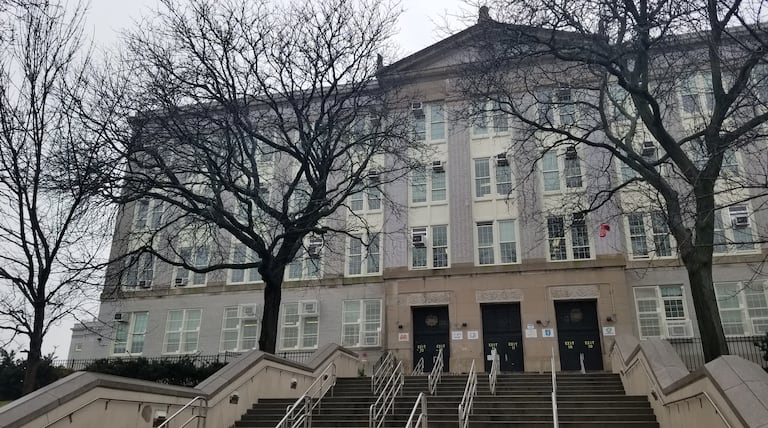
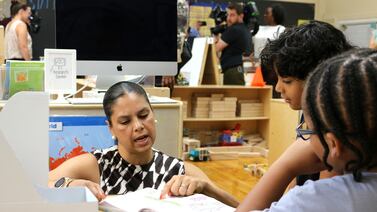
The classroom is actually a library at a Chinatown middle school with just 80 students, but school officials are hoping that it offers a glimpse into the future of the school system, one in which every student’s individual strengths and weaknesses are calculated before each day is planned.

Students in the new pilot program, a $1 million effort that officials are calling the School of One, take a quiz every afternoon, and then receive a computer-generated schedule each morning, called a “playlist.” A student’s playlist might tell him to begin the day by meeting with a tutor, then to complete a set of online tasks, and then to work on a project with his classmates. The program, which focuses only on math instruction, will expand to three sites in January.

Schools Chancellor Joel Klein will roll out the program today, along with its mastermind, Joel Rose, who previously worked for Edison Schools, the for-profit education management company now known as EdisonLearning. The announcement will mark one of the first initiatives of Klein’s administration that focuses on what happens inside classrooms since he unveiled citywide math and reading programs six years ago. That effort scripted moves down to how teachers should arrange their classrooms and the size of rugs.

The School of One project is based on the much different view that every student in the city should be taught a curriculum designed specifically for him or her, with technological innovations leading a transformation of the way teachers and students interact. Earlier this year, Klein told a New York Times columnist that he envisioned a school system where instruction was individualized by cutting down on the number of teachers and relying more on technology.

The School of One actually has a lower student-teacher ratio than typical middle school classrooms, with 10 students to every one adult. The summer pilot includes 80 rising seventh-graders from Manhattan’s MS 131 and, on the supervisory side, four teachers, four assistant teachers, and two high school interns, according to Will Havemann, a schools spokesman.

At the end of the summer, the department will test the students on 80 discrete math skills, and an independent group will assess the program’s effectiveness.

The department plans to open three School of One math programs in January, Havemann said. Expansion beyond that and into other subjects is dependent on the pilot’s success, he said. But he noted that most schools would not need any major structural changes before they could run a School of One program.

John Chubb, a fellow at the Hoover Institution and an executive at EdisonLearning whose new book “Liberating Learning” lays out the vision for using technology to individualize instruction and lower the number of teachers, praised the School of One in an interview yesterday. But Chubb, who co-authored the book with Stanford professor Terry Moe, cautioned that it’s too early to decide whether the program is working.

“There are lots and lots of people who are trying to figure out how to use technology to figure out its promise, which is to be able to meet the needs of students at their own pace,” Chubb said. “This is a very promising effort to try to do just that. How well it works out — who knows.”

CORRECTION: This article originally said that Joel Rose “headed” the Edison Schools company. In fact, he managed only Edison’s after school division. Rose joined the Department of Education in early 2007.

24 Comments

Subscribe to comments with RSS or TrackBack

  1. Super Interesting. Even though it seems infinitely strange to me just reading about it briefly here, and I immediately consider how well-cemented routines in classrooms and schools in general are important to kids learning (and us all) I’m all for this. An innovative summer pilot program that will be quantitatively and qualitatively evaluated at summer’s end is exactly the type of thing Klein and nyc should be doing. Especially using technology.

  2. Sara

    Great, now there will be no more reason to leave the home, because this program will eventually be shifted to home computers (to save money, you know). Students, who already spend way too much time on the web, ipod and tv will now find their education via video pixels with all the cute animations and other attendant gizmos and attention-grabbers. What happens if a kid using these customized programs fails to perform? Do you give a “U” rating to he computer? How about the software developer? Do we then begin to deliver counseling and such via a separate window on the screen? (”‘Atta boy! You can do it, Carlos!)

  3. JSS

    How can they state with a straight face that a program with a 10:1 student to teacher ratio is a pilot for removing teachers from the classroom?

  4. Point Guard In Chief

    this sounds like a setup for bogus research to me. it has been documented in some studies that humans who know they will be tested after a trial period perform better on whatever sort of exit-exam they are subjected to. seems to me that if a small group of kids and teachers who know they’re on the line are going to go out of their way to show some improvement when the data collectors come back around. does that really represent how this program would work if widely implemented in classrooms that then would not have this kind of immediate accountability? doubtful. …whatever, Edison has been so forthright in the past, we should just trust them:
    http://www.nytimes.com/2002/07/16/us/complex-calculations-on-academics.html

  5. Michael M.

    Is it just me, or does “School of One” sound a bit too much like “Army of One?”

  6. Michael M.

    Is this a stealth charter, or what?

  7. I don’t know precisely what it is. It does, however, contradict the basic cookie-cutter approach that students can only learn in semicircles or on rugs. Somehow, each year brings a new cry that this is the only possible way to teach, and that last year’s only possible way to teach was an utter failure.

    If this administration really wanted more individual instruction rather than lip service and cool-sounding distractions it would reduce class sizes, as it’s pledged to do–and for which it’s accepted at least hundreds of millions of dollars.

  8. canwetalk

    This is Klein’s Orwell’s 1984 and Space Odyssey 2001 initiatives. Will Klein eventually be replaced with HAL? Will Artificial Intelligence classrooms replace the personal interactions students have with teachers? Will computers sign the graduates’ yearbooks? I am assuming that some microchip will be chaperoning the cyberspace proms. Hey, George Jetson will be the chancellor of learning and teaching!

  9. Michael M.

    If this program is deemed successful, I hope to hear that a 10:1 student:adult ratio is a proven winner.

    And don’t forget the two high school interns — not even counted — or it would be 80:10, or 8 to “One.”

    But gawd ferbid the $1M for this pilot (with expansion plans locked in before the verdict) came from a PTA.

    Got iTweed Shuffle?

    BTW, how does this two-month pilot cost $1,000,000? $1M for say two months is a $6M/yr pace. Knock out 80 PC’s at $1k each. Say $5.92M. Are each of these eight adults making the equivalent of $740k/yr each?

    On the other hand, if the software development costs are so high, why is the city footing the bill on an unproven experiment? Where’s the Office of Accountability when ya needs one?

  10. Diana Senechal

    Perhaps this is not so different from Balanced Literacy as it seems. Both seem to follow the mantra of “differentiated instruction.” It has become more or less a crime to teach anything to a whole class, or to assume that there is anything substantial that a class should learn together. If you are not at least showing on paper (for the inspectors) that you are “differentiating” your instruction, you are in trouble. Of course, we do need to adjust our instruction for the different students in the room, and whole-class instruction is not appropriate all the time. But great things can be done with a whole class, and those should not be tossed out.

  11. Philissa: what exactly is an ” assistant teacher” and how does that differ from the asst. teachers that DOE has blocked PTAs from hiring, and about which practice the UFT filed a grievance?

  12. “It does, however, contradict the basic cookie-cutter approach that students can only learn in semicircles or on rugs.”

    NYC: you must have missed the requirement that the computers must be placed in a semicircle and on rugs in order for this program to be effective.

  13. Pogue

    Oh, I hope my grandchildren get a young, fresh robot teacher and not an old one that sits around, spits out worksheets, and defrags itself all day.

  14. The 2nd to last paragraph says that John Chubb’s book is “Liberating Education”. The correct title is: “Liberating Learning”.

  15. Thanks for the catch, Meredith. I’ve made the fix.

  16. Michael M.

    I can’t wait for the sequel: “Eradicating Education.”
    Or the for-profit-billionaire-eduphilanthropreneurs’ guide: “Chumming for Charters.”

  17. I suppose placing computers in semicircles entails less space than placing people in semicircles, so perhaps there’s some appeal for that to Tweed. After all, if there is any space, it’s usually earmarked for Eva Moskowitz anyway.

  18. Leonie: The “assistant teachers” are actually student teachers from NYU, I found out today.

    And Michael M: The vast majority of the $1 million was start-up costs to develop the computer algorithm and build a curriculum bank. The city says those features can be scaled up to other schools without much additional cost.

  19. [...] GothamSchools got the scoop on the pilot program, to be officially rolled out today. It’s a $1 million summer math instruction program for 80 seventh graders from Manhattan’s MS 131 being held in the library of a NYC middle school.  And it’s definitely…dare I say it…innovative. [...]

  20. Michael M.

    Thanks Philissa. In all seriousness, that’s what I would have guessed, so my second point still pertains.

    Why are We The Taxpayers paying to help a for-profit firm develop its software? Are we stakeholders in some kind of for-profit at-risk venture? Who will own the rights to the software? etc.

  21. What $1 million dollars to these guys — while they’re laying teachers off and class sizes are rising?

    Nothing.

  22. Frank Ruscica

    Small-scale, but portentous…

    On a related note, from http://edupreneursvkleptobankers.wordpress.com/

    “Canonical research findings suggest that American entrepreneurs who establish popular online markets for customized education will catalyze the creation of many good jobs in America, and will end the reign of America’s kleptobankers. Some of the researchers: Clayton Christensen, Paul Romer and Paul Krugman.”

  23. [...] learn more, check out articles in Forbes, Gotham Schools, and The New York [...]

  24. Valerie Visconti

    I am working on a piece about this initiative for the NewsHour on PBS. We will be visiting the school next week. If anyone is interested in talking with me about their viewpoints about this new program please contact me at 212-725-7000 ext. 246. Thanks!

    Valerie

Leave a Reply

Tips, questions, feedback?

Contact us at .

Mapping the Budget Cuts

Post a comment about the budget cuts at your school on our interactive comment map. more »

Chalk It Up

Our Twitter Updates

  • That was anticlimactic: Chancellor Klein just announced that school is closed tomorrow. Go stock up on cocoa now! 2 hrs ago
  • What are odds that tomorrow will be a snow day in NYC schools? Mayor Bloomberg is holding a 1 p.m. presser to discuss the city's snow plan. 2 hrs ago
  • Citywide Council on High Schools meeting is set to proceed as scheduled, for now. Same goes for the PEP meeting rescheduled from Jan. 26. 21 hrs ago
  • From the DOE: In anticipation of inclement weather, the Specialized High School open houses scheduled for Weds. have been postponed. 21 hrs ago
  • @datadiva What do you see as the biggest changes? We're having trouble figuring out what to make of the 2010-2011 changes. in reply to datadiva 21 hrs ago

Events Calendar

Archives

February 2010
M T W T F S S
« Jan  
1234567
891011121314
15161718192021
22232425262728

GothamSchools by Email

Technology in Education

The blogroll is a work-in-progress; to be added or if you've been miscategorized, send us an email at .