GothamSchools — daily independent reporting on NYC public schools

Klein bats away critics’ calls for checks and balances

baruch-mayoral-control2

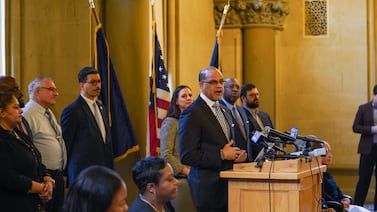
Chancellor Joel Klein responds to a question from moderator Doug Muzzio. (Left to right: Ana Maria Archilla, Doug Muzzio, Joel Klein and Monica Major) (GothamSchools / Kyla Calvert)

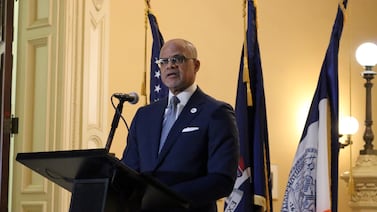
With the state legislature’s deadline for making a final decision on mayoral control less than two months away, Schools Chancellor Joel Klein himself made an appearance at one of the panels debating the issue across the city.

Sandwiched between assorted people who have called for curtailing the mayor’s power over the schools, Klein, who supports preserving the law intact, fielded criticism calmly.

When other panelists raised arguments about whether test scores and graduation rates were increasing at the dramatic rate touted by the Department of Education, the chancellor shot back with more data.

“In 2002 CUNY enrolled 16,000 students, in 2008 CUNY had 24,000 students enrolled,” Klein said. “I don’t care what you say about the graduation numbers — those are 8,000 real kids whose lives have changed because of the opportunities that are a product of mayoral control.”

Klein reiterated previous statements that he is open to having an independent agency review Department of Education data, like graduation rates and test scores. But he kept the door closed to other concessions. When the teachers union chief operating officer, Michael Mulgrew, asked Klein if he would be willing to consider removing MS 399 in the Bronx from the list of schools slated to close, Klein balked. (Mulgrew had replaced union president Randi Weingarten at the last minute; he is considered her likely successor as president when she transitions to running the national American Federation of Teachers union full-time.)

Mulgrew pointed out that the school’s English test results jumped 20% this year, according to results released last week. Klein initially replied by saying that another school that was removed from the closure list after the union threatened a lawsuit also had a relatively good year, with proficiency rate of 50%. But that should be tempered by the fact that the charter school the city wanted to replace it with saw a proficiency rate of 95%.

When Mulgrew pushed, Klein said he was “willing to engage in a discussion.” “But,” he added, “I want to wait to see the data, I want to see the math scores. I don’t make policy decisions in forums like this.”

In addition to Mulgrew, panelists at the debate, which was hosted by Baruch College, included a Hunter College professor, Joseph Viteritti, who led a commission on school governance whose recommendations Klein and Mayor Bloomberg sharply criticized; a member of the Campaign for Better Schools group; and a parent leader.

Klein was the only panelist who argued for maintaining mayoral control without any changes. Even the organization represented by his strongest ally, Rev. David K. Brawley, co-chair of East Brooklyn Congregations, has called on the state to create an independent advocacy group for parents.

Joining the chorus of those asking for more public discussion before decisions are made, a member of the audience, Martin Needelmann, of the Brooklyn Legal Service Corporation, drew a comparison to Mayor Bloomberg’s eventual embrace of affordable housing in Williamsburg, following a heated debate. Why couldn’t the same back-and-forth process benefit the city schools? he asked.

“There is a big issue here with having an independent board,” Klein said. “We would submit to going back to the old system.” He argued that the old system was better at blocking initiatives than at creating new plans.

“I think he avoided the issue,” Needelmann said after the panel. “The issue I raised was an example of how the mayor is not perfect and some of his appointments are terrible. Schools are different from other municipal services, consulting with parents is critical, and there has to be some power to it.”

Mulgrew also urged more public discussion. “Every policy should have some debate,” he said. “For most policy, it should be clear in terms of what is good for children, but shouldn’t we be sure?”

Leonie Haimson, the executive director of Class Size Matters, agreed with Mulgrew. “The panel tonight, this is what school governance should look like,” Haimson said.

  • Pogue

    Could we please start to get some data on how many students drop out of the CUNY system due to the cost of remedial classes and the rigors of college? Colleges have to take high school graduates. I want to know more about what happens to them when they get there. I’d love to see a little history and data on CUNY remedial classes and high school graduates.

  • Elizabeth Green

    I asked CUNY for this information months ago and was sidelined. Admittedly I didn’t push hard enough, but maybe there’s some way we can all leverage our desire for the hard facts… I will dig up my e-mails with the spokeswoman tomorrow and try to think of a way to do this. Keep pushing us on it!

  • Michael Fiorillo

    The Chancellor’s statement about CUNY is typically erroneous, deceptive, or both. CUNY admissions are skyrocketing primarily because of the economic crisis, in addition to its increasing appeal to nonresidents drawn to the city and its low tuition.

    For a prominent lawyer, I’m surprised to see Mr. Klein to respond with such a non-sequitur.

  • Michael M.

    New York, New York…
    It’s a wonderful town.
    Enrollment’s up, Graduation’s not down.
    There’s towers up, but no schools to be found.
    New York, NEW YORK…
    Bring the Chancellor to ground!

  • Michael M.

    Re the 20% leap in scores at MS 399…
    As often as I have criticized the School Progress Reports for their over-reliance on the flawed-in-any-weather “progress” metric, it would be interesting to see what letter grade MS 399 would get according to the CHANCELLOR’s own grading system.

    A 20% swing in “performance” would drive an even bigger swing in “progress.”

    Klein gets an “A” for avoiding the point.

    Oh, and let me guess: MS 399 would be replaced by… a charter?

  • Socrates

    To Michael’s point, it would be interesting to see what enrollment/applicant numbers in CUNY-like schools across the country are. I agree that they’re probably up everywhere. I also think it’s strange that Klein uses this as a new indicator of success when he says the NAEP is not relevant as an indicator because it’s not the metric mandated by NCLB. I’m not an expert on the specifics of NCLB, but I’ll go out on a limb and say that I doubt CUNY enrollment is included in their menu of accountability options.

  • http://ednotesonline.blogspot.com/ Norm

    The important point seems missed that Klein argues for dictatorships of absolute control of school systems made up of people of color in contrast to systems with mostly white kids where parents have a higher level of input is basically racist and a great contrast to his citing of civil rights.

    When the ed deformer program is declared a failure – and it may take a decade or more to see this – the new civil rights demand will be to take back the schools from dictatorial mayors.

    It’s nice to see Marty Needelman involved in this debate. He has a wealth of experience to put on the table. We grew up together in East NY and he’s been involved in Williamsburg for over 40 years. His intial activity was in the schools as a lawyer working with the community and it was through him that I became politically active in 1970, trying to create a dialogue in community school board meetings.

    Remember those? No matter the level of disfunctionality, there were 32 public forums every month. Instead of tweaking mayoral control, we should let it sunset and tweak the old system which could have been fixed.

    And remember, those were only k-8 while the high schools remained centralized, as they always had been for a century. Klein’s first reorganization actually reduced the centralized structure of high schools by putting them in 10 regions, which was a disaster. He doesn’t get enough “credit” for the multiple reorganizations, each one worse than the last.

  • http://www.classsizematters.org leonie haimson

    What one has to examine in addition to the additional no. of students enrolling at CUNY is the percentage — given that the total cohort nos. of students of HS age were increasing over this period as well.

  • rick mangone

    Coupled with the Marist poll released today that indicates that the majority of parents do not favor the exisiting system of total unbridled mayoral control, the chancellors comments or lack of accountability by his averting the question appears to be a major victory for the good folks. Way to go MM and Leonie. At least that is the opinion of an old unionist still in the trenches.

  • canwetalk

    Klein is so anal about data that drives the Mayor’s agenda that will keep in a very lofty position that Klein is averting the data that shows that students are not succeeding in college. Klein states that there should be no social promotion and all high school students are held to this purported “promotion policy”. Yet, when the stats don’t look good, which makes the mayor look bad, then principals, out of fear of losing their job, will put tremendous pressure on teachers to push students forward at the cost of those students’ rightful education. As a teacher, I want every child to learn, to be given the time to learn, to experience learning, to embrace the love of learning, and if it means for that student to take longer than the required time so be it! Graduation should not be at this set term of 4 years. It’s not reasonable because progressive learning or knowledge acquisition is not a set time frame. Some children take longer, but they learn. Could you imagine if you were told that you HAVE to finish a four-year college course in exactly four year! High school was meant to prepare the students for the future, NOT for the stats! Colleges are now responsible for teaching all the high school course in college. Those individuals interested in changing the law and promotion policy should revisit the issue of what does graduation from high school really mean and what is the acceptable time frame for the individual student. Maybe high school graduation should begin in college and teachers should teach up to grade 11 and allow the college professors to do the rest. Then we can blame the colleges for the low high school graduation rate from their campuses. Something to think about.

Tips, questions, feedback?

Contact us at .

Follow GothamSchools

RSS

Feb. 10: You’re invited!

Chalk It Up

Recent Comments

18 comments so far today

Our Twitter Updates

  • We're headed to Cobble Hill to The Schools for International and Global Studies; parents say they are suing Eva Moskowitz, co-location plan 1 hr ago
  • MT @NYDNBenChapman: Chancellor Dennis Walcott said he spoke with FBI agents at PS 243 this a.m. where aide is accused of molesting students 1 hr ago
  • RT @NYDNBenChapman: Schools chancellor Dennis Walcott just arrived at PS 243 where teacher aide allegedly filmed kiddie porno in school 1 hr ago
  • Says a Robeson senior: “Teachers will let us eat during class, but it’s just chips, not a full meal. You can’t live off chips alone.” 1 hr ago
  • At Paul Robeson High School, which is phasing out, students start at 8:35 a.m. but don't eat lunch until after 2 p.m.: http://t.co/VeMk5hLH 1 hr ago
  • More updates...

Archives

February 2012
M T W T F S S
« Jan  
 12345
6789101112
13141516171819
20212223242526
272829