Post a comment about the budget cuts at your school on our interactive comment map. more »

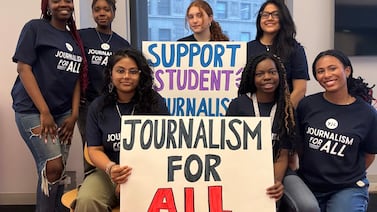
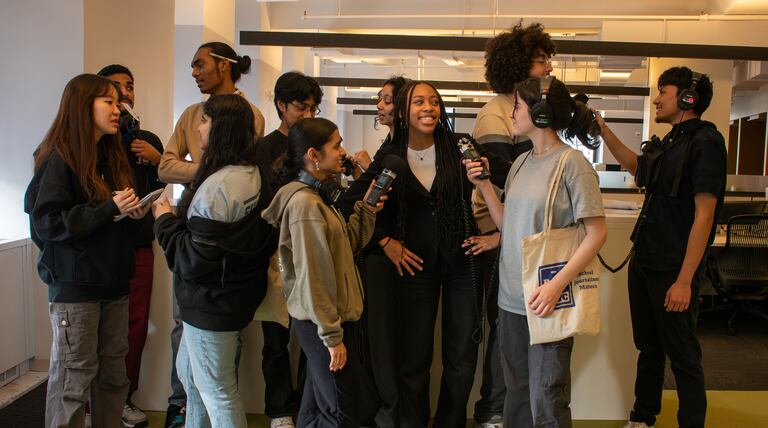
Renaissance students organized a protest against the freeze in their budget. (Lisette Lopez, Renaissance junior)
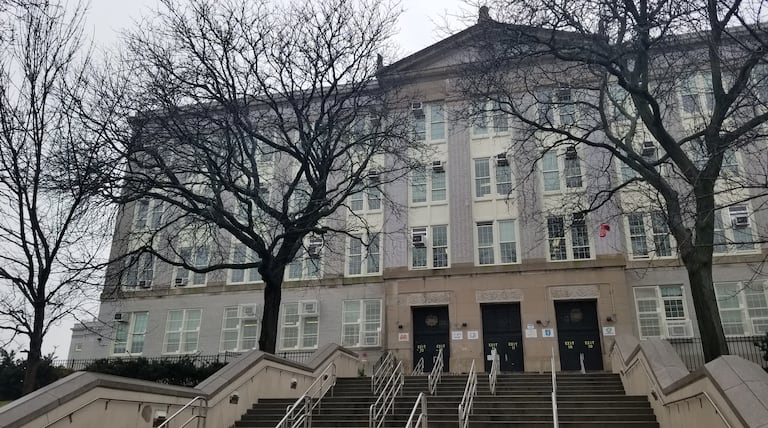
Staff at a Queens charter school that is represented by several city labor unions are growing frustrated with the unions, which they worry sat quietly by while state lawmakers slashed charter school budgets two weeks ago.
The school, Renaissance Charter School in Jackson Heights, is expecting a cut of between $500,000 and $600,000 from what was projected for next year after state lawmakers froze planned funding increases to charter schools two weeks ago.
Charter school activists have said that they’re hopeful that Senate Majority Leader Malcolm Smith, who founded another unionized charter school in Queens, will yet restore the extra funds to charter schools, but no deal has been struck yet.
That leaves teachers at Renaissance planning for possible teacher layoffs and big program cuts. (The $500,000 cut from the increase the school was expecting is especially hard to shoulder given that pension costs are skyrocketing by $300,000 next year and teacher salaries are slated to go up.)
A main frustration, a Renaissance administrator said, is that the unions to which Renaissance’s staff belong did not give them a heads up about the cuts — even though staff repeatedly asked union leaders if they should expect a cut. “Our members here feel shafted,” Nicholas Tishuk, Renaissance’s director of programs and accountability, said. “We were told that this charter school cut was mentioned two months ago, and it hasn’t been on anyone’s lips. And then we find out the Sunday night before the vote on Tuesday that not only was it on everyone’s lips; it’s actually happening.”
Most charter schools in New York City are not represented by teachers unions, since the schools operate outside of the Department of Education and therefore do not see their staffs unionize automatically. But the union has fought to bring charter schools teachers into its fold. Their slow but steady inclusion has put the union in the tricky position of on the one hand lobbying for limits on charter schools, while, on the other hand, representing some charter school staff.
Renaissance teachers had joined other charter school union members in a campaign to lobby against possible cuts to charter schools after a New York State teachers union official, Alan Lubin, indicated in February that he supported slashing funds to charter schools. Charter school supporters said that what he called for would have amounted to a double cut for charter schools, whose funding is based on the amount of money that goes to traditional public schools.
The concerns led a group of charter school teachers represented by unions to plan a press conference that would have called on the president of the New York City and national teachers union, Randi Weingarten, to denounce Lubin’s testimony. But the press conference was canceled after Weingarten wrote a letter to charter school teachers assuring them that she does not support unequal cuts. (Peter Murphy, of the New York State Charter School Association, first reported the canceled press conference on his blog.)
Tishuk, who as an administrator at Renaissance belongs to the Council of School Supervisors and Administrators, said that he also reached out to his union for advice, and was told by president Ernest Logan that he had not heard of any cuts. (I’ve yet to speak to Logan about this; I will report back with a comment from him.)
Tishuk said that representatives of the city teachers union, the United Federation of Teachers, came to Renaissance last week to discuss concerns about the budget with staff, meeting first with Renaissance teachers and then with administrators. Tishuk said that staff members did not leave satisfied.
“We don’t think that it’s consistent to have a union charter school basically lose the support of the union. There’s plenty of political back and forth — they say the numbers are this, we say the numbers are that – but no matter how you cut it, next year I’m doing a budget that’s going to have $500,000 less in income, and $300,000 more in costs,” he said.
Tishuk said that he was also dismayed by testimony from a leader of the DC 37 union at yesterday’s City Council hearing about charter school expansion. A union leader testified critically of charter schools, yet office aides at Renaissance are represented by DC 37. “It just blew my mind,” Tishuk said.
I have not spoken yet to the two UFT officials Tishuk said he spoke with. I’ll report with those details.
Tishuk’s testimony to the City Council is below. You can also check out this Web site that students at Renaissance have made to protest the funding freeze.
Esteemed City Council Members,
My name is Nicholas Tishuk and I am the Director of Programs and Accountability at the Renaissance Charter School. Our small school has served the Jackson Heights community in Queens for fifteen years and currently serves 530 students grades K-12.
We are a school that works: we have happy kids, a dedicated and respected staff, and an involved parent body. We have received “A” ratings on our most recent K-8 and High School progress reports from the Department of Education and have K-8 and Regents scores that outperform similar schools and the City averages. We are, in the very best sense, a community school serving the needs of families in Jackson Heights, District 30 and Queens. As a conversion school, we are one of the oldest charter schools in New York City.
Our message is clear, charter schools are public schools and our 530 students and their families deserve to be treated with respect. The recently passed budget from Albany has been called a “freeze”, but we had already received a preliminary allocation from the Department of Education and this “freeze” has slashed our expected budget by over $500,000 for the 2009-2010 school year. This catastrophic budget cut has forced us to come together as a community. I invite all City Council Members to visit our student developed website, linked below, which documents the rallies and march that our students participated in to let elected officials know how these cuts affect our small school in Queens.
Councilmen Dilan’s New York City Resolution 1889 is a step backward. By making access to facilities and space more difficult, the City Council will be making a grave mistake. I am an absolute believer and advocate for public education in New York City and, whether foes like them or not, charter schools are public schools full of public school children. To cut the funding for these children, as Albany has done, or to restrict their access to buildings, as Resolution 1889 proposes, is an injustice against the civil rights of our students to a great education.
Thank you for your time.
Nicholas Tishuk
The Renaissance Charter School
The charters are now getting the same equitable funding as the DOE-operated schools, which should have always been the case. What the Albany budget does, cuts and all, is put charters and DOE community schools funding on a par. Of course they both deserve more funding, but blaming the UFT and the CSA –as Elizabeth’s source seems to do–for cuts to the charters is bogus.
Eumenides you are flat out WRONG. Charter schools get about 70% of what district schools get in funding.
That was BEFORE the second cut made by Albany this year.
Hey, Kitchen sink, would appreciate a link or two on that comment.
Tom
I don’t think anyone has published a reasonably precise calculation of relative funding of charter schools and traditional public schools. Having done some work on this, I would estimate that charter schools get a bit less than traditional public schools. My latest guesstimate is 93%, but “guesstimate” is the appropriate word! I wouldn’t be surprised if my guess is significantly incorrect.
Unfortunately, the DOE hasn’t done a good job of releasing the information that would be needed to make a more precise statement. In theory, the best solution would for school funding to follow a strict “money follows the child” approach in which all schools received all of their funding based on a formula that considers the number and demographics of their students and didn’t consider the form (charter or traditional) of the school. There are many practical reasons why this is difficult, of course, but I hope we head in that direction.
Ken, does the State Charter Schools Association have anything in black and white?
I know that they estimate the capital debt service to be about 30% of state aid to district schools, and that’s exactly what’s taken out before it passes through to charters.
I’m also basing my analysis of the number on the published report of $16,212 per school listed on the state’s Comprehensive Education Report for each NYC public school. See https://www.nystart.gov/publicweb/School.do?county=NEW%20YORK&district=310300010000&school=310300010087&year=2007 for an example, PS 87M, and click on the report to open the pdf. The per child expenditure is at the bottom.
That $16,212 is for FY 2006, when charter schools in NYC only received $9,084 per child. 56% doesn’t pass the smell test, it seems unreasonably low, and if it were accurate you can be sure the state association would be trumpeting it up and down the NYS Thruway. It’s unclear, for example, whether that figure includes special education funding, for which charters receive a small amount per child based on the level of service they are providing.
Charters in 2008-09 (and now, it seems, in 2009-10 as well) receive $12,443 per child, which is still less than DOE schools purportedly spent per child in 2005-06. DOE spending has risen by between 8 and 10 percent per year (I am pulling that number out of my, um, ear, but I don’t think you will find anyone to dispute that), so the DOE is now likely spending in excess of $20,000 per child.
THe DOE is certainly making up for the budget gap with the in-kind contribution of DOE space for many of the charters, putting those charters in DOE space on par with DOE schools…until this funding freeze, which is after all what the whole post is about.
Charter schools receive roughly 70%-75% of what public schools are allocated in per-pupil spending. In addition, charter schools are not allocated any facilities funding whatsoever, ultimately meaning they are significantly shortchanged when compared to their traditional public school counterparts. Consequently, even when it comes to charters in DOE space, they are not allocated any money to renovate or maintain those classrooms. It’s a major issue for charter operators.
While I have no data to back this up (I just wanted to quickly respond to the post), having worked for a charter school, I can assure you this is the case. Just wanted to openly concede that.
As a parent of children who attend a nyc charter school, I just want it noted that I pay the same amount of taxes as a parent of a child who attends a regular nyc public school and I don’t see how my children receiving anything less than what those children is receiving is anything but unfair!!
Charters definitely don’t get the same funding as regular public schools and this is really stoo-pid. Children should get the same funding regardless of the school they attend. I suspect what is behind efforts to stop full transparency in per child funding is that it will lay bare how much the Department of Education spends on things that never get to the school level, like the billions and billions that go to teacher pensions, health and welfare benefits, sabbaticals, etc. Everytime the UFT says that they want more funds to go “in the classroom,” this is what they are really talking about.
As my mom would have said, with friends like these who needs enemies? I wish the unions would rethink their policy of uniformly shafting charters, even the unionized ones! Shouldn’t they be courting charter schools instead? Charters considering unionization are almost certainly going to be put off by the UFT’s (and other unions’) very public mistreatment of their own members. They’re just providing fuel to the anti-union rhetoric. I am staunchly pro-labor but the UFTs behavior is outrageous and far from their stated mission of teacher advocacy.
First, I want to point out that if you don’t control for special ed students & their funding, you’re not making close to an apples-to-apples comparison.
Second, and more importantly, I think that this story — rather than the arguement dominating this thread — is a fascinating product of a confused larger debate.
For many (most?), the most important thing about charter schools is that their teachers are not unionized. On the other hand, the unions are trying to sign them up, and some faculties are interested in doing so. However, the larger fact remains that most charter faculties are NOT unionized, and the right wants very much to keep it that way.
So, the unions are right now between a rock and hard place. On the one hand, they want to protect their members and fight for funding to go to schools that actually recognize workers’ rights. On the other, they have an obligation to *all* of their members, not just the ones whom are most easily recognized as working at unionized schools.
I don’t know what the best answer here is. Obviously, the union had a obligation to keep the charter teachers informed — an obligation they failed to live up to. But give that that vast majority of their members are not in charter schools and the charter movement is in large part an effort to deny teachers basic rights as workers, it makes sense for them to fight charter funding.
And so, I wonder if charter faculties ought to sign up with traditional teacher unions. Or, perhaps in NY (an AFT state), they should sign up with the NEA.
I just don’t know.
ceolaf, good point. It is very sticky.
I feel the unions have shot themselves in the foot. The lives of unionized teachers in this city are not (imo) going to change noticeably for the better if the union manages to use their considerable political weight to cripple the charter school movement in NY. At the same time charters are very much on the national radar and not likely to go away. By not supporting their unionized charter members, the message the UFT sends is: If you’re a charter in NY, why unionize? You get all the fees and restrictions and none of the help. Hacking indiscriminately at charters makes the union look greedy and self-interested which is Exactly how the right wants them to look. This is why I said I wish they’d rethink their strategy. Many of the charters who started conversations with the UFT to unionize have since backed away. I don’t know if that’s because of recent events but everyone is watching. Hamfisted moves like cue cards and denying the funding differentials for charters, trying to present charters as “not really public schools” and the like, are tactics that are making unions look worse, not better.
But charter schools are not public schools; they’re private schools capitalized with public funds:
- they are run by private boards that are not accountable to the public.
- many, if not most of them cherry pick their students, either on the front end by having a
self-selecting population to draw from; or on the back end by having students and parents
sign contracts and by students being subject to easy expulsion for behavioral or academic
reasons.
- they receive huge direct and indirect corporate and philanthropic subsidies that are denied
local public schools.
The infuriating reality of charter schools is that the idealism of young teachers and the yearning of parents for opportunities for their children are being manipulated by a constellation of forces that seek to privatize public education, while cynically using the rhetoric of civil rights.
As a UFt chapter leader, I’d be the first to recognize the union’s many missteps, although I’d say their greater sin has been its unwillingness to do everything necessary to expose this monumental exercise in fraud and self-delusion.
Charter schools: knaves or dupes, take your pick.
Michael, sounds like you’re the dupe, one who’s been misled by your union leadership seeking only to raise its coffers. And attempting to destroy children’s futures in the process. (Randi to children: drop dead). If you’re going to post such an inflammatory statement, please check out your facts and do some thinking first. You are dead wrong–charters are public and even the most ardent opponents publicly admit that (while they will quietly spread this damaging rumor behind closed doors).
A private school (a) is for-profit, meaning the owners of the corporation pocket any surplus dollars the school raises, (b) generally, though not exclusively, charges tuition from its students, (c) is not accountable to the State Education Department for its results, but instead to one or various accrediting agencies, and (d) is not supported by public funds.
Let’s go point by point, then we’ll look at your objections.
(a) All charters in NYS are required to file for 501c3 tax exemption by the IRS. They cannot do so without meeting certain strict qualifications proving that they are not, in fact, for-profit. Boards are composed of volunteers, meaning if there is excess revenue (ha ha, not likely given the funding disparity), it goes back to the school, not to any “owner.” There is no owner - it’s the state, you and me.
(b) Charter schools are free tuition.
(c) Charter schools take all the state tests, have regular visits by state officials and are required to follow all state laws as outlined in the New York Charter Schools Act of 1998.
(d) That same act authorized the legislature to provide funds based on district expenditure, for some reason excluding capital funds. (Obviously charter school children don’t deserve buildings.)
Now for your objections:
Charter school boards are required to follow the NYS Open Meetings Law. This means that board meetings are public meetings. When is the last time decisions were made in the DOE at a public meeting? To say that these boards are “private” only means that they are not open for just anyone to join. New trustees are picked by each other, and certified by the state. That last step is key - doesn’t sound private to me. I would be surprised if, as a chapter leader, you would suggest that it’s better to have decisions made not by a small body of interested and skilled community members and professionals but by the political fathers that populated the community district school boards in the past, or DOE hacks on various other decision making bodies.
Secondly, you asser that charters cherry-pick their students. When is the last time you attended a lottery? These are massive exercises in randomness. Signing up for a charter school is as easy as signing up your child for the district schools. In some areas, charters are even MORE accessible to our most vulnerable kids. Charter schools generally serve high-poverty students, and the charter law specifically states that the mechanism is intended to assist at-risk kids. As far as “contracts” go, any such documents cannot have a clause stating that children will have to leave if parents do not follow the agreed upon strictures. Children cannot be pushed out for academic failure or just because the school thinks they’re bad kids/bad parents. Charter schools actually don’t talk about kids and families that way - the opponents who make up these “cherry picking” analogies do. There are simply no data to support this claim. If there are hordes of disenfranchised families who have been illegally kicked out of charter schools, then let’s see the teacher’s union show its true face and spend its hard earned dues money organizing those parents. I’d even contribute a donation to that organizing, as I’m all for more support for disaffected, disenfranchised parents. In fact, I want them to choose charter schools. Because by their nature, their activism and their welcoming of families, charter schools actually CREATE engagement in families. They FOSTER the kind of support for kids that charter opponents decry is lacking in the families who “stay behind” in district schools. Maybe in doing this kind of organizing charter opponents would learn the lessons that charter schools already know: that if you listen, support and welcome parents, you dissolve that disaffection.
Third, on the subject of private fundraising. Please provide a list of all of the non-DOE programs (such as Chess in the Schools, Junior Achievement, Principal for A Day, anything sponsored by PTA fundraisers, etc.) that your school has. Now tell me about corporate philanthropy. Guess what? The DOE is also non-profit. And guess what? The DOE also raises private funds. Ask Caroline Kennedy!
Some PTAs at wealthier district schools actually raise hundreds of thousands of dollars per year for school activities and materials. This is impossible at a charter school with a 90% poverty rate. Yet, absent DOE facilities support, which is thankfully still on the rise, charters are required to find and fit out their own buildings.
Remove the blinders from your eyes, put aside your self interest and do more research. You’re flat out wrong - says this ex-UFT member who left the union and the DOE because it simply wasn’t serving kids appropriately.
And finally, ceolaf, for me, for my colleagues, for parents, it doesn’t matter one way or the other whether charter schools are union-organized. It’s that last point that matters: are they serving kids appropriately? Do you really think that most charter school teachers WANT to unionize? For many of them, the UFT is a symbol of all that’s wrong with the DOE, all the bureaucracy and politicization of school funds that they sought to escape by teaching at a charter school.
Much like the ballyhooed but not factual disaffected parent group kicked out of charter schools, don’t you think that if hordes of charter school teachers wanted to unionize but weren’t allowed to, there would be a massive uprising? Or at least a huge churning of teachers at charters - that would prevent the kind of unprecedented success charter schools are experiencing across the city?
Stop this nonsense and learn more about charter schools. They are here to stay, with or without union support and representation.
I commend you for leaving the DOE because it is not serving the kids appropriately and I share your anger and distrust at the leadership of the UFT. Now, if we could only get rid of those at the top of both entities, the children, parents, and teachers would be better off.
Anonymously,
You’ve written a lot of things that I don’t agree with.
First, there are lots of reasons to unionize. They include:
* A local show of power, aimed at getting a real voice a local table of decision-making.
* A local show of power, aimed at removing arbitrary and inconsistent treatment of teachers replaced with something more orderly and reasoned.
* A local show of power, aimed at giving workers better leverage in compensation negotiations.
* Access to prices and deals that can only be gained through large groups (e.g. dental insurance).
* Gaining a voice voice at many levels, to gain a voice at other levels of decision-making to potentially balance voice of others at those tables.
Clearly, the UFT failed in the last one for these teachers. But that doesn’t mean that these teachers shouldn’t unionize. The benefits of unionization are not limited to having a voice in Albany.
*************
There’s often a real question as to whether unions — and I don’t mean any particular union — has best represented its own interests or the interests of its members. One legitimate complicating factor is that many unions try to consider the rights of their current members and their future members — or potential future members.
I don’t think that there is any evidence that non-union teachers are treated better by their administrators or districts than union teachers, or that they are higher paid. So, it IS rather in the interest of future teachers that unions fight for unionization of all schools. That doesn’t necessarily mean a long contract or particular provisions, but unionization gives the teachers a chance to establish their priorities and get them made part of the official priorities.
***********************
Don’t confuse unionization with particular contract provisions. You certainly can have the former without the latter, and the latter can be imposed on a system without the former (e.g. the salary scale and seniority system, but of which predated teacher union contracts by decades).
Michael,
You make good points, and I understand why charter schools do not seem to be public schools to you. And I think that Ken might agree with you that they publicly financed private schools. But not everyone would.
First, it is in the interest of charter school operators and proponents to have people view them as public schools. That way, they gain legitimacy, make their funding more stable, and have a better chance of attracting certain kinds of employees and further support.
Second, it is in the interest of many who do not support them to have people view them as public schools, too. It gives us leverage by establishing a basis for our arguments. For example, if they are private schools, then if they are are concerned with delivering private good, that’s not a real problem. But if they are public schools, then that’s obviously a problem. Another example concerns whether or not they are government entities. As government entities, they are obliged to follow certain laws and respect certain rights. The government is regulated by the constitution and the law in ways that private entities are not.
I suppose that it comes down to how your define “public school.” They certainly do challenge old ideas about what public school is, and it is understandable why you might think that their challenge is so great that they cannot be reconciled with public schooling. However, I think that it is only in the interest of those whose goal is defunding them to take that stance. For those of us whose goals is to fix their fundamental problems — and failing that, defund them — and those who would continue them or even expand them, it is in our interest to accept them as public schools.
KitchenSink,
While I agree with you that charter schools ARE public schools, there are some serious flaws in your argument.
First and most fundamentally, virtually all of the points you make are specific to NY charter schools, and therefore products of NY’s charter school law(s). There are many other states with charter schools, and they work in different ways. Also, there are large parts of the charter school movement who consider a “strong” charter school law one that limits or controls charter schools as little as possible.
Second, most private schools are non-profit institutions, as I understand it. In fact, I cannot think of a single for-profit private K12 school off the top of my head.
Third, lots has been written — including here at Gotham Schools — about the ways that charter schools cherry pick their students. Clearly, some do it more than others, and perhaps some do it hardly or not at all. But KIPP’s lotteries do not insulate it from the cherry picking charge, for example. The discourage families that are unwilling to committ to their demands on families and students to apply, and appear to encourage them to move their students to other schools if they get in. Also, while some lotteries are held publicly, I believe that most charter and non-charter lotteries are held behind closed doors; we don’t really know what is going on there.
As for unionization of charter schools, I understand that many in the charter movement do not care either way. But it has been quite clear that many do — and most of the powerful backers of the charter movement care quite a bit. I understand that you have not been impressed with the UFT, and I certainly do not seek to defend it. But the UFT is not unionization; it is just one local of one union. And as for whether most teachers want to unionize? Well, I don’t think that most of them understand what unionization is really about — it’s not something we really cover in school — and so I don’t think that they have informed opinions. If they understand the history of the labor movement, understood the history of the treatment of teachers in American in NYC, and understood the benefits and purposes of unionization, perhaps most would. And, if unionized teachers in non-charter public schools in the city understood these things, perhaps they would demand a different kind of union. But — to complicate all of this — I believe that there is also a class thing going on there, in addition to a bunch of other factors.
It’s complicated, KitchenSink. It’s complicated.
Ceolaf, your argument that charter schools “cherry pick” students is fundamentally flawed. Charter schools overwhelmingly service poor black and poor Hispanic families. It is not like middle class families are flocking to enroll their students there. And in New York City, it is the poor Black and poor Hispanic families that the so-called “neighborhood” schools of the Upper East/West Side of Manhattan and Brooklyn Heights have always tried to exclude and segregate, much to the approval of those neighborhoods. So I ask, just exactly what “kind” of students are charter schools “cherry picking” if they overwhelmingly serve the students who have been traditionally excluded from the best public schools?
Crusader, I hear ya on two fronts.
1) I think the “cherry picking” is with respect to Spec Ed and ELL, not socio-ecomic groupings (ethinicity and/or Title 1 status), and the effect on aggregate test scores.
2) De facto segregation is indeed the flip side of “neighborhood schools.” But the charter school topic and desegregation are two distinct topics, even if overlapping. Squeezing local kids out of their zoned non-charter school ain’t the solution.
Ceolaf, I’m not sure where you think you and I disagree in regards to collective organizing. I am pro-union, as I stated above, for all the reasons you mentioned and more. My point was that the UFT and other unions who are taking a non-nuanced, anti-charter stance are hurting themselves by punishing all charters unilaterally and ALSO creating an environment that encourages hostility towards unions in general.
I think we’ve arrived at this (as you say) complicated pass because some of the more high-profile charter schools have become the short-hand reference point, good and bad, for the entire charter school movement. I honestly don’t know to what extent charter schools engage in negative behaviors like “creaming”, etc. But I think we can identify and correct behaviors (like creaming) that are not in the proper spirit for public schools without unilaterally condemning an entire approach to educational reform nor tarring all schools with the same brush. Certainly creaming is neither new nor unique to charter schools.
And it’s this “shoot em all and let g_d sort em out” approach that I find most unsettling about the UFTs stance. If there are educational practices that are wrong, we can probably agree as a community in their wrongness and stop ANY school for engaging in them. As you concede, maybe some charter schools aren’t engaging in any behavior we would find objectionable. If the UFT wanted to identify best-practices or standards for excellence in educational practices and set about enforcing them through social pressure or legislation, I think that would be constructive and helpful. But what I do believe is that if all charters signed up for the UFT tomorrow, we would never hear another word about creaming/cherry picking, private funding, the existence of charter boards, or how charters are the reason why some public schools are failing.
Charters are not a right-wing conspiracy. Many are extremely progressive politically. In concept and design, they are politically neutral. Tarring all charters with the same brush will have the effect of polarizing an argument into an “us” vs “them” where charters, especially smaller, independent ones, will have no choice but to seek cover with the larger charter players, many of whom ARE anti-union. Let’s try to stop this from happening.
Kitchen Sink,
Your response to my post is filled with inaccuracies and distortions:
First of all, I said charters are private schools, not profit-making entities (although that is the covert objective that underpins them, a reality that many naifs cannot or will not recognize); you put those words in my mouth, either from misreading me or intentionally distorting my words. Also, many explicitly private schools are non-profit corporations.
You say in your response that “you and me” are the owners of charter schools. But that’s exactly their insidiousness: “we” capitalize them but they are and remain- no matter what you say - private corporations managed by private groups. You proved my point with your own words: “New trustees are picked by each other. ” And since so many of those trustees hail from Wall Street, in particular the hedge fund and private equity world, the deeper motivations and latencies begin to reveal themselves. As for the open meetings law, that’s a poor consolation for the loss of democracy and public input into policy. So what if the public can attend if there’s no vehicle for affecting change?
You speak of “randomness” in the lotteries, but you still evade the point that they by their structure invite the participation of self-selected populations. As for cherry-picking after the fact, it has been publicly reported that both KIPP and Eva Moskowitz’s Harlem Success Academy have high attrition rates among their students, to say nothing of their incredible teacher attrition rates (which by the way gives the lie to these schools purported concern for students; a stable teaching staff is a sine qua non of an effective school). Moskowitz has been quoted as saying that if you don’t accept the program, the school’s not for you.
I assume your attack on “DOE hacks” refers to former Board of Education employees and administrators, since by referring to the DOE you’re referring to the corporate ed deform regime of Klein and Bloomberg that is the chief patron and enabler of charter schools and the resulting privatization of public education. However, by attacking those folks, you seem unaware that whatever their many shortcomings, virtually all of those people were career educators, accountable to public officials and publicly elected boards, unlike the consultants and lawyers who currently run the DOE.
Crusader, you conflate black and latino students with middle-class students. The reality is that, as with other populations, there is a lot of variation among the poor and racial minorities. There is a substantial low-income population of working, stable families who are deeply involved in their children’s educations. This is the population that charter schools are drawing from, whatever their protestations. Their is also a large low-income population of black and latino children coming from families that are broken and unstable, suffering from high rates of under and unemployment and incarceration, who have suffered from poor or no pre-natal care, low birthweight, and all the other stifling nuances of poverty. These are the children charters and their champions are not serving, instead casting them off into the remaining public schools, which can then conveniently be labeled failing.
As one poster said, charter schools are not a right-wing conspiracy, and that’s true. Rather, they are a ruling class consensus, powered by a huge PR machine that has been uncritically covered - or in the case of The Washington Post, owner of Kaplan, dishonestly covered - by the mainstream media.
It’s a shame that so many energetic and well-meaning people are having their idealism and efforts manipulated by a corporate program that has hijacked what were originally teacher and parent-led efforts to reform the public schools. Instead, the gravitational pull of managerial control of curriculum and instruction, and profit-seeking will inevitably lead many of these schools to be turned into for-profit franchises. After all, why do you think all those private equity, hedge fund and venture capital people are sitting on charter boards and working as COOs?
All those self-described progressives - who are in fact unwitting union busters - will be terribly disillusioned when in the coming years, if their still teaching at all, they find themselves purged as the true face of corporate ed deform shows itself. See how “progressive”it all appears then.
By the way, and for whatever it’s worth, although a UFT chapter leader and staunch trade unionist, I am a public opponent of Randi Weingarten, and a member of a dissident caucus in the UFT.
.
Crusader,
I actually would not volunteer the term “cherry pick” for what charter schools do. I should not have picked up on the word in this thread, because of that. I think that cherry picking implies picking out individual students. I think that what charter schools is a bit different than that. Skoolboy covered the issue quite well in his post, “Toward a new definition of ‘creaming’”
http://gothamschools.org/2009/02/17/toward-a-new-definition-of-creaming/
Anonymously,
Actually, I *do* think that charter schools are a right wing conspiracy. They are other things, too, of course. But most of the political power in the charter movement comes from people on the right, and their aim — in my view — is at the labor movement generally and teacher unions in particular. They do this because unions are reliable supporters of the Democratic party, making phone calls on behalf of Democratic candidates and doing the labor-intensive work of going door to door to identify likely Democratic voters and get them to the polls.
Whether or not unions are right to do that, to organize that or to allow that kind of grass-roots organization to happen through their own organizations, that is what they do. And, that is why — in my view — the right has latched on to charter schools.
Obviously, there are other members of the charter school coalition. There are business interests who believe that principles of marketplace — which we know work so well, right? — should be applied to our public institutions, who believe that regulation is bad and the abject failure of some is the acceptable price for the greater success of others. Of course, these people have remarkably little experience with schools or the public sector generally, and therefore cannot really bring their egos to bear on the real work of schools (i.e. instruction, care for children, etc.), and instead focus on governance issues because they are more easily reshaped to match their own institutions and experience. Not a conspiracy, but a dangerous and ego-driven naivete. (Though, clearly, some of them ARE also in on the right wing conspiracy, too.)
There are also members of relatively powerless communities who have not been well served by schools or other public institutions. They see charter schools — like other forms of decentralization — as a way to bring some of that power to their communities, or closer to their communities. They are the ones I respect and care for most in the charter coalition. They have a lot of valid complaints, and I have devoted my career to improving their schools. Unfortunately, I am afraid that the right wing conspiracy is using them to further their own ends. You don’t see huge calls for charter schools in the suburbs where the the members of the right wing conspiracy live, though their public reasons for supporting charter schools would be just as valid there.
And last, there are the educators. Many of these people are exactly the ones that Al Shanker — the UFT president — was thinking of when he came up with the idea of charter schools. (Yes, folks, charter schools were invented by the UFT or the AFT. Deal with it.) Lots of young and naive people who don’t really understand the dynamics of non-charter schools and district. And others who have more experience in non-charter schools, and haven’t like what they’ve seen. Unfortunately, they are doing the whole-school equivalent of “closing [their] door and doing [their] own thing.” I’ve never had a lot of sympathy for this approach in the classroom, and I don’t have a lot more sympathy for it on the whole school level. Again, I’m afraid that these people are also being used by the right wing conspiracy.
I don’t paint all charter schools with the same brush. Charter schools are quite diverse, no question. But the impact of charter schools are a wide variety of other systems usually stems from their common existence, not their individual particulars.
Ceolaf,
I hope you are plannnig on attending the National Charter Schools Conference in Washington this June, because you could add a lot to the conversation.
Your last two posts have been thoughtful and well-considered, and some of the most reasoned union talk I’ve heard on these blogs with regard to charter schools. Unfortuntely the UFT is the 800 pound gorilla we are stuck with at this point, and it’s safe to say that those in charter schools see a more practical application of their skills in working with chlidren and families in this context than in reforming the UFT or providing outside pressure for it to change.
When I was teaching, I was asked by a colleague to run for union rep at my school. I declined for this very reason. He had asked me because the union was going along with the principal’s plan to encourage mediocrity in herself and the staff by watering down the observation requirements that year, and I spoke out against it at a chapter meeting. When you are literally watching kids suffer in your classroom because they don’t have the support and services they need, and you know you are complicit in that equation, there’s just no time for that BS. Let’s work together to give kids what they need–charters provide that outlet.
I think you should give mom and pop charter operators, and even the Dave Levins of the world a bit more credit than to call them naive; I think they are wholly aware of the two factors you lament: the strange bedfellows of an alleged right wing conspiracy and the “close your door and do what you think is right, schoolwide” issue. Note that I don’t disagree with you on either point; I am just applying, in my mind, a sense of urgency to these issues and I think neither is a strong enough argument not to support the charter school movement.
On the alleged right wing conspiracy, if a high profile potential donor supports charter schools but also supports union-busting activities in other places, and you’re trying to put up a multi-million dollar facility since the public isn’t financing charter school space, wouldn’t you take that money (assuming no strings attached - and I’ve never heard of a charter donor requiring union-busting for money)? Again, I go back to that kid in my classroom sitting under my desk. He’s not getting what he needs and there’s nothing more urgent to me. Give us this money and stay out of our operation, no matter who you are, and we can make it work for him and his family.
The political power of the charter movement is not exclusively or even primarily right wing. At this point it’s a diverse coalition. We have a a democratic president, governor and State Senate Majority Leader who all at least nominally support charter schools. Don’t forget that Klein is also a Democract coming out of the Clinton (another Dem charter supporter) administration. There are many, like Howard Fuller and Geoff Canada, who see the charter movement as an extension of the Civil Rights Movement. Folks who talk this way aren’t interested in excluding the most vulnerable ELL and special education students, and neither are they interested in excluding political opponents of other stripes. Dr. King spoke of interposition and nullification; these are actions and not attributes, and if the governor of Alabama were to change his actions then King would have marched with him too.
Regarding the “close your door and do what you think is right,” well, that’s the point for many charter operators. The difference is, the classroom as a unit of change has minimal impact. But on a school level, you can have a real, lasting, sustaining positive effect on a community. The charter law, under Al Shanker’s vision which I wholly subscribe to, allows parents and teachers to close that door to the district office and do what is right for the local community. It allows teachers to be free to practice their craft as part of a team that has that mighty advantage, self-determination. Isn’t that what a union should be fighting for?
Here’s my last word on the subject: someone hinted that maybe charter teachers should organize under NEA to put some pressure on AFT/NYSUT/UFT. If the NEA leadership was smart, it would start quietly supporting the pro-teacher efforts of charter schools. I think you would, then, start to see charter teachers look to the NEA as an alternative, perhaps as a sensible union that would support their efforts rather than undermine them due to politics.
Mayor Bloomberg and Chancellor Klein…do what you were supposed to do with mayoral control, help and enhance the NYC public schools as you both had promised when given the authority and power. Do this, and then we can talk about charter schools, otherwise, it is a betrayal against NYC school children, their parents, and their teachers.
I cannot help but notice that Kitchen Sink studiously avoided my refutation of her points about charter schools.
Also his/her response to ceolaf about “no-strings attached” money from union busting sources - a la The Walton Foundation, for instance - is an example of either willful self-delusion or outright duplicity, a common symptom of charter flacks.
Also I must smirk in regard to his/her comment about charter teachers “free to practice their craft (with)…self-determination.” That’s a hot one: how do you square it with the Neo-Pavlovian/ behavior modification/ scripted lesson model employed by that over-hyped darling of corporate ed deformers, KIPP?
I work in a NYC public high school with a diverse, experienced staff, led by a career educator who respects teachers and students, and who provides them with professional autonomy. Our school is successful by any measure, and it functions under the terms of the UFT contract, which allow teachers to have families and lives outside of school, while simultaneously serving a high-needs population. The union, for all its many shortcomings - which as a UFT dissident I’d be happy to enumerate in another context - allows teachers to have a CAREER as educators, unlike charters, which have a labor relations model consciously based on a Peace Corps/missionary structure, churning through large numbers of enthusiastic, idealistic young teachers who pass through teaching on their way to higher-status positions elsewhere.
Unfortunately, I hear Goldman Sachs isn’t doing much hiring these days, and many of these TFA folks may actually have to stay in the classroom for a while (unless of course they intend to be groomed as union-busting, privatizing administrators, which TFA is always on the lookout for). That being the case, they may yet discover the drawbacks of mandatory 80 hour weeks, and an ideology that places the entire responsibility of a child’s progress on the backs of teachers while simultaneously ignoring the many factors that create obstacles for low-income children.
The entire discourse about charters is based on the ideological construct known as the “achievement gap,” which frames the entire discussion as being only about the teachers, to the exclusion of other factors.
Hey, Kitchen Sink, how about the health gap? The housing gap? The income gap? The incarceration gap?
And most important, how about the truth gap?
I’m not ignoring you, Michael, I’m just not seeing a lot worth responding to. At this point in our conversation any thinking individual can look at our arguments and form their opinion. Your prose is filled with assumptions and insinuations. I’m not interested in refuting your assumptions because no matter what I say, you’re going to continue believing what you believe.
It sounds like you work in a wonderful school community. Unfortunately the labor relations at your school seem to be rare in the DOE. In my experience in charter schools, there is a lot more openness and free exchange of ideas.
Remember, not all charter schools are the same, and not all believe in scripted curricula and top-down management. That’s one assumption I would be glad to refute.
And once again, those other socioeconomic gaps you mention are real. But it’s self-defeating to conflate what a school can do with all the other social issues. The achievement gap is also real and it’s partly caused by educators (and others, not just teachers, mind you) who willingly deceive themselves into thinking “this kid can’t learn” because of those other “gaps.”
And by the way, make a mockery if you want of the Klein-Sharpton alliance, but one of the key initiatives of both NCLB (which does it poorly) and the Klein administration (which is more sophisticated and constantly trying to improve the way it does so) is to separate school performance by controlling for those other factors. There are schools–district, public, what have you–that are erasing the achievement gap, as evidenced by comparing their performance to that of otherschools–again, district, public what have you–with the same demographics, including all the gaps you mention.
Is there magic in those schools? Luck in the population? Not when you examine the commonalities between the schools that are actually succeeding. They generally share these factors: http://newyorkcharters.org/documents/renewalBenchmarks.doc.
KitchenSink,
First, it was *me* who mentioned the NEA as an alternative to the UFT/AFT.
Second, there is nothing in the NY charter legislation for teachers or teacher autonomy. There’s a lot there for school leaders, of course. Principals without professional oversight, and teachers without the hard-earned protections from arbitrary and abusive treatment at the hands of principals. Shanker wanted teachers to run schools collectively, but the charter legislation does not give them any voice, power or authority.
Third, I don’t know why you called the right wing conspiracy “alleged.” They aren’t secret about it. Read all the anti-union editorials, listen to the blow hards the politicians. They don’t want unions in charter schools. Period. Most of them are quite clear and public about this.
Fourth, the political backing for this stuff has come from the right. Look at who votes for this stuff in the legislatures? Look at the kind of charter legislation that people on the left might talk about and the kind that people on the right might talk about. And look at what gets passed.
Fifth, I am well aware that many see education as the next step in the Civil Rights Movement, and that some of them look to charter schools as their next victory. But these people don’t have political power. If they did, their non-charter public schools would not be in the condition they are in.
Sixth, and last for this comment, there are 1.1 million students in this city’s public schools. I do not approve of the moral stance that allows someone to turn their backs on 1.1 million of them, that s/he could focus on just 400-600 of them. I don’t mean that every educator is wholly responsible for each and everyone student in the system; rather, I mean that each has a dual responsibility to the students in front of him/her AND improving the system on a whole. Obviously, individual teachers have limited reach, but through collective action they can have larger influence. Obviously, principals have greater — through still limited — reach, and through collective action they, too, can have larger influence. People have said to me and my ilk, “America, love it or leave it.” Well, I ain’t going nowhere, and I am trying to make it better. I look at our non-charter public schools — which the vast majority of our students attend — and cannot condone turning one’s back on them.
KitchenSink,
NCLB makes no (none, zero, nana, zilch, zip, the big ol’ null set) attempts to separate school performance by controlling for other factors. Rather, it attempts to find everything that might be labeled failure, even if it is statistically unsupportable. I applaud its desegregation of test scores, but the US DOE has refused over and over again efforts to fix the inane measurement and analysis flaws. The subgroups are far far too small, especially without confidence intervals — which would illustrate exactly how crazy it is to have subgroups that small. Advanced analysis has been discouraged over and over again and it’s not even clear that it is at all concerned about real issues of performance.
If the tests themselves are not valid, it doesn’t matter how much analysis is performed, or how brilliant the analytical techniques would be with valid data. NCLB does nothing to address test quality, and the states have done little to address it themselves. Test quality is the foundation, and nothing built upon it has any credibility until that foundation is strong. Of course, by waving their arms and saying big words like “disaggregation” and “value-added,” folks think that they can distract the public from the weaknesses of the foundation, but some of us know better. (There was a TAL recently, that had a great example of a similar situation. People bought luxury condos with hard wood floors and granite counter tops — just beautiful stuff — but there literally was no foundation under the sub-flooring. Just dirt.)
And last, for this comment, the document that you linked to is not an empirical or research oriented piece. It’s an aspirational set of “standards.” I’ve sat on a standards committee before. I know how these things are put together. And let me tell you, it’s based on research or even experience in the field.
I agree that the debate between me and Kitchen Sink is becoming redundant. I’d just like to make one last point, in reference to his/her statement about Chancellor Klein’s great success in narrowing the achievement gap. KS reverts to the circular argument of ed deformers: testing measures achievement, ergo increased test scores represent achievement, ergo let’s compel instruction to center on tests. This, however, rests on a fallacy.
I am not familiar with the elementary and middle school math and ELA exams, but I am quite familiar with the high school English Regents exam, and while they might superficially appear to be rigorous, a close reading of the essay-grading rubrics shows enough loopholes to drive many trucks through. It’s all part of the collective delusion/fraud to rigidly connect test results with education, which a long time ago in a universe far away was thought to center on the cognitive, social, and emotional development of the whole child. Why, it was even thought to involve developing the ability of young people to develop into citizens participating actively in a democracy, rather than the production of future service industry proletarians, trained at a young age to be docile, inured to overwork, tedium and subject to remote surveillance. Please excuse me my quaint romanticism there. But that’s OK, since corporate ed deform is doing its best to extirpate such humane anachronisms from the schools in the US.
Ceolaf, I wish I could agree with you that the forces pushing charters come primarily from the right. If only that were true.
The initial move to privatize did indeed come from the right, and centered on vouchers. But vouchers have had very bad PR. The evolving substitute strategy has been to append the rhetoric of the civil rights movement to a Wall Street and foundation-capitalized effort to divert funding from the public schools (while simultaneously undermining the remaining ones by mandating statistically impossible-to-achieve benchmarks and flooding them with the “rejects” from the charter schools and small schools), neutralize or bust the teacher unions, and set up a parallel privately-managed system (which will ultimately be rationalized and consolidated among the biggest and most successful franchises). At that point whatever diversity of instruction and mission that does exist among charter schools will be homogenized out of existence.
Look at who is part of this ruling-class coalition pushing charters: big city mayors (largely Democrats), and front groups such as Democrats for Education Reform, et al., up to and including including the President of the United States, who apparently is such an admirer of the great progress made by Michelle Rhee and DC charter schools that he chooses to send his own children to an elite private school. No surprise there.
No, the terrible injustice and tragedy of our dilemma is that the propaganda of school choice and charter schools has been accepted by Democrats and many who call themselves progressives. Let’s look around; we’ve seen the privatizing of myriad public services, infrastructure, prisons and war-making. It’s all about the replacement of public government, which despite it’s many faults at least holds out the potential for people to influence the institutions that affect their lives, with private government, all of it abetted by Democrats and so-called allies of labor.
Call me old-fashioned, but I don’t see destroying the public sector and unions as a progressive project. I’ll stick with the union and the public schools.
Michael, I’ll indulge for a minute in your “Total Recall” fantasy where you are the action hero or perhaps even the mysterious rebel leader Quato saving Mars from the oppressive industrialists. Assuming you’re right about all that you said about the Wall Street-test prep company-charter school complex, there’s one comment you made that is screaming for a response on this page. Read the headline again and ask yourself if the folks at Renaissance are going to let this happen:
“At that point whatever diversity of instruction and mission that does exist among charter schools will be homogenized out of existence.”
If you think the Renaissances of the world (and particularly Reniassance, look at how activist they are) would idly sit by while the charter movement is converted to test-prep-factory-land, you’re not up to date on the charter movement. And you’re vastly underestimating the people power of Renaissance, whose ethic goes all the way back to the labor movement, civil rights, women’s suffrage, and beyond. KIPP and Achievement First may get all the press, but there are now more mom-and-pop, community based charter schools in NYC, with words like citizenship and leadership in their missions, than there are test prep machines.
And at charter schools, unlike the DOE schools where I have worked and (generally) visited, the mission isn’t just a paragraph on the wall that’s put up for visitors; it organizes EVERYTHING that is done at the school.
Forgive me if you seem paranoid to me. Charter schools shouldn’t be seen as threatening to district schools. They are an option, an alternative, more akin to the New Vision high schools than private schools. I’ll repeat my mantra: visit some charter schools and you’ll see.
Ceolaf,
Thank you for reading my posts. I am humbled by your attention.
I have to agree with you about NCLB - yes, I mouthed off about it, but the point I was trying to make is that (while I also detest the law), finally someone is standing up and shining a light on the educational disparities between demographic groups.
Go ahead, alarm bells, go on and on about poverty and foster care and all that - it’s part of life and schools have to learn to deal with it. NCLB at least has us having this conversation, which in my experience was swept under the rug in the past and was only germane to a small but loud ‘radical’ sect of the education field.
“Who cares about those kids?” has been replaced by a vigorous debate about what constitutes achievement and what constitutes advantage. That’s the space where we have to be together if our nation is going to move forward.
Your concern for the entire system is a beautiful thing, but it’s too daunting for me. I look around and see too many problems. I’m not interested in squashing the system (I’ve been a part of several powerful collaborations between charter schools and district schools - there is more intentional, symbiotic resource sharing than many think, it just doesn’t make headlines like the battles do), but it takes a stronger person than me to have your view. After teaching in two different schools, I was ready to walk away from education. It was the pull of working with kids and families that led me to the charter sector.
Lots of charter folks don’t see themselves as “education reformers,” just as people who are trying to do the right thing by families.
And frankly, I left the UFT. If working at a charter school pisses off the UFT, then so be it. The system should work first for kids, not for adults.
KitchenSink,
I, like you, don’t care about pissing off the UFT. The UFT’s happiness is not anywhere on my list of priorities.
And I, like you, think that the system should work for kids. However, I also know that if the system does not work for adults, then it cannot work for kids. We need to keep teachers long enough for them to get really good, and then keep them while they are really good. We need compensation and working conditions good enough to attract potentially great teachers in the first place. We need to treat teachers — and administrators — with the respect and dignity the need to grow as professionals. That is the path to better instruction; instruction is what matters.
So, you might want to change your rhetoric to “The system should work for kids, not just for adults.”
But you should also realize that we don’t have a shortage of new teachers, and never really have. Rather, we lose them too quickly. It’s not a bucket we cannot fill, but rather a very leaky bucket that we have trouble keeping filled. That tells me that it hasn’t been working for adults, either.
So, please don’t paint me or everyone who values teacher unions as being willing to sell out the kids for the benefit of adults.
KS, you again fail to adequately deal with my points:
I am not denying the good intentions or idealism of the many people and community organizations that have started charter schools. What I have said, and what you refuse to acknowledge, are the deeper motivations and interests that are driving this process, namely, a corporate/foundation/academic complex that is creating a publicly-funded, privately-managed school system that is “scaling up” to eventually stand on its own feet and overwhelm the public system. None of your posts have addressed that reality, which is essentially acknolwedged by the chancellor’s and superintendents of the urban systems that are the beachhead for this effort.
Sure, Bill Gates, Eli Broad, the Walton family, et al., will at first cast their funding seeds widely. After all, in their own words, it is “seed capital” isn’t it? But these folks have cash registers for brains, and don’t give money away unless their own interests are covered, - if you don’t believe that, I suggest you check out Eli Broad’s history as a real estate developer and “philanthropist”in the art world and in LA, his home base - and you are naive to think that the gravitational force of funding, control and profit will not exert itself. Maybe not this year or next, or even in five, but rest assured when these programs have scaled up, they will. When that happens, we will all be in danger of having lost the potential for meaningful engagement and reform within a public system, and your boutique charter schools will be impelled to either get with the program - i.e., labor force training based on overwork, tedium, remote surveillance and authoritarianism - or lose funding.
When that happens, which side will you be on?
Michael,
You’re right; I’m on your side when that day comes. That is, as soon as Cohaagen makes plain his threat to ruin people’s lives by excessively mining the Turbidium, I’m switching sides and joining the resistance. I’m absolutely with Quato in that innocent people should not be turned into mutants by the corporate mining complex.
But until I see evidence that alien artifacts are truly being suppressed, it’s all just conspiracy theory to me; I DON’T see anyone being harmed by the charter school movement. I only see children being helped. And I think Quato would agree with me on this one.
Sorry, gotta run. The Rothschilds are calling. The Illumaniti are meeting and they want the latest data on the charter school suppression plan.
KS uses a mocking tone to misrepresent my points regarding the attempt to privatize the public schools, and the efforts to use a fallacious business ideology tp bring in privayley-managed and publicly funded charters to do so.
KS must resort to mockery and misrepresntation becasue he/she is unable to refute my points, which are based on publicly reported information. Can you deny:
- that private equity and hedge fund operators, as well as Wall Street investment banks
are deeply involved in the charter school movement, and that their actions in recent
years exceed the widest paranoia of their critics? Why should educators, students,
parents and public officials have any faith whatsoever in their altruism/
- Eli Broad has publicly stated that he couldn’t care less about instruction and curriculum,
and is only concerned about school governance (read control)?
- That charter schools are privately-managed schools capitalized with public money
You can’t? I didn’t think you could: thus your pitiful need to attack me.
How lame: all that high-sounding rhetoric about kids and parents when you are really a stalking horse for the rich and powerful. And you seem to think it takes courage to stand up fore the rich and powerful, while hiding behind the rhetoric of racial justice and parent involvement.
By the way KS, if you’re so proud of the work you do, why not sign your name? I write my name on every post and statement I make, and stand by them. Why not show the courage of your stated convictions? Or might that show us that your indentity is more compromised than you’d like us to believe?
Michael,
I think that you make a few basic mistakes.
First, and most importantly, you don’t account for well-meaning but mistaken people.
For example, I have *huge* disagreements with Ken, but I don’t think his ultimate goal is anything other than children’s well-being, at least as he understands it. I think that those who work in charter schools truly want what is best is for their students. And I think that Obama and Duncan really believe that charter schools are good for kids an the education sector, generally.
They may be wrong, but not all of them are evil or selfish.
Second, you don’t seem to understand why so many outsiders focus on governance rather than instruction. Quite simply, they don’t know a lot about instruction. Like most people, they believe that what they know is not just germane, but actually key to finding good solutions. I would argue that people who work in schools similarly fail to consider governance and policy issues, again because they believe that what they know is key. (Obviously, *I* think that we need to figure how policy and governance can actually improve instruction.)
Third, there’s a long a glorious history of pseudonyms. There’s the the old internet convention, of course. But there’s also a long tradition of political leaders, writer and others. Different people have different reasons for using pseudonyms, and some of them might even be defensible. So, unless you are willing to label everyone on the internet who uses a pseudonym is stooge of some sort — even though who agree with you — let KitchenSink be KitchenSink.
ceolaf,
To address your points in order, and then provide some historical context, which perhaps I should have done at the outset:
1. In my first post here I did distinguish, albeit harshly, among people in the debate about charter schools.Perhaps I should have developed it and elaborated upon it further.
I believe that the overwhelming majority of teachers working in charter schools are well-meaning and hard-working folks who are being duped by a massively funded and hyped effort to siphon public monies away from publicly administered schools, and toward schools that are privately managed and that cream students on the front and back ends. This process then reinforces the propaganda about charter schools being superior to public schools, which must educate the students who, for whatever reasons, are unable to navigate the obstacles placed in their way. This is a very easy thing to “miss,” if all you do is focus on the trees in your school rather than the (systemic) forest.
As I said,the majority of folks involved in this process are well-meaning, but naive and ahistorical- I know that’s harsh, but I believe it fits - whose idealism is being manipulated for ultimate ends that might appall them if they were clear about what is going on. However, while the majority are well-meaning, there is a smaller but more significant group of opportunists, who see which way the wind is blowing and want to get on the professional gravy train. And then there are the outright privateers, who see in the privatization of the public schools a once-in-a-lifetime opportunity to enrich themselves, and extend absolute mangerial control into one of the few workplaces where labor has maintained some control over the work process. If this sounds far-fetched to you, I suggest you read “Labor and Monoply Capital” by Harry Braverman, which lays out the elimination of worker control of the labor process by an ever-encroaching management imperative of efficiency and productivity, as defined by management. Braverman was writing about industrial and office settings; the focus on schools came later, but his narrative fits quite well. Additionally, braverman wrote about the continual de-skilling of the workforce, which we are now seeing with the focus on fungible teachers forced to focus on constant test prep.
The opportunists and the privateers are not always one and the same people, and there is overlap among them. Regarding ultimate ends, however, they are indistinguishable.
2. As for the distinction between governance and instruction, I’m well aware of the difference between the two. I’ve been actively involved in the governance issue for quite a while, and was a member of the UFT’s governance committee, speaking at the union Delegate Assembly in favor of a minority report that called for the elimination of mayoral control of the schools. Needless to say, Randi Weingarten, who supports mayoral control and without whose support mayoral control would have never ocurred, opposed that. Again, I write here as a loyal trade unionist and active and open dissident within the UFT, which in fact does have a complicated and checkered history in educating minority children. That said, the union, for all its many faults, represents better than any other institution the people who actually work in the schools educating children. That cannot be said about the consultants, foundations and Wall Streeters - and yes, KS can mock my supposed paranoia, but I suggest he/she take a look at the private equity and hedge fund types on the Boards of charter schools and ed deform groups, many of whom have simultaneous investments in for-profit, proprietary schools (Jeffrey Leeds of Green Dot NY, New Schools Venture Fund, to name two) who are pushing charters.
My point, which I perhaps did not sufficiently develop, is that the billionaires who are using their so-called philanthropy to buy policy, don’t primarily care about teaching at all, except insofar as it provides them with a pliant and minimally capable workforce. Their real concern is to use the governance issue to neutralize or eliminate the unions and exert the same absolute control of the school workplace as they have everywhere else. The schools then become the model for the postmodern workplace, a place with 100% management control of the work process, stress (see non-stop focus on high-stakes testing) tedium (ditto), remote surveillance (see ARIS), and no rights, protections or benefits (see a constanttly-churned workforce of Peace Corps/missionary/TFA’s who function as a high-status contingent workforce).
With all their shortcomings, public schools remain a vehicle for democratic participation, humanistic instruction and teacher control of the work process - I know some teachers may bridle at my apparent reduction of our craft as a labor process, but rest assured that’’s how the Broad’s, Gates’ , Waltons, et. al. see it - and that is the reason for their focus on governance. Once they can control the management of the schools, free of the pesky demands of teachers and parents, they can move on to the next stage of the process: organizing it as they would any of their other subsidiaries.
3. As for pseudonyms, obviously, everyone has the right to publish under whatever name they see fit. However, I just think that by writing under your own name you have a degree of credibility that doesn’t exist otherwise. By writing under my own name, readers can judge for themselves what interests and agendas I might have, separate from those openly stated in a post. This is especially true of people, like KS, who claim that they are fighting for the well-being of students against the big, evil Union. If we knew the actual identity of this person, perhaps it would inform our interpretation of their point of view.
As for historical context, one historical point that is never brought up by corporate ed deformers and their parrots in the press is, where have they been all these years? Where were they in the 1970’s and 1980’s when public school budgets were being cut, when 15,000 NYC teachers were laid off, when an entire generation of NYC public school students were denied music and art instruction? Read Michael Bloomberg’s autobiography, and you will not find a single word about the public schools. Where was Eli Broad when Proposition 13 in California destroyed what had been probabbly the best and most generously funded public school system in the country? These people have only expressed an interest in public education when they wanted to control it and have it serve their narrow purposes.
Again, ed deformers harp on about the achievement gap, narrowly framing the issue so that it can be placed on the backs of teachers. But why limit the rhetoric to education alone? Choose almost any index of social well-being and you will find the US near the bottom among industrialized countries. The US has the among the highest infant and maternal death rates among developed nations: where’s that outrage directed at OB-GYN’s? Where are the demands for “accountability?” The OB’s are left alone- not that I’m suggesting we go after them - because medicine has already been privatized in tbis country, and largely functions under complete corporate management control. That’s the busienss model of education.
The fact is that the arguments about education have been falsely and unfairly framed so as to place the entire responsibilty for children’s progress and well-being on teachers, to the exclusion of other factors. This then becomes the logical pretext for attacks, direct and indirect, against their representatives (their unions) and the entire system of public control of the schools.
Look around you: private communities, private roads and infrastructure, private prisons, private armies, private (charter schools), private government, all funded with public tax monies, but removed from public control. That’s fundamentally what this is all about.
It’s not a conspricacy; it’s a consensus, a consensus among the ruling class, in whichj you can’t say you didn’t know.
Michael,
I’m agreeing to disagree on some points. (No more insulting metaphors, sorry if it got too personal.)
Question about your billionaires: other than the for-profit educational ventures you mentioned (and I can’t say I know what those particular people are doing), what do they hope to gain by realizing the fearful anti-labor future you are painting? That is, other than enacting their ideology (wherein they probably view unions as too powerful in the name of education reform, for kids)? Will Eli Broad and Mike Bloomberg get richer if the UFT gets weaker? Or will they feel that they have imprinted their political ideology on a school system that they see as suffering, inefficient, woefully inadequate?
I’m not advocating one way or another here, I’m looking to understand your position and to characterize the ‘educational privatizing’ complex.
My perspective on ‘privatizing’ education is very different. I was inspired to join the charter school movement by a teacher cooperative charter school in Minnesota, http://edvisionscooperative.org/. The website talks about replacing the traditional union structure with a teachers-as-owners cooperative, a private organization that contracts with the school district to provide services.
Who needs a union if the teachers are owners?
There’s no reason this can’t be done in NYC.
The point here isn’t to bust the union, but to accomplish its ends (teacher advocacy & empowerment) while accomplishing other ends (radical education reform and reaching our most at risk students) and to do so, discarding the baggage that the UFT has shouldered.
Yes, freedom from bureaucracy. It’s very attractive for competent educators. Obviously it would never work for the “teachers” who are merely test prep robots in scripted curriculum charter schools, but neither do I think that such a characterization describes the majority of NYC charters.
A last note about creaming: I haven’t talked to the Ed Visions people in a long time (the ones in Minnesota), but my recollection is that they are truly the vanguard of the charter school movement. And guess how they told me they found their initial student body? They literally went around the community and looked for truants and high school dropouts, and described project based learning to them. They did a sales job for strong, student-centered curriculum on dropouts! And the school has been phenomenally successful. The teachers run the “business,” so obviously the students run the school! Explore their websites or give them a call if you have doubts.
KitchenSink,
Do you mean privatizing, or decentralizing?
I would call it centralizing, but I was addressing my post to Michael, who I believe would call it privatizing.
KitchenSink,
There are various aspects in the issues here. I think that Michael is particularly concerned with privatizing, which appears to be a part of the charter form, but might not necessarily have to be. His concerns about privatizing would apply in other circumstances, too — even without charter schools.
Ken has not actually come out in favor of privatization, but I think that he might, at the end of the day. I know from side conversations with him that there are constraints placed on public schools — because they are government entities — that he does not like.
On the other hand, there are many proponents of charter schools who have no interested in privatization, and would be aghast at the idea. They believe that charters do not equate to privatization, and that the ills of privatization can be avoided.
Get back to Michael, I’m fairly certain that he is concerned that charters are really privatization in sheep’s clothing, or the camel’s nose under the the tent. I’m don’t know that he’s conspiracy-minded, but rather I think that he is saying that the ultimate goal of many charter proponents is an expansion of privatization of schooling.
It happens that I — and many others — not agree with him, even if we, too, are wary of the charter school movement. I have quite different concerns than he does. For example, I the research has failed to show –over and over again — that decentralization makes a big different for the better. That’s not nothing to do with privatization. I’m concerned about all kinds of segregation — but that’s not just a charter issues and is certainly not privatization. I am concerned about the loss of the public good — and that’s not the kind of economic privatization that Michael is talking about. (i.e. he is concerned about private profit-motives of education management organizations or vendors, whereas I am concerned about the balance of public good and private good for students/families).
It is conceivably possible that his concerns could be dealt with while still allowing for your preferred model of charter schools. I don’t think that you should assume that he is opposed to what you have described.
On OB/GYNs: Michael, are you suggesting that the public should be able to sue educators for malpractice when the teaching is bad? If that level of accountability were imposed on teachers, I’m sure the clamor for other types of accountability would die down substantially. I don’t think that would be a good idea, but if you want to compare the professions like this, I think it’s only fair to mention the very real accountability that OB/GYNs do feel.
On anonymity: What I’m sure KitchenSink realizes, as do I (and experience has verified this), is that if s/he reveals her or his name, s/he will be targeted in a very real way not only in the blogosphere but in real life. Right now, KS is an anonymous charter leader with well-reasoned opinions that make the union look bad. If KS becomes a real name, his or her charter school becomes a target. I know this, as I have been attacked mercilessly, begged for my real name, slandered, and so on, all because I choose to remain anonymous (and have the basic minimum technological skill necessary to use a free IP address proxy). The last thing I need is a powerful union breathing down my neck. Michael, surely you understand the benefits of online anonymity in this corporate-controlled autocracy we inhabit.
Kitchen Sink:
You say that “other than enacting their ideology,” what would Bloomberg and Broad have to gain? But that’ s precisely my point: their interests are interwoven with their ideology. Now, by interests, I don’t mean that they see this as a mechanical one of their own personal enrichment (although there are people involved in the process who do so). I don’t believe they have any intentions of directly profiting personally from this; on the contrary, their “idealism,” as well as their behavior, is inextricably bound up in their class and managerial predispositions,. They’re doing it for the team, so to speak. In Bloomberg’s case, this is especially so, since he is explicitly seen as integral to finance and real estate capital’s domination of not just the economy but the politics of NYC.
I use the language of class struggle and conflict, but I take no pleasure in doing so. After all, it’s Warren Buffett, unusual among financiers for his candor, who said.”You bet there’s a class war, and my class,, the rich class, is winning it.” (Perhaps not an exact quote, but quite close).
You refer to the teacher cooperative model embodied in the first charter school efforts in Minnesota. These are admirable, and I don’t dispute them. I have stated all along that education reform was initiated by parents and teachers, and has since been hijacked by corporate interests. You say, “Who needs a union if teachers are owners?” But charter schools, at least the ones that are scaling up and are being used as models for nationwide franchising, are not owned by teachers. They are controlled by their Boards of Directors, who may, or may not, have a token teacher in residence, but in reality are made up of an incestuous and interlocking group of people from interested foundations (Gates, Broad, Walton, Fordham, et. al.), corporations and academics who receive funding from same. Again, there’s a reason why they use the language of the inverstment world, and particulary venture capital: they are seeding a variety of programs and waiting to see how they play out and which may become the next Google. Some will succeed, and proceed on to a literal or figurative IPO in the future, and others will be cut off. Call me cynical, but I believe the one’s that “succeed” will be the one’s that hew most closely to the (perceived) needs, managerial and labor-force related, of their funders.
Ceolaf,
Briefly, my view about privatization of the schools is inseparable from my view of the public good. I believe in private property (I just don’t believe in “absolute” unregulated private property rights), and I believe in the right of people to send their children to private or religious schools. What I oppose, and what I think runs contrary to the public good, is the weakening and elimination of public services in the name of private control and, by default, profit, which inevitably means a dimunition of those same services and a loss of public control and oversight.
Socates,
My point about Ob-Gyns is in regard to the rhetoric of corporate ed reform, which posits the “failings” of public schools and their teachers in very narrow terms, and to the exclusion of other factors. My point is that the master discourse in this debate posits education as the only route out of poverty, ignoring things like investment patterns, wages and living standards. As a teacher, I spend my professional life extolling the benefits of education to my high school students, but as an informed citizen I must recognize that other factors intrude.
Take some taxi rides in NYC and get into conversations with the drivers. Ask them their backgrounds and you’ll often be amazed at their levels of education. I’ve been driven by doctors, architects, chemical engineers, etc., none of whom could use their educations in the countries where they earned them. According to the ed deformer ideology, their educations should have magically led to an improved standard of living, but it didn’t work out that way: they’re driving taxis in NYC.
An additonal cruel twist to this process is that the very people who have fabulously enriched themselves by extracting the patrimonial wealth of the country- which is fundamentally what rentier/finance capital has done over the past generation, vis-a-vis outsourcing, leveraged buy-outs, etc. - is also positioning itself to benefit from the fragmenting of public education.
As to the real or perceived benefits of internet anonymity, I recognize it’s a personal choice based a number of factors. I post using my own name because I believe it gives me a certain level of credibility. I also must say - and I don’t include Kitchen Sink in this grouping- that over the years I have read many posts on these sites defending charter schools and corporate ed reform that sound remarkably similar if not robotic, and recycle the same points, and which I believe are being churned out by charter/foundation/DOE PR flacks. People using their own names is a partial remedy for that.
As for Kitchen Sink or others being hypothetically in danger of vindictive retribution from the big, bad UFT, let me reassure him/her: the UFT under Randi Weingarten is a paper tiger and is recognized as such by Bloomberg, Klein and corporate ed players. You’ll notice how they all say that she’s “someone we can work with.” The union may be a convenient punching bag, but in reality is either too weak to contest corporate ed deform, or in many cases - high stakes testing, merit pay, weakening of fundamental union rights such as seniority and tenure, etc. - fundamentally agrees with it. Most of Randi’s time is spent triangulating between her membership- which ranges from apathetic to worried to exremely unhappy with her leadership - and the real power brokers she is so desperately trying to impress with her “realism” and “statesmanship.” Randi is a hardworking and extremely capable tactician; it’s just a shame that her gifts are not primarily used in the defense of her members or the schools they work in, but rather her own political advancement.
So, ed deformers, if it’s the UFT you’re worried about, you may sleep easy.
I don’t know, Michael, Randi seems pretty powerful to me since she was able to heist that $50 million in taxpayer money away from charter school kids. Without NYSUT’s intervention, charter schools would be getting their fair share of funding next year.
I say, we may agree on some of these points: I will stay anonymous, but I’ll also tell you that I’m not a KIPPster and I don’t necessarily think the scaling-up model of charter school growth is such a good idea. I favor the mom and pops. (Remember, though, that KIPP was founded by two teachers.) We definitely disagree on the “threat level” of corporate interests funding charter schools and other ed reforms - I’m somewhere between green and yellow and it seems like you’re on red. It’s all part of the big tent for me.
But to boil down my point: we both seem to agree that the best model for education reform includes a heavy emphasis on valuing teachers, supporting strong pedagogy and using dynamic and real curriculum…and kids with special needs and ELLs should be part of the equation!
“we both seem to agree that the best model for education reform includes a heavy emphasis on valuing teachers, supporting strong pedagogy and using dynamic and real curriculum…and kids with special needs and ELLs should be part of the equation”
From your mouth to God’s (all educators) ears!
Kitchen Sink,
While I do think there are some things we can agree upon, that nevertheless less points to significant disagreements about implementing them:
- if charter schools are to get their “fair” share of state funding, public schools will not
get the targeted corporate and foundation gravy train available for the most part only
to charters, a privately-generated policy that is not subject to real democratic input.
- you’re preference for “mom-and-pop” charters, is unfortunately irrelevant to the structural,
tectonic forces pushing for consolidation and scaling up. These are not economically
sustainable models unless they employ economies of scale. In the 1970’s, Nixon’s
Secretary of Agriculture famously said to farmers: “Get big or get out.” The same will
inevitably happen with charter schools, as they franchise or become absorbed by EMOs,
or disappear.
- While I personally am fortunate to teach in school where the teachers are respected, I
certainly don’t feel valued when I see powerful forces attack things (professional judgement and autonomy, tenure, seniority, pensions,etc.) that are of serious material and professional
importance to me and my colleagues. And all of which, by the way, provide schools
with the protections and stability that are important for children and communities.
I don’t feel valued when people who’ve never taught a day in their lives presume to
say that teachers and their unions are the problem facing schools and children, and I
don’t feel valued when I often can’t tell where the incompetence ends and the malice
begins with the Chancellor and Mayor.
Thanks Michael for standing up for public schools and public school teachers during the spring break.
Great job Michael!
Kitchen sink has been sunk for quite a while now, as this worm incinuates himself into any converstaion where he can malign unions. He’s irrational and unreasonable- and perhaps has a financial interest that he is not disclosing here.
51 Comments
Subscribe to comments with RSS or TrackBack