Post a comment about the budget cuts at your school on our interactive comment map. more »

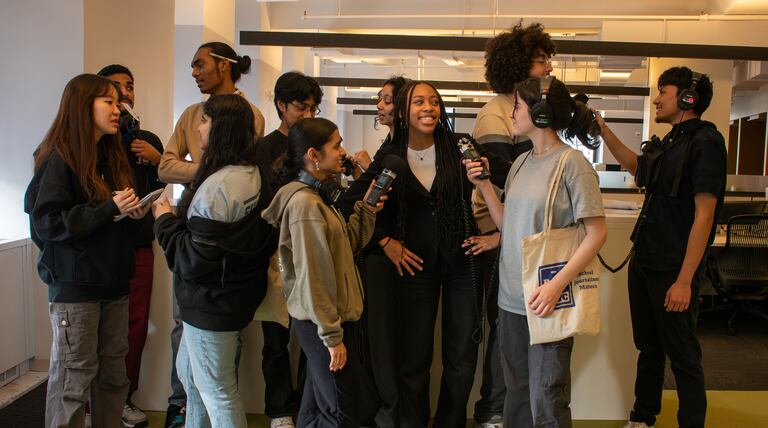
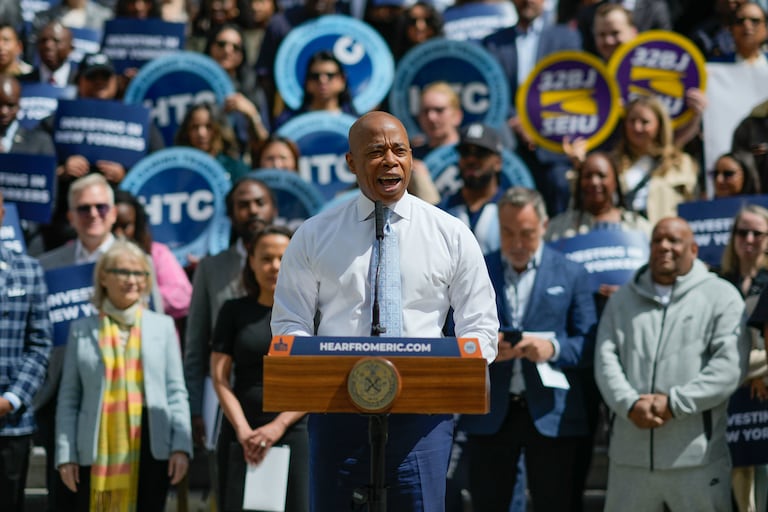
Members of the Campaign for Better Schools at today's press conference. Photo courtesy of the Campaign for Better Schools.
One final installment in today’s all-mayoral-control-all-the-time report: Before the Assembly hearing began this morning, a coalition of community groups that promised to evaluate mayoral control by its results issued its its school governance recommendations.
Citing “reckless budget cuts” and a continued gap between black and white students in obtaining Regents diplomas, The Campaign for Better Schools recommended reconfiguring the city school board so that the mayor no longer appoints a majority of members.
The campaign’s platform, posted in full after the jump, addresses several of the chief critiques leveled against the Department of Education in recent years. One is that communities don’t have adequate input in making decisions about opening, closing and locating schools; the campaign recommends requiring community consultation. And the platform responds to a recent decision by the state education commissioner that principals have the right to determine school budgets by requiring that budgets be developed in consultation with parent leaders.
The coalition’s member organizations include Advocates for Children and the Alliance for Quality Education, among others. It is funded by a grant from the Donor’s Education Collaborative, a consortium that supports projects to enhance public engagement in education.
RECOMMENDATIONS TO THE NEW YORK STATE LEGISLATURE ON GOVERNANCE OF THE NEW YORK CITY SCHOOL DISTRICT
The Campaign for Better Schools is a diverse coalition of more than two dozen parent, youth, community based and education advocacy organizations from all five boroughs of New York City. The Campaign for Better Schools supports the concept of Mayoral Control, but disagrees with the way it has been implemented. At the same time, the reforms and policies that have been put in place as a result of mayoral control have not led to the turn-around of schools in some of New York City’s highest-need communities. For instance, the achievement gap between African American and Latino students and white students in obtaining Regents diplomas has not budged, and graduation rates for immigrant students learning English has actually dipped in the last four years. In addition, mayoral control has resulted in reckless budget cuts, and reforms have led to parents, students and communities being shut out of important decisions that affect the quality of education students receive.
The reforms outlined in this proposal will make mayoral control of schools workable by strengthening the decision making process by which education policies and reforms are developed, and by restoring the trust that families and communities put in the school system. These recommendations were developed through a rigorous year long process that involved numerous discussions with national and local education experts, parent, student and community organizations in neighborhoods throughout New York City. It is a community-driven proposal, developed by parents, youth and community groups.
CHECKS & BALANCES
Panel for Education Policy (PEP)
The PEP should have a narrow majority of members appointed by the City Council or other elected officials, and a minority of members appointed by the mayor.
PEP members should serve for set terms of a relatively short duration (3 years or less) and have full voting rights.
The PEP should select a Chair who sets meeting agendasChancellor
The mayor should appoint the Schools Chancellor
The Chancellor should not be a voting member of the PEP, but may serve as an ex-officio member.
Criteria and Selection of Board Members
The PEP should be diverse geographically (representatives from all boroughs).
The members of the PEP should reflect the school system’s diversity.
The PEP must include multiple community representatives. Community representatives should be defined as parents, students and representatives of community based organizations.
Powers of the PEP
The Chancellor should have the power to propose the DOE operating budget and the five-year capital plan. The PEP shall have approval power over the annual DOE operating budget and five-year capital plan.
The Chancellor should propose changes in education policies. The PEP shall have the power to approve major Chancellor-proposed education policy decisions.
The PEP should approve large DOE procurement contracts.
PEP Operations
The PEP should operate with an open public process. As such all PEP meetings should be held publicly, on a regular monthly basis. All decisions should be made publicly, by roll call vote. Notices and agendas of PEP meetings should be widely disseminated publicly, in multiple languages, at least two weeks in advance. PEP meetings should be held in venues large enough to accommodate large public attendance and appropriate interpretation services shall be provided at all meetings. The PEP should solicit public comment on all voting issues.
TRANSPARENCY
The Independent Budget Office should be given legal authority to report on all aspects of the City school district including DOE’s finances, school performance, student achievement, student safety and shared decision making at the school level.
Sufficient funding should be provided to the IBO to support their new monitoring and reporting functions.
The IBO should:
- Be guaranteed full and timely access to all NYC DOE data;
- Annually compile, produce, and widely disseminate school system student demographics and achievement outcomes, as well as annual analyses of school system resource allocation and fiscal expenditure;
- Use methodologies, benchmarks and indicators recommended by national agencies and expert researchers to produce the annual set of required data reports, and make their methodologies, benchmarks and indicators public;
- Carry out annual analyses of critical school system education policy issues and issue their findings in widely disseminated public reports.
The law should be clarified to make the DOE’s finances completely open and available to the City Comptroller for financial oversight and auditing purposes.
PUBLIC PARTICIPATION
School Level
The role of parents and high school students, on the school leadership teams should be strengthened. Student representatives should be selected through vote of student body.
Principals should be required to develop school based budgets in consultation with School Leadership Teams and ensure that budgets are aligned with schools’ Comprehensive Education Plans (CEP).
Principals should be required to hold public meetings to report on school finances and student performance, and to discuss plans for meeting CEP benchmarks and budget targets.
Parents and high school students who are involved in shared decision making should receive adequate training and support to responsibly carry out their duties and obligations.
District Level
Superintendent
District superintendents should be responsible for supervising principals and providing administrative oversight of schools in their district. They should have access to all schools in their district as well as access to all school records to carry out their evaluations effectively.
Superintendents should be empowered to address issues regarding school choice, discipline (suspensions, expulsions, etc), language access (parents, ELL students), special needs, and shared decision-making.
Superintendents should hold public meetings to report on district performance and discuss plans for improvement of district schools.
The Chancellor should appoint district superintendents in consultation with the CDEC, Presidents’ Council and District Leadership Team.
District superintendents should be supported by sufficient staff to carry out their duties.
School Closings & New School Siting:
A process should be established that ensures community input before schools are closed, new schools are created, and new schools are placed inside existing schools.
At the hearing on Mayoral Control, Assemblymember O’Donnell used a quote from Shakespeare “First we kill all of the laywers”. It might be the real cost savings at the DOE.
Mom Blogs - Blogs for Moms…
…
These proposals are good in theory - it’s all well and good to want parents to have a greater voice in school decision-making. But going back to a system where no one is in charge does NOTHING to increase this role for parents.
I’d like to see reasoned arguments contesting this one man’s experience: http://www.learn-ny.org/main.cfm?actionId=globalShowStaticContent&screenKey=cmpNews&show=viewpoints&s=learnNY.
Campaign for Better Schools is NOT suggesting we go back to the old system. Our proposal would have the mayor directly appointing the chancellor, which is a significant difference from the old system where the Board of Ed appointed the chancellor. In addition, even though the mayor wouldn’t have a majority of appointees on the PEP, he would have more than he did on the former Board of Ed and the difference would be much closer (say 6-7) so that he would only have to convince one or two other appointees on the merits of his proposals. If he can’t do that, I think it’s fair to expect him to reconsider his strategy.
Allowing the continuation of autocratic rule by the mayor would be tantamount to saying that parents should not have any say in decisions that affect the quality of their children’s education, because that’s the way things currently are. That is not the way the legislature envisioned mayoral control working in the first place, and it was because of the potential for unforseen issues like this that the legislature put the sunset provision in the original mayoral control law. They new things weren’t working and needed a major change, but they weren’t sure they’d get it 100% right the first time around. That was very wise of them, because they didn’t get it 100% right. Steve Sanders as much as admitted that at the hearing on Friday.
To suggest that there should be no changes what-so-ever is not only a slap in the face to parents, it is also an acceptance of mediocrity from our schools. Even though schools have improved by some indicators, there are many indicators that show NO improvements under mayoral control. Should we be happy even with minor improvements over the previous system? I say no, parents say no. We still have half of students not graduating, most of them African American and Latino students. How we we say that’s a success? I think we can do much, much better. Parents and students NEED us to do much much better.
I have no reason to believe that the current system is improving education for all children. In
the past 5 years NYC has examined services for students with special needs at least 5 times….Hehir, Hevisi, Di Napli, Council of Great City Schools, Thompson. In that time there has been no improvement in the graduation rates for students with IEPs (Inividualized Education Plan). 18% of students with IEPs graduate with a diploma. After another 2-3 years, 24% of students graduate. Post school numbers are not much better as 33% of individuals with disabiilties are employed. Of that 33% fully 66% are under employed.
Now an individual with no classroom or education experience will examine programs for students with special needs again…… for efficiency’s sake.
A quote from David Cantor of the NYC DOE press/war room, “The reorganization is “most definitely related” to the current budget conditions, Cantor said, because it is laying the groundwork for the department to eliminate positions. But he said, “Garth’s mandate is not to go in to save X amount of money or any amount of money. His mandate is to go in and efficiently organize the special education office.”
Efficiency was also the goal of the old soviet republics. How did that work?
[...] - Campaign for Better Schools, descirbed here. [...]
[...] Scott Stringer, Jim Brennan, Marty Dilan, ICOPE, UFT, Independent Parents Commission, CSA, the Campaign for Better Schools the “sun setters, and the “make governance permanent” crowd. Did I leave any [...]
7 Comments
Subscribe to comments with RSS or TrackBack